Pour Over vs. Espresso: Two Different Coffee Games
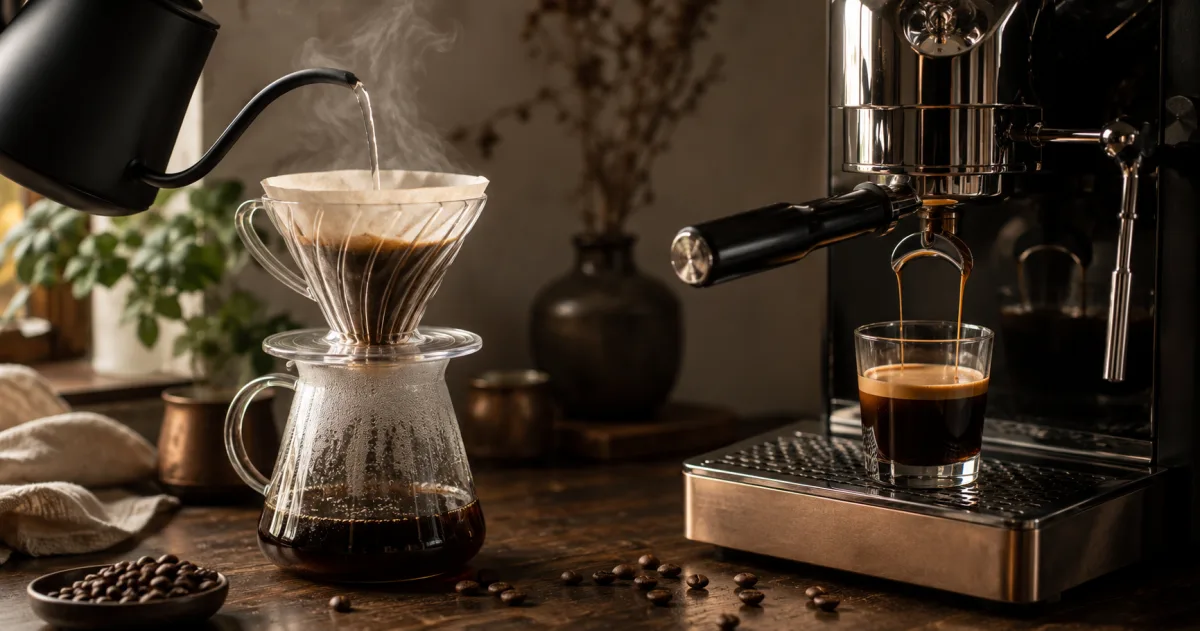
How pour over and espresso differ in taste, technique, gear, and cost, why each is good at different things, and how to choose between them.
Pour over and espresso both pull flavor out of ground coffee with hot water. They do it so differently that they end up being two separate skills, with their own gear, their own failure modes, and their own reasons to love them. This guide covers how they differ, what each one is good at, why espresso runs café culture while a lot of specialty drinkers reach for a V60 at home, and how to pick.
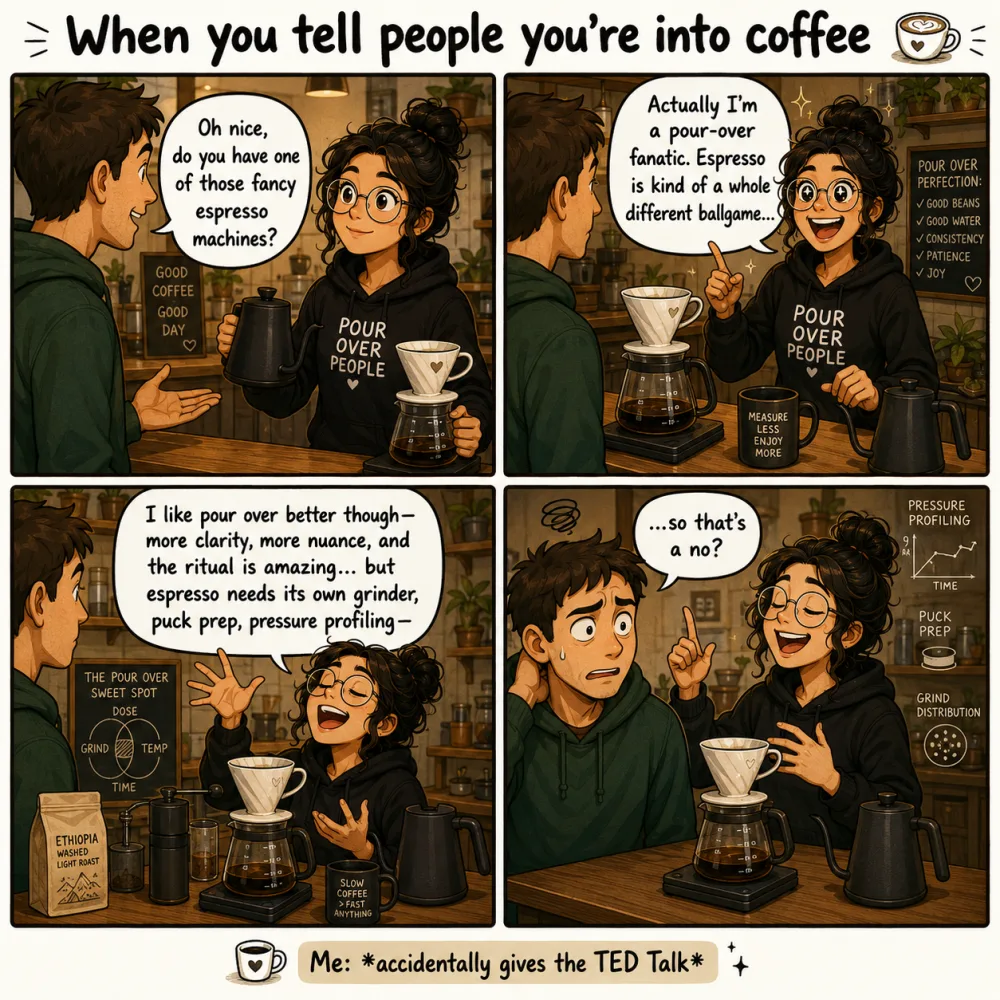
When someone hears “coffee hobby,” they tend to picture an espresso machine. Some of us picture a V60, a gooseneck kettle, and a drawdown time we care a little too much about.
The short version
| Pour over | Espresso | |
|---|---|---|
| The drink | A full, dilute cup you sip over minutes | A small, concentrated shot |
| Best at | Clarity, acidity, origin character | Body, crema, intensity, milk drinks |
| Gear cost | Low to moderate | Moderate to high |
| Hardest part | Pour technique and grind | Grinder, puck prep, and dialing in |
| Feedback loop | Slow and clear | Fast and unforgiving |
| Logs as | Ratio, grind, temp, pour, drawdown | Dose, yield, time, pressure, puck prep |
Same science, different physics
Both methods dissolve soluble flavor out of coffee, so they share the same two dials. Strength is how concentrated the drink is, measured as total dissolved solids (TDS). Extraction yield is how much of the dry coffee ended up in the cup. Coffee extraction and measuring extraction yield cover both in depth.
The physics is where they split. Pour over is gravity pulling water through a bed of medium-ground coffee in a paper filter. It runs at roughly a 1:15 to 1:17 ratio, so the cup is mostly water with a low concentration of dissolved coffee. Filter coffee tends to taste balanced around 1.15 to 1.35% TDS and 18 to 22% extraction, the SCA’s Golden Cup window.
Espresso forces hot water through a fine, compacted puck at around nine bars of pressure. The classic definition is a small shot, roughly 25 to 35 mL pulled from about 7 to 9 grams of coffee in 20 to 30 seconds at 195 to 205°F, though the SCA’s own history of the espresso definition shows how loose that has always been. Modern espresso often runs larger doses and longer ratios, with an 18 gram dose pulling 36 grams of liquid a common starting point. The idea holds either way: a lot of coffee, a little water, under pressure.
So espresso is far more concentrated than pour over. A shot can sit near 8 to 12% TDS, several times a filter cup. It reads as intense because there is more dissolved coffee in every sip, served in a much smaller cup.
What pour over is good at
Pour over gives you a clean, transparent cup. The paper filter traps oils and fine particles, so the coffee comes through bright and light-bodied, and the lower strength leaves room to taste acidity, sweetness, and the floral or fruity notes that mark where a coffee is from. A washed Ethiopian or a light Kenyan has more room to show itself in a V60 than it does buried in a concentrated shot.
It also hands you every variable. Grind, dose, ratio, water temperature, pour pattern, filter, and drawdown are all yours to set, which makes pour over easy to log and repeat. Change one thing, taste, and write down what moved.
- Good at: clarity, acidity, origin character, a full mug, low gear cost, an easy entry point, and repeatable manual control.
- Harder with: body and texture, milk drinks, and speed. The pour matters more than people expect, and a coarse grind or a stalled bed shows up fast.
See grind size and the best home brewers for the gear and dial-in side.
What espresso is good at
Espresso gives you concentration and texture that pour over cannot reach. The pressure pulls out a syrupy body and a layer of crema, and that intensity is what lets a single shot carry a latte or a cappuccino without disappearing into the milk. Once a machine is dialed in, a shot takes under a minute.
That intensity comes with real mechanical complexity, and there is hard data behind it. A 2020 study in Matter, Systematically Improving Espresso (Cameron et al.), modeled espresso extraction and then tested it. The model said finer grinding should keep raising extraction, but the experiments found a peak: past a certain fineness, yield fell again, because water channels unevenly through a tightly packed puck. The authors tie that uneven flow to espresso’s poor reproducibility and the coffee wasted during dial-in. Grind, dose, puck prep, basket, pressure, temperature, and the grinder itself all swing the result.
- Good at: concentration, body, crema, milk drinks, speed per drink once dialed, and deep room for technique.
- Harder with: cost, consistency, and forgiveness. Great espresso at home is doable, but the path from new gear to café-quality shots is longer and pricier than most people expect. For a lot of home brewers, espresso is a second hobby rather than the next step after pour over.
Why espresso runs café culture
Espresso is the base of almost every drink on a café menu. Lattes, cappuccinos, flat whites, cortados, mochas, and Americanos all start with a shot, so for most people espresso is what “fancy coffee” means.
The numbers back that up. The National Coffee Association’s Spring 2026 report found nearly 195 million American adults drink coffee each week, and 66% had coffee in the past day. Espresso-based drinks are driving specialty growth: past-week consumption of espresso-based beverages rose from 40% in 2022 to 45% in 2026, lattes from 17% to 21%, and straight espresso from 16% to 20%. The Specialty Coffee Association’s 2026 read of the same data put past-day specialty coffee at 47%, ahead of traditional coffee at 42%, with espresso drinks counted as a large part of specialty.
For most drinkers, specialty coffee means a latte. The carefully brewed single-origin V60 is a much smaller world.
The $20 pour-over problem
There is an odd mismatch in how we price craft drinks. A $20 cocktail barely raises an eyebrow in most cities. People accept that it pays for skilled labor, good ingredients, and the room you drink it in. A $20 pour over often gets read as a ripoff, on the grounds that it is “just coffee.”
A high-end pour over can carry a lot: rare green coffee, careful picking, an unusual process, precise roasting, controlled grinding and water, and a brewer who knows how to extract it without flattening it. The coffee itself is sometimes more unusual than anything in a standard cocktail. None of that guarantees the cup is worth $20, and cafés can overcharge for novelty. The reflex is still telling. We tend to pay for visible performance, the shaker, the hissing machine, the menu of obscure ingredients, over quiet precision.
Pour over is quiet. It does not put on a show. There is a kettle, a filter, and a few minutes of attention. When it is done well, that plainness is the point.
Why many specialty drinkers reach for pour over
For people chasing the coffee itself, pour over is usually the better window. A concentrated shot compresses everything into one intense hit. A pour over spreads the same coffee into a larger, lower-strength cup where acidity and aromatics are easier to pick apart.
The SCA’s Towards a New Brewing Chart makes the related point that strength and extraction strongly shape what you taste, and that the old habit of labeling coffee simply weak or strong, under or over, flattens a much wider range of flavor. Pour over gives that range more room to spread out.
The home setup can be unusually good
One reason pour over keeps such a loyal following is that the home math is almost unfair. For a couple hundred dollars, some practice, and good beans, you can make exceptional pour over at home every day. You do not need a commercial machine, plumbing, or a counter of specialized tools. A decent grinder, a dripper, filters, a scale, and a gooseneck kettle get you close to the ceiling of what the method can do.
Espresso is a steeper climb. The machine matters, the grinder matters even more, and puck prep, pressure, flow, and temperature stability all have to line up before a shot tastes like a good café pull. Pour over has a learning curve too, but a friendlier one: grind finer or coarser, adjust the ratio, change the pour, taste, repeat.
That is a big part of why specialty drinkers get attached to it. With fresh beans and a good grinder, a home pour over is often cheaper and better than what you would get from a café that is built around milk drinks, speed, and consistency rather than carefully dialed single-origin filter coffee.
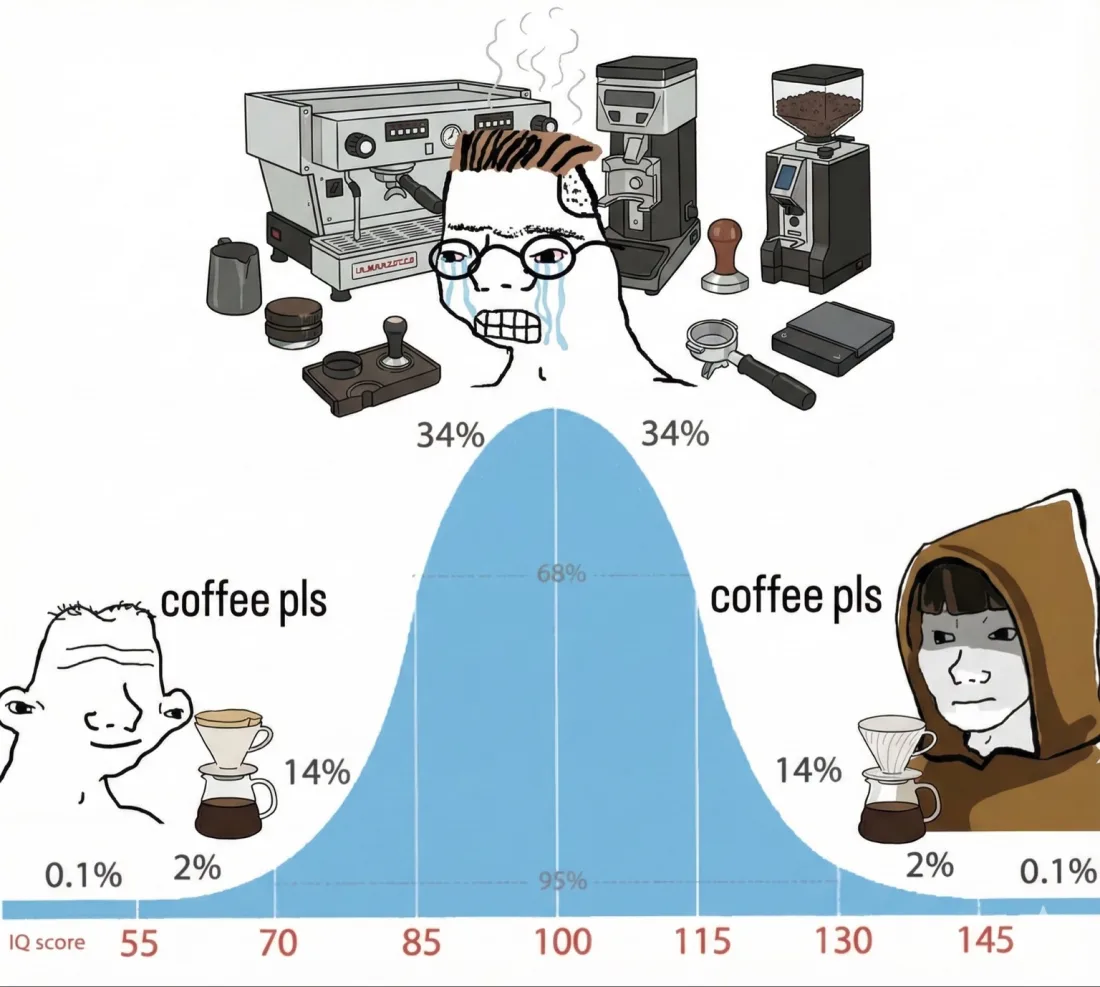
Coffee Twitter’s favorite self-own. The least obsessive drinker and the most obsessive one both reach for a plain pour over, while the rest of us agonize over gear in the middle. We see ourselves on this curve, and it is funny.
Where they overlap
For all their differences, both methods stand on the same fundamentals. Get these wrong and no brewer saves you.
| Shared variable | Why it matters in both |
|---|---|
| Coffee quality | Poor green coffee or a bad roast cannot be fixed by brewing. |
| Fresh grinding | Grind size and particle spread shape extraction either way. |
| Water | Minerals and alkalinity change how coffee extracts and how acidity reads. |
| Brew ratio | Sets strength and shifts extraction in both methods. |
| Temperature | Works mostly through how fast coffee dissolves. |
| Agitation and flow | Too little under-extracts; uneven flow turns the cup harsh. |
| Logging | Change one variable at a time to actually learn anything. |
One research note that surprises people: temperature may matter less than it feels like it should. Batali, Ristenpart, and Guinard (2020) found that once strength and extraction were held constant, brewing between 87 and 93°C made little difference to taste. At home, where you do not re-tune everything to match, hotter water still raises extraction. See brew temperature and coffee water.
A note on health
One real difference sits in the filter. Paper traps more of the coffee oils that carry cafestol and kahweol, the diterpenes that can raise LDL cholesterol. A 2025 study in Nutrition, Metabolism and Cardiovascular Diseases on workplace machine coffee measured far higher diterpene levels in unfiltered and machine coffee than in paper-filtered brews, where the numbers dropped sharply. Separately, an analysis of the Tromsø Study (Open Heart, 2022) linked regular espresso to modestly higher serum total cholesterol, with a stronger association in men than women.
Treat this as observational context rather than a verdict on espresso. The effect is small, the studies describe population patterns, and coffee has plenty of documented upsides. If you drink a lot of unfiltered coffee and watch your cholesterol, a paper-filtered pour over is the gentler choice.
How to choose
Pick by what you want out of the cup.
- You want to taste the coffee: origin, process, roast, acidity, and sweetness come through most clearly in pour over. Start there.
- You want milk drinks or café intensity: espresso is the way to get real crema, body, and a base that holds up under steamed milk.
- You are starting out or on a budget: pour over costs less, dials in faster, and teaches the fundamentals that carry over to espresso later.
- You want a project: espresso rewards deep technical attention. Treat it as its own branch of coffee craft, with a learning curve that mostly starts fresh from pour over.
Plenty of people end up doing both, a pour over on a slow morning and espresso for milk drinks. The methods are different games, and you are allowed to play both.
Track it in BeanBench
Both methods improve the same way: change one variable, taste, and write it down. The trick is keeping a record you can act on next time.
In BeanBench you can log a pour over by method, ratio, grind and grinder, water and temperature, pour structure, drawdown, and tasting notes. For espresso, log dose, yield, shot time, pressure, puck prep, basket, and grinder. Over a few bags you start to see which coffees you push for more extraction and which you pull back, and “I think that one was better” turns into a brew you can repeat.
From here, dial in with grind size and brew temperature, read up on extraction, or pick a recipe.
Frequently asked questions
Is espresso stronger than pour over?
Espresso is far more concentrated, so each sip has much more dissolved coffee. The serving is small though, so a full pour over can hold more total coffee and caffeine than a single shot. Strength per sip and total amount in the cup are two separate things.
Is pour over better than espresso?
Neither is better in general. Pour over is better for tasting a coffee's origin and clarity. Espresso is better for body, crema, and milk drinks. They are different drinks made from the same beans, so it comes down to what you want.
Do I need an expensive machine to make good coffee at home?
No. A good pour over setup is a grinder, a dripper, filters, a scale, and a gooseneck kettle, often a couple hundred dollars total. Espresso is where the gear gets expensive, mostly because the grinder and machine have to be precise and repeatable to pull a clean shot.
Why do coffee shops push espresso drinks?
Espresso is the base for lattes, cappuccinos, and most café menu items, and those drinks are popular and quick to make. National survey data shows espresso-based drinks driving specialty coffee growth, so cafés lean into them.
Can I use the same beans for pour over and espresso?
Yes, though many roasters dial a roast toward one or the other. Light, fruit-forward coffees often shine in pour over, while espresso-leaning roasts run a touch darker for body and sweetness under pressure. You can brew either coffee either way and see what you like.
Does pour over have less caffeine than espresso?
Per ounce, espresso has more. Per drink, a full pour over often has as much or more, because you are drinking 8 to 12 ounces instead of one or two. Caffeine tracks the total coffee and water more than the brew method.
Is filtered coffee healthier than espresso?
Paper filters remove more of the oils that carry cholesterol-raising diterpenes, so paper-filtered coffee is gentler on that one measure. The effect is small and the research is observational, so treat it as one factor among many rather than a reason to quit espresso.