Coffee Grind Size for Pour-Over: Settings for Ode Gen 2, Encore & More
How grind size controls extraction, why light roasts often want a finer grind, and pour-over starting settings for the Fellow Ode Gen 2, Baratza Encore, 1Zpresso, OXO and more.
Grind size is the biggest lever you have over a brew. It changes how fast water can dissolve flavor from the coffee and how fast water moves through the bed, so a small grind change can take the same coffee from sour and thin to sweet and balanced.
The catch is that words like fine, medium, and coarse are rough. “Medium-fine” on one grinder is a different particle size from “medium-fine” on another. What’s actually repeatable is the grinder and the number: Fellow Ode Gen 2 at 6.0, Baratza Encore at 15, 1Zpresso ZP6 at 45 clicks. That’s why BeanBench records grind as a setting with grinder context.
What grind size for pour over?
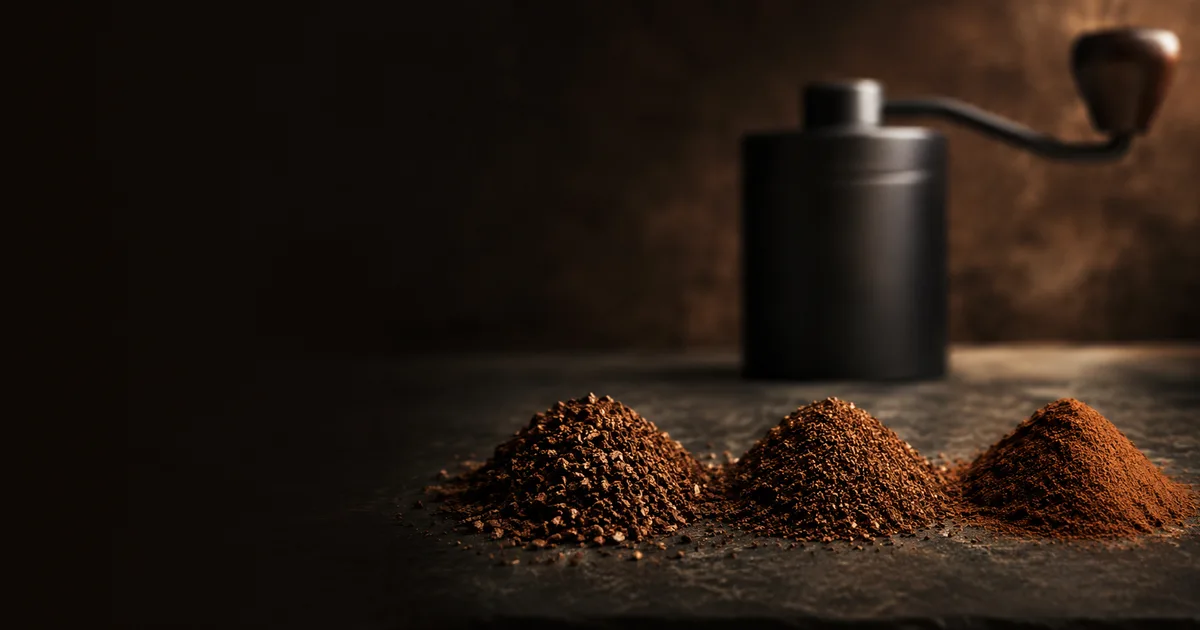
For most specialty pour-over coffee, start with a medium-fine grind, around the texture of table salt or slightly finer, then dial in by taste. By brewer:
- V60 / cone dripper: medium-fine.
- Kalita / flat-bottom: medium.
- Chemex: medium-coarse.
- Hario Switch / Clever: medium to medium-coarse.
- AeroPress: fine to medium, depending on the recipe.
- French press: coarse.
- Cold brew: very coarse.
Then dial in by taste: if the cup is sour, thin, or weak, grind finer; if it’s bitter, dry, or slow-draining, grind coarser. If it’s sour and dry at the same time, the brew is probably extracting unevenly, so go slightly coarser and pour more gently.
How grind size controls extraction
Brewing is extraction: water dissolves soluble material out of the grounds. Grind size steers that in two linked ways.
First, surface area. Finer grounds expose more surface, so water dissolves flavor faster. Coarser grounds expose less, so extraction is slower.
Second, flow. In a pour-over, water has to move through a bed of coffee. Finer grounds pack tighter and slow the drawdown; coarser grounds drain faster. Slower flow means longer contact, which also raises extraction.
For most of the range, finer means more extraction. That breaks down if you go too fine, though. A modeling study on uneven extraction found that below a certain grind size, grinding finer can actually lower extraction: the extra fines make flow uneven, so water races through some channels and stalls in others. The result tastes under-extracted and over-extracted at once, which is sour, dry, and hollow together.
What “good extraction” actually means
Coffee strength is measured as total dissolved solids (TDS), and how much of the coffee you pulled into the cup is the extraction yield. The old brewing control chart paired these with simple flavor labels, but the updated UC Davis and SCA research that mapped tens of thousands of tasting data points found preferences are more varied than a single “ideal” point: different drinkers like different spots on the chart. That variation is also why AI brewing advice cannot tell you a correct grind setting without knowing what you liked.
One practical takeaway: high extraction is not automatically bitter. A well-run brew can pull a lot of flavor and still taste sweet if the extraction is even. Much of what gets blamed on “over-extraction” is really uneven extraction from channeling or fines.
Why light roasts often want a finer grind
Light and ultra-light roasts are denser and harder to extract efficiently, so they usually need more extraction energy to taste sweet and complete. A finer grind is one way to add that energy. You can also use hotter water, more pours, more agitation, immersion (a Switch or Clever), or a longer rest after roast. How much agitation a bed will take before it clogs is covered in pour rate and agitation.
So a finer grind is a good first move for a light roast, not the only move. For a Nordic-style washed Ethiopian on a V60, starting finer and hotter than your medium-roast default is reasonable. If the brew stalls, dries out, or goes hollow, back off and grind coarser. Some coffees and some pouring styles simply make a lot of fines, and past a point, finer hurts.
Starting grind by brewer
| Brewer | Starting grind | Why |
|---|---|---|
| V60 / cone pour-over | Medium-fine | Cones drain fast, so a finer grind slows flow and raises extraction. |
| Kalita / Orea / flat-bottom | Medium | Flat bottoms already slow flow and can taste muddy if too fine. |
| Chemex | Medium-coarse | Thick filters and bigger brews need more permeability. |
| Hario Switch / Clever | Medium to medium-coarse | Immersion makes extraction more forgiving. |
| AeroPress | Fine to medium | Short recipes go finer; long immersion goes coarser. |
| French press | Coarse | Long contact time doesn’t need a fine grind. |
| Cold brew | Very coarse | Very long contact time. |
Dial in by taste
Change one thing at a time, and let the cup point the way:
| What you taste | Likely cause | What to change |
|---|---|---|
| Sour, sharp, salty, thin | Under-extracted | Grind finer (or hotter water, slower pour). |
| Weak but balanced | Not enough strength | Use a stronger ratio before touching grind. |
| Bitter, dry, harsh | Over-extracted or stalled | Grind coarser, less agitation, fewer pours. |
| Sour and dry together | Uneven extraction / channeling / fines | Slightly coarser, gentler pour, less swirling. |
| Hollow, muted, papery | Too fine, over-agitated, or stale coffee | Try coarser and gentler first. |
| Great flavor, too intense | Strength, not extraction | Dilute or use a weaker ratio. |
How much drawdown time matters
Treat brew time as a diagnostic signal, not the target. A 3:00 brew that tastes sharp and thin is worse than a 4:15 brew that tastes sweet and clear.
One bit of precision: drawdown technically means the final phase, after your last pour, when the remaining water drains through the bed. Barista Hustle separates that from total contact time, which runs from first water to last drips. Both are shaped by grind, fines, filter, dose, pour style, and agitation, not just by extraction.
That’s why a slow brew isn’t always over-extracted. Heavy agitation can push fines into the filter, clog it, and stretch the time out while parts of the bed stay under-extracted. A slow, sour, dry cup is usually a clogging or channeling problem, so the fix is coarser and gentler, not finer.
As a rough sanity check for a normal V60, total time often lands around:
| Dose | Typical total brew time |
|---|---|
| 12–15 g | ~2:15–3:15 |
| 16–18 g | ~2:45–3:45 |
| 20–22 g | ~3:15–4:30 |
| 25 g+ | ~4:00–5:15 |
If you’re inside a plausible range and the cup tastes good, ignore the clock.
Grinder setting starting points
These are starting points for one-to-two-cup specialty pour-over, not fixed rules. Calibration, burr wear and seasoning, roast level, dose, filter, and pouring style all move the target. Numbers below are marked official (from the manufacturer) or community (commonly cited ranges with no manufacturer chart).
Fellow Ode Gen 2
Fellow suggests starting around 5 for pour-over, and notes the Gen 2 burrs grind finer than the original Ode, so older guides run coarse (Fellow). In practice, most pour-over lands between 5 and 7.5, and a setting of 6 or 7 is normal, not too coarse.
| Brew context | Starting range |
|---|---|
| Small V60, 12–16 g | 4.5–6 |
| Standard V60, 18–22 g | 5–7 |
| Larger pour-over, 25–30 g | 6–8 |
| Kalita / Orea / flat-bottom | 5.5–7.5 |
| Chemex / thick filters | 7–9 |
| Hario Switch / Clever | 6–8 |
| French press | 8–10+ |
Baratza Encore
Official Baratza starting points: V60 15, auto-drip 18, Chemex 20, French press 28, all meant to be adjusted to taste (Baratza manual).
| Brewer | Starting range |
|---|---|
| V60 / cone pour-over | 13–18 |
| Kalita / flat-bottom | 16–20 |
| Chemex | 20–24 |
| Clever / Hario Switch | 18–24 |
| French press | 26–32 |
Other popular grinders (V60 pour-over)
| Grinder | V60 starting point | Source |
|---|---|---|
| OXO Conical Burr (Brew) | 6–8 (pour-over 6–10) | Official (OXO) |
| 1Zpresso K-Ultra | 80–90 clicks | Official (1Zpresso) |
| 1Zpresso ZP6 | 40–50 clicks | Official (1Zpresso) |
| Baratza Encore ESP | 18–28 (start ~23) | Community estimate |
| Comandante C40 MK4 | 18–25 clicks | Community estimate |
| Timemore C3 / C3S | 13–18 clicks | Community estimate |
The OXO and 1Zpresso numbers come straight from the makers. The Encore ESP, Comandante, and Timemore ranges are community baselines, since those brands don’t publish pour-over charts, so treat them as looser.
Why your setting may differ from any chart
Grind charts are fragile by nature. Two grinders of the same model can differ from calibration, burr alignment, burr wear, and seasoning, and the right number also shifts with roast, dose, filter, and how much you agitate.
A real example: a common Fellow Ode Gen 2 pour-over default is around 6.75. A simplistic chart that says “V60 equals 4 to 5.5” would call that too coarse, but it can be exactly right for a larger dose, a flat-bottom brewer, a slower filter, a high-agitation recipe, or a coffee that throws fines. The chart is a starting point. The cup is the judge.
A simple dial-in loop
- Keep dose, water, temperature, filter, and pour recipe fixed.
- Change grind by one small step.
- Record the brew time and how it tastes.
- Repeat until the cup is sweet, clear, and balanced.
Track it in BeanBench
A brew note like “medium-fine” fades fast. A note like “V60, 18 g, 300 g, 96°C, Fellow Ode Gen 2 at 6.0, finished pouring 1:45, total 3:20, sweet but slightly thin, try 5.7 next” is something you can actually repeat and improve on.
In BeanBench you can log the grinder and setting alongside brewer, roast and rest, dose, water and temperature, pour structure, drawdown, and taste, then your next adjustment. Over a few bags your own history beats any generic grind chart. That habit is why I built BeanBench in the first place. From here, read up on coffee extraction, Nordic-style coffee, processing methods, and resting, or pick a recipe. If you are still choosing a grinder, the first coffee gear to buy covers what to buy in what order.
Frequently asked questions
What grind size is best for pour over?
A medium-fine grind, around the texture of table salt or slightly finer, is the right starting point for most pour-over on a V60 or cone dripper. Flat-bottom brewers like the Kalita want a touch coarser, and a Chemex coarser still. From there, grind finer if the cup is sour or thin, and coarser if it is bitter or slow-draining.
What grind size should I use for V60?
Start medium-fine, then adjust by taste. If the cup is sour, thin, and drains fast, grind finer. If it's bitter, dry, or drains slowly, grind coarser. On a numbered grinder that's roughly Baratza Encore 15, Fellow Ode Gen 2 around 5–6, or 1Zpresso ZP6 around 40–50 clicks.
What setting should I use on a Fellow Ode Gen 2 for pour-over?
Fellow suggests starting around 5, but the normal real-world pour-over range is about 5 to 7.5. Settings of 6 or 7 are not 'too coarse' — they're common for larger doses, flat-bottom brewers, slower filters, high-agitation recipes, or coffees that throw a lot of fines. The Gen 2 burrs also grind finer than the original Ode, so old charts run coarse.
What setting should I use on a Baratza Encore for V60?
Baratza's own starting point is 15 for a Hario V60, 18 for auto-drip, 20 for Chemex, and 28 for French press. Start at 15 and move one or two numbers finer if the cup is sour or thin, coarser if it's bitter, dry, or slow.
Should I grind finer for light-roast coffee?
Often, yes. Light roasts are denser and harder to extract efficiently, so they usually need more extraction energy. A finer grind is one way to get there, along with hotter water, more pours, more agitation, immersion, or a longer rest. If the brew stalls or tastes dry or hollow, grind coarser instead.
Should I grind coarser for dark-roast coffee?
Usually. Dark roasts are more brittle and extract quickly, and they tend to throw more fines, so a coarser grind reduces bitterness and dryness.
Does grinding finer always increase extraction?
No. Up to a point, finer grinding raises extraction. Past a certain fineness it can reverse: too many fines clog the bed and create uneven flow, so some grounds over-extract while others stay under-extracted. The cup can taste both sour and dry at once. The fix is usually coarser and gentler, not finer.
Is brew time the same as extraction?
No. Time is a useful signal, not the goal. A slow brew can still taste sour if the bed is clogged or channeling, and a fast brew can taste great if everything else lines up. Let taste decide the direction, and use time to help explain why.
Why does my coffee taste sour and bitter at the same time?
That usually means uneven extraction: part of the bed is under-extracted (sour) while part is over-extracted (dry, bitter), often from channeling or fines clogging the filter. Try a slightly coarser grind, gentler pouring, and less swirling rather than grinding finer.