Why Coffee Got Expensive, and What a Home Cup Costs Now
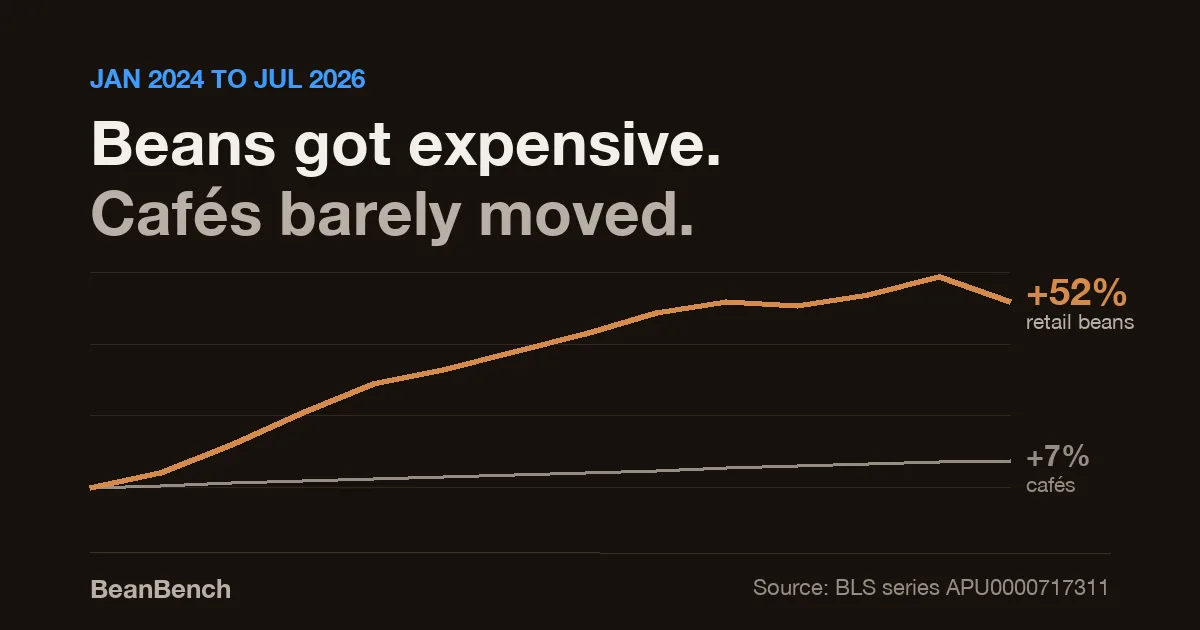
Retail coffee is up about 52% since early 2024 while cafe prices barely moved. What that did to the home versus cafe gap, what a pour-over costs today, and how to buy around it.
Coffee did something unusual over the last two years. The beans you brew at home got much more expensive, and the coffee you buy at a cafe did not. Those two prices normally move together, so it is worth understanding why they came apart and what it changes about how you buy.
Cafes are priced fairly for what they sell. This is arithmetic about where your coffee money goes, and about one buying decision that got harder.
Open the freshness calculatorWhat happened to coffee prices
Green coffee, the raw commodity, hit a record in early 2025. The International Coffee Organization’s composite indicator averaged 354 US cents per pound in February 2025, the highest monthly figure the index has recorded, after weather damage to the Brazilian and Vietnamese crops.
Retail followed with a lag. The Bureau of Labor Statistics tracks an average price for 100% ground roast coffee across US cities, and that series went from about $6.12 a pound in January 2024 to a peak of $9.72 in April 2026, sitting at $9.32 in July 2026. Call it a 52% increase in two and a half years.
The tempting conclusion is that the worst has passed. Green prices did fall hard, reaching 232 cents on 9 June 2026, the lowest in nearly two years. Then they rebounded 15% in a single month to average 287 cents in July. Retail bag prices have come down about 4% from their April peak, which is very little given how far the commodity fell. The useful read is that green coffee is volatile right now rather than cheap, and roasters who absorbed the increase have limited room to pass relief back.
Cafes are the interesting comparison. Food away from home rose about 3.4% a year over the same stretch, which is ordinary. A cafe’s cost structure is dominated by labor, rent, and equipment, and the beans in a latte are a small share of the total. So a doubling in green coffee moves a cafe menu very little, while it moves a bag of beans a lot.
What a home cup costs now
Take Olympia Coffee, a Washington roaster whose everyday lineup is easy to price. Their standard bags are 12 oz, or 340 grams. Here is the cost of the beans alone at four common doses.
| Coffee (12 oz) | 15 g | 18 g | 20 g | 22 g |
|---|---|---|---|---|
| Morning Sun, $19.00 | $0.84 | $1.01 | $1.12 | $1.23 |
| Ethiopia Benti Nenka, $24.00 | $1.06 | $1.27 | $1.41 | $1.55 |
| Colombia Pink Bourbon, $27.75 | $1.22 | $1.47 | $1.63 | $1.80 |
Those sit at or a little below the normal specialty range. Our guide to buying beans puts a typical 12 oz specialty single origin at $24 to $32, so treat the cheaper rows as an everyday blend rather than the going rate for a competition lot.
Beans are most of the cost but not all of it. A paper filter runs about a dime. If you spend $300 on a dripper, a grinder, a kettle, and a scale, and you brew daily for five years, the kit adds about $0.16 a cup. That puts a realistic all-in figure around $1.50 a cup for someone brewing a mid-priced coffee every morning.
One caveat that matters more than the arithmetic. That figure assumes you drink the bag while it is good. Cost per cup counts every cup in the bag; cost per good cup counts the ones worth drinking, and those two numbers separate fast if you buy more than you can get through. Our freshness guide works through why.
The cafe gap narrowed, and not the way you would expect
Run the same comparison two years apart. A cafe latte averages $5.54 today according to Joe’s Q2 2026 menu survey, which sampled 7,479 observed latte prices. Roll that back at 3.4% a year and it was about $5.18 in 2024. Roll the home cup back by the BLS bean series and an 18 gram dose of a $24 bag was about $0.86.
| Two years ago | Today | |
|---|---|---|
| Cafe latte | $5.18 | $5.54 |
| Home cup, 18 g | $0.86 | $1.27 |
| Difference | $4.32 | $4.27 |
| Ratio | 6.0x | 4.4x |
The dollar saving per cup is essentially unchanged. The multiple collapsed from six times to four. If you talk about home brewing as being “a fraction of cafe prices,” that fraction got noticeably larger, even though the money in your pocket at the end of the week is the same.
The Joe figures are menu prices collected from a point-of-sale platform. That distinction matters because no official series for cafe coffee exists: the BLS coffee index covers packaged coffee for home use only, and cafe drinks disappear into a broad restaurant category.
Bigger bags are cheaper until they go stale
The obvious response to bean inflation is to buy in bulk, and per gram it works. Olympia’s Morning Sun is $19.00 for 340 grams and $104.60 for 2268 grams, so a 20 gram dose costs $1.12 from the small bag and $0.92 from the 5 lb. That is about 18% off, which is real money on a daily habit.
The catch is that a 5 lb bag holds roughly 113 cups at that dose. At one cup a day that is nearly four months, which is far past the good window for any roast style. You would be buying cups you will not enjoy, and cost per good cup can end up higher than the small bag you finish at peak.
Bulk works if you freeze most of it in single doses at the start, or if a household is drinking several cups a day. The freshness calculator takes your bag size, dose, price, and pace and tells you how many good cups you are buying, which is the number that decides this.
Divide price by grams before you compare
One more thing that got easier to get wrong as prices rose. Standard bags are usually 12 oz. Micro-lot, gesha, and competition coffees are frequently 6 oz, or 170 grams, and they sit next to the standard bags at similar shelf prices.
Olympia sells Morning Sun at $19.00 for 340 grams and an Ethiopian anaerobic natural at $19.00 for 170 grams. Same number on the label, $0.056 per gram against $0.112, exactly double. Nothing is being hidden here, the weight is on every product page, but a price grid invites you to compare the wrong number.
Divide price by grams before you compare anything. On a small bag that is often the difference between an everyday coffee and something you should buy on purpose, as an experiment rather than a default.
Track it in BeanBench
Prices move, roasters change bag sizes, and your own dose drifts. The only way to know what your coffee costs is to log it. In BeanBench you can record what you paid, the bag weight, your dose, and how the cup tasted, then watch cost per good cup settle out over a few bags.
From there, read how to buy good coffee beans for what to look for beyond price, coffee freshness for the window that caps bulk buying, and the best coffee brewers if you are still choosing the kit that the per-cup math above assumes.
If you are curious how the same spending looks from the money side, CardSavvy covers which card actually earns on cafe purchases, including why a cafe sometimes fails to count as dining at all. Same team, no affiliate relationship in either direction.
Frequently asked questions
Why did coffee get so expensive?
Green coffee hit a record in February 2025 after weather damage in Brazil and Vietnam, and retail bag prices followed with a lag. The BLS average price for ground roast coffee went from about $6.12 a pound in January 2024 to about $9.32 in July 2026. Green prices have since come off that record, but they have not settled, and retail has barely moved down.
How much does a cup of home pour-over cost?
Beans run roughly $0.85 to $1.80 a cup depending on the coffee and your dose, using a 12 oz bag at $19 to $28 and a 15 to 22 gram dose. Add a paper filter and the amortized cost of a modest kit and about $1.50 is a reasonable all-in figure for a daily brewer. What matters more is cost per good cup, since coffee you drink past its window costs the same and tastes worse.
Is brewing at home still much cheaper than a cafe?
Yes, though the multiple has shrunk. Two years ago a home cup ran about six times cheaper than a cafe latte. Today it is closer to four times. The dollar gap per cup is almost unchanged at roughly $4.25, because bean prices rose sharply while cafe prices did not.
Are five pound bags cheaper per cup?
Per gram, clearly. A 5 lb bag of the same coffee can run about 20% below the 12 oz price. Whether it is cheaper per good cup depends on how fast you drink it, because a bag you cannot finish inside its window loses cups to staling. Run your pace through the freshness calculator before buying bulk.
Why do two bags at the same price cost different amounts per cup?
Check the weight. Standard bags are usually 12 oz or 340 grams, but micro-lot and competition coffees are often 6 oz or 170 grams at similar shelf prices. That is double the cost per gram for the same number on the label.