How to Cup Coffee at Home: A Side-by-Side Tasting Setup
How to run a comparative coffee cupping at home: the SCA-based recipe, ratio, water temperature, timing, and Fellow Ode Gen 2 and Baratza Encore grind settings.
Cupping is the simplest way to taste several coffees side by side and actually trust the comparison. You make the same small immersion brew for every coffee, so the only thing that changes from cup to cup is the coffee itself. Origin, process, roast level, and freshness all get easier to spot once the brewing is held still.
It helps to be clear about the goal. Cupping gives you a fair, repeatable comparison. It will not always give you the most delicious cup, and that is fine. A well-cupped coffee can taste a little flat next to a dialed-in V60. You are after a comparison you can repeat, and the protocol below gets you there with gear you probably already own.
Why cupping beats brewing for comparison
Brewing adds variables. Your pour wanders, agitation changes, the bed drains a little differently each time. Two coffees brewed as pour-overs taste different partly because of the beans and partly because your second brew was not quite your first. That noise makes side-by-side judgments shaky.
Immersion removes most of it. Each coffee gets the same dose, water, temperature, grind, and time, steeped in its own vessel with no pouring technique to muddy the result. Whatever you taste across the cups comes from the coffee.
The BeanBench home cupping recipe
One rule outweighs the exact ratio: every cup in a session is made the same way. Pick your numbers, then hold them across all the coffees on the table.
| Parameter | Setting |
|---|---|
| Coffees per session | 3–4 to start, up to about 6 |
| Cups per coffee | 1 for a casual taste, 2 for a closer look |
| Coffee per cup | 9 g or 10 g (pick one, keep it constant) |
| Water per cup | 160 g |
| Ratio | 9 g → 1:17.8; 10 g → 1:16 |
| Water temperature | about 93 °C (200 °F) |
| Grind | medium-coarse, a step coarser than paper filter |
| Steep | 4:00, then break the crust |
| First taste | about 8–10 minutes, as it cools |
Both dose options are reasonable. The SCA’s current cupping standard, the 2024 Coffee Value Assessment, prepares 8.25 g of coffee per 150 mL of vessel volume, about 55 g/L or 1:18.2. Your 9 g at 160 g lands close to that at 1:17.8. At 10 g it runs stronger at 1:16, which can help a newer palate hear the differences. Both sit inside the range home tasters use. James Hoffmann’s Square Mile World’s Largest Coffee Tasting used 12 g to 200 mL, or 1:16.7.
For water, heat filtered water to a boil, then let it settle for roughly half a minute to about 93 °C (200 °F). The SCA cupping standard calls for 93 °C within a degree. Lean to the hotter end for light roasts and slightly cooler for dark, but keep it the same for every cup in a session.
Grind settings
Cupping wants a medium-coarse grind, a touch coarser than you would use for a paper filter. The SCA standard specifies a grind where 70–75% of the grounds pass through an 850-micron (US #20) sieve, which in practice sits between pour-over and French press. Grind each coffee right before you pour, and run a gram or two of the next coffee through first to clear the burrs.
Fellow Ode Gen 2
Start around 7, roughly one step coarser than a typical pour-over setting. The Gen 2 burrs grind finer than the original Ode burrs, so the older chart under the hopper lid reads coarse (Fellow). If the cups taste thin or grassy as they cool, move toward 6. If they turn muddy or harsh, move toward 8. Our grind size guide covers the same grinder for pour-over.
Baratza Encore
Start around 20, about where Baratza puts the Chemex and coarser than its V60 setting of 15 (Baratza manual). A useful cupping window is 18 to 22. Go toward 18 if the cups taste hollow, toward 22 if they taste silty or bitter.
Step by step
- Set out identical vessels. Same shape and volume for every coffee. Glasses or small bowls around 200 mL work well. Skip scented or travel mugs.
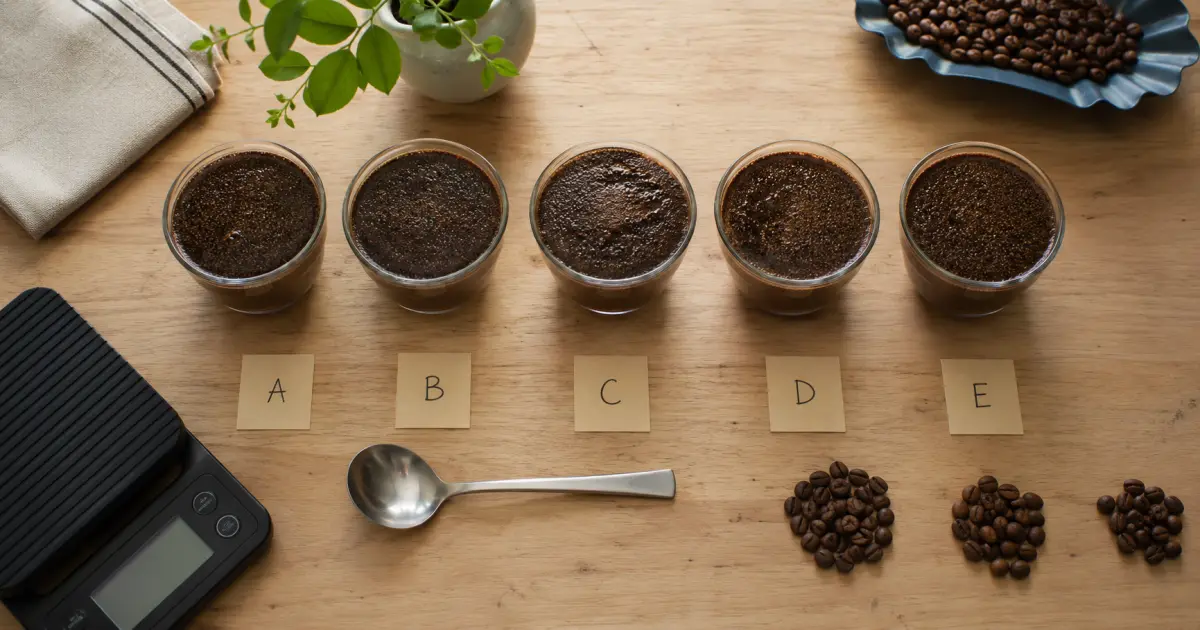
- Weigh and code. Measure 9 g or 10 g of whole beans per cup. Label the cups A, B, C, D and keep the bags out of sight.
- Grind fresh. Grind each coffee just before pouring, purging a little between coffees.
- Smell the dry grounds. Jot quick notes: floral, cocoa, citrus, berry, roasty, savory. Keep it simple.
- Pour. Add 160 g of water to each cup and start a timer on the first pour. Pour every cup in the same order.
- Wait. Leave the cups undisturbed. A crust of grounds floats to the top.
- Break the crust at 4:00. Push your spoon through the crust and stir gently about three times while you smell the aroma that releases. Rinse the spoon between cups.
- Skim. Lift the floating foam and grounds off the surface with a couple of spoons. Clear enough to taste cleanly.
- Taste in rounds. From about 8 minutes, slurp a spoonful so it sprays across your palate. Taste each cup again as it cools.
- Reveal. After your first honest pass, uncover the bags and match your notes to origin, process, roast date, and price.
Taste each cup as it cools
Coffee changes a lot as the temperature drops, so taste every cup more than once. The SCA protocol uses three rounds as the liquor cools, near 70 °C, 55 °C, and 38 °C. Roughly, that means a first pass around 8 to 10 minutes, a second a few minutes later, and a last one once the cups are close to room temperature. Sweetness, body, and any defects often show up most clearly in that final cool round.
Blind-label your cups
Blind tasting matters more than it sounds. Knowing the origin, roaster, or price of a coffee shifts how you taste it. The SCA reported a study in which 150 trained professionals scored the same coffee higher when it arrived with an origin story rather than a plain label (SCA). If trained palates move, yours will too. Code your cups A through D, take your notes, and reveal only after the first round.
Etiquette and clean technique
For solo cupping, slurping straight from your spoon is fine. In a group, keep a spoon that touched your mouth away from the shared cups. The SCA’s modified sanitary protocol uses a serving spoon to move coffee from each cupping vessel into your own spoon or small cup, and spoons get rinsed in hot water before they touch the next vessel (SCA, 2020). A few habits keep a session honest:
- No perfume, scented candles, or strong cooking smells in the room.
- Skip toothpaste, gum, and spicy food right before.
- Write your own notes before anyone talks.
- Avoid announcing “this one is obviously blueberry” before others taste.
- Keep water, dose, grind, and timing identical across cups.
For beginners, chase differences
If you are new to this, go after differences instead of perfect descriptors. You do not have to name “bergamot and lychee” on day one. Better questions to ask of the table:
- Which cup is sweetest?
- Which has the most acidity?
- Which feels heaviest or lightest?
- Which tastes cleanest?
- Which has the longest aftertaste?
- Which would you actually want to brew tomorrow?
For a first session, pick three coffees with obvious contrast, like a washed Ethiopia, a natural Ethiopia or anaerobic, and a washed Colombia or Guatemala. Several similar washed coffees make a frustrating first cupping. When you do want vocabulary, the World Coffee Research Sensory Lexicon gives you a shared, descriptive reference with intensity scales, rather than a list of poetic guesses.
Advanced exercises
Once the basics feel routine, add structure:
- Two cups per coffee to catch an off bean or an uneven grind.
- Triangle tests: set out two cups of one coffee and one of another, then find the odd cup.
- Water control, especially hardness and alkalinity. See coffee and water.
- Roast-age control, tasting bags at a similar number of days off roast. See resting.
- Temperature notes, recording how each coffee shifts from hot to cool.
- Separate “what is it?” from “do I like it?” The 2024 CVA splits descriptive assessment from preference for a reason: they answer different questions.
What the pros do and what to borrow
A professional cupping table runs five cups per coffee, a grind checked against a sieve, and standardized scoring forms. At home you can take the parts that matter and leave the rest. Keep the identical vessels, the fixed ratio, the four-minute crust, and the blind labels. You can skip the five-cup sets and the Q-grader paperwork. James Hoffmann’s home cupping video makes the same case, that careful comparison teaches you more than chasing one perfect brew. Sample Coffee’s home guide lands on nearly the same numbers, around 150 g of water near 94 °C with the crust broken at four minutes.
Track it in BeanBench
A cupping is only as useful as what you remember from it. “Coffee B was sweeter” fades by next week. A logged note like “B: natural Ethiopia, 10 g / 160 g, Ode at 7, boozy and sweet hot, strawberry as it cooled, beat the washed Colombia” is something you can act on the next time you buy.
In BeanBench you can log each coffee with its grinder and setting, dose, water, temperature, and tasting notes, then line your sessions up over time. To run a session in your browser, the cupping sheet times each pour and crust break, takes your notes round by round, and reveals the coffees at the end. From here, read up on coffee extraction, processing methods, and resting, or pick a recipe to brew the winner properly.
Frequently asked questions
How much coffee and water do I use for home cupping?
Use 9 g or 10 g of coffee per 160 g of water, and keep whichever you pick identical for every cup in the session. 9 g (about 1:17.8) sits close to the current SCA cupping ratio of 8.25 g per 150 mL (1:18.2). 10 g (1:16) is a bit stronger, which can make differences easier to spot for a newer palate.
What water temperature should I use for cupping?
About 93 °C (200 °F). The SCA's 2024 cupping standard calls for 93 °C within a degree. Heat filtered water to a boil, let it settle for roughly half a minute, and keep the temperature the same for every cup in the session.
What grind setting should I use for cupping on a Fellow Ode Gen 2 or Baratza Encore?
Cupping wants a medium-coarse grind, a step coarser than paper filter. On a Fellow Ode Gen 2, start around 7 (roughly 6 to 8). On a Baratza Encore, start around 20 (roughly 18 to 22), near its Chemex setting and coarser than its V60 setting of 15.
When do you break the crust when cupping?
At 4:00. After the water steeps undisturbed for four minutes, push a spoon through the floating crust of grounds and stir gently about three times while you smell the aroma that releases, rinsing the spoon between cups.
How many coffees should I cup at once?
Three or four is a good start, and about six is a sensible upper limit before your palate tires. Cupping more than that in one sitting makes it hard to keep your impressions straight.
Should I blind-label coffees when cupping?
Yes. Knowing the origin, roaster, or price changes how you taste. The SCA reported a study where 150 trained professionals scored the same coffee higher when it came with an origin story. Code your cups A through D, take your notes, then reveal the bags.