James Hoffmann's V60 Technique, Explained: Ratio, Pours, Grind, and Fixes
Learn James Hoffmann's V60 method: the 1:16.7 ratio, bloom, pours, grind size, temperature, and how to fix sour, bitter, slow, or hollow cups.
James Hoffmann’s V60 method is one of the most-copied pour-over recipes online, and the numbers are easy to find. The value is in understanding why the technique works, so you can fix a cup that comes out sour, bitter, hollow, or slow. This guide explains the method behind the recipe and how to adjust it. For the timed steps, use James Hoffmann’s one-cup V60 recipe.
Which Hoffmann V60 do you mean?
James Hoffmann, the 2007 World Barista Champion and co-founder of Square Mile Coffee Roasters, has shared two well-known V60 recipes, and people mean different ones when they search.
| Version | Coffee | Water | Ratio | Best for |
|---|---|---|---|---|
| Ultimate V60 | 30 g | 500 g | 1:16.7 | two cups, a larger brew |
| Better 1 Cup V60 | 15 g | 250 g | 1:16.7 | a single daily cup |
Both run the same 1:16.7 ratio. The Ultimate V60 uses one big early pour, while the Better 1 Cup uses a larger bloom and several small staged pours. The BeanBench Hoffmann V60 timer follows the one-cup version, and there is a large-batch timer for the Ultimate V60.
Why the V60 needs technique
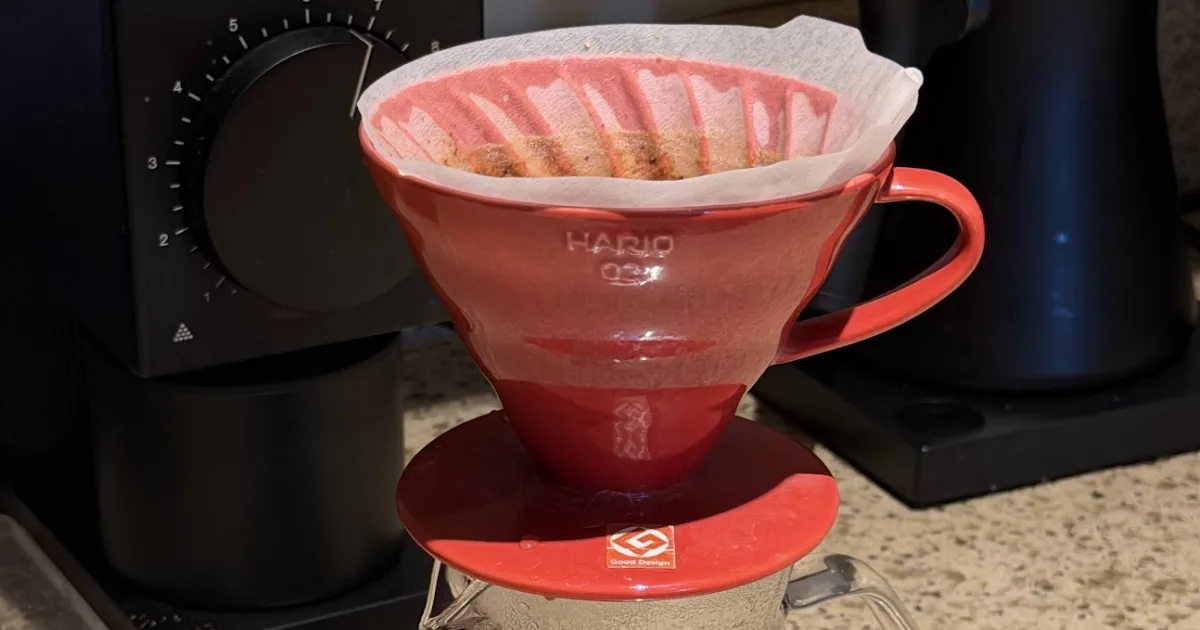
The V60 gives you a lot of control, which is why technique matters. Hario builds it as a 60-degree cone with a single large hole and tall spiral ribs. The cone makes a deep coffee bed, the large hole lets flow respond to your grind and pour rate, and the ribs lift the paper off the wall so air can escape and the bed can swell (Hario). The result is a brewer that rewards an even pour, where small changes in grind, agitation, and flow show up clearly in the cup. For what those pouring variables do on their own, see pour rate and agitation.
The bloom: wet everything first
The bloom is the first pour, usually about twice the weight of the coffee, poured to soak every ground. Fresh coffee releases carbon dioxide, and that gas pushes water away and keeps it from extracting evenly. Wetting the whole bed and giving it 30 to 45 seconds lets the CO2 escape so the main pours extract cleanly. Hoffmann swirls the V60 during the bloom for the same reason: a swirl settles the grounds and clears dry pockets. Freshly roasted coffee blooms more, which is one reason rested coffee is easier to brew.
The pours: extraction and flow
After the bloom, the pours do two jobs: they add fresh, hot water that has extraction power, and they control how fast water moves through the bed. Hoffmann’s two recipes handle this differently. The Ultimate V60 uses one large pour early, bringing the water up to about 60 percent before topping up, which keeps the bed full and extraction high. The one-cup version uses a 50 g bloom and four small 50 g pours, which holds the slurry level steadier and keeps extraction gentle on a small dose. Both work well. Larger pours build strength and speed, and smaller staged pours give more control, so pick the one that suits your coffee and your patience.
Grind size: the main control knob
Grind is the lever you will reach for most. It sets how fast water flows through the bed and how much it pulls from the coffee.
- Start medium-fine, a little finer than table salt.
- If the cup is sour, thin, or drains too fast, grind finer.
- If it is bitter, dry, or drains slowly, grind coarser.
- If it is sour and dry at once, the bed is probably extracting unevenly. Work on an even bloom and a steady pour before you change the grind.
See grind size for settings on common grinders, and the guides on sour and bitter or dry coffee.
Temperature and roast
Water temperature is a secondary dial, and it follows the roast. Use these as starting points and adjust to taste:
- Light roasts: 96 to 100°C, near boiling.
- Medium roasts: 93 to 96°C.
- Dark roasts: 85 to 92°C, which can soften harshness.
Once strength and extraction are dialed in, temperature moves the cup less than it feels like it should. Batali, Ristenpart, and Guinard (2020) found that between 87 and 93°C, with strength and extraction held constant, temperature made little difference to taste. See brew temperature and coffee water.
Troubleshooting
| What you taste | Likely cause | First adjustment |
|---|---|---|
| Sour, sharp | Under-extracted or grind too coarse | Grind finer, or pour more gently and evenly |
| Bitter but not dry | Too strong or over-extracted | Use a slightly weaker ratio or a coarser grind |
| Dry, papery | Fines, a clogged bed, or too much agitation | Grind coarser, swirl more gently |
| Slow drawdown | Grind too fine or the filter clogged | Grind coarser, agitate less |
| Hollow, weak | Stale coffee, too coarse, or flat water | Check freshness and water, then grind finer |
| Muddy | Too much agitation or too many fines | Fewer pours, a softer pour, a better grinder |
Change one thing at a time so you can tell what helped.
Hoffmann V60 vs the 4:6 method
Hoffmann’s V60 and Tetsu Kasuya’s 4:6 method are the two most popular V60 approaches, and they suit different goals. Hoffmann’s is a clean, repeatable daily driver built around even extraction, and it shines once your grind is dialed in. The 4:6 method is more of a framework: it splits the water into two parts so you can tune sweetness, acidity, and strength by changing the pours. The 4:6 method is easier to adjust by feel, and Hoffmann’s is easier to treat as a fixed extraction routine. Many people learn both and switch depending on the coffee.
When it is not the right tool
The Hoffmann V60 is a strong default, though it is not always the right pick.
- Very small cups, around 10 to 12 g, leave a shallow bed that is hard to brew evenly.
- Grinders that throw a lot of fines will clog the bed and slow the drawdown.
- Very dark roasts brewed with near-boiling water can turn harsh.
- If you want a thick, heavy cup rather than clarity, an immersion brewer or a body-focused recipe may serve you better.
Track it in BeanBench
The V60 is sensitive enough that a written record pays off. Brew with the Hoffmann V60 timer, then log the grind, temperature, drawdown time, and tasting notes in BeanBench. Change one variable, taste, and write down what moved, and within a few bags you will know where a given coffee wants its grind.
From here, read up on extraction and grind size, or compare it with the 4:6 method and the full recipe list.
Frequently asked questions
What is James Hoffmann's V60 technique?
A pour-over method from James Hoffmann, the 2007 World Barista Champion, built around an even bloom, controlled pours, and a moderate 1:16.7 ratio. It comes in two versions: the larger Ultimate V60 (30 g to 500 g) and the Better 1 Cup V60 (15 g to 250 g). Both aim for a clean, balanced, repeatable cup.
What ratio does the Hoffmann V60 use?
About 1:16.7, or 60 g of water per liter. That is 30 g of coffee to 500 g of water in the Ultimate version, or 15 g to 250 g in the one-cup version. It is a moderate strength that leaves room for clarity and sweetness.
What is the difference between the Ultimate V60 and the one-cup version?
The Ultimate V60 brews a larger batch (30 g to 500 g) with one big early pour. The one-cup version (15 g to 250 g) uses a 50 g bloom and four small staged pours, which is gentler on a small dose. Both use the same 1:16.7 ratio.
What grind size should I use for the Hoffmann V60?
Start medium-fine, a little finer than table salt. Grind finer if the cup is sour or drains too fast, coarser if it is bitter or drains slowly. The exact setting depends on your grinder, so use it as a starting point.
What water temperature should I use?
It depends on the roast. Around 96 to 100°C for light roasts, 93 to 96°C for medium, and 85 to 92°C for dark. Once your strength and grind are set, temperature has a smaller effect on taste than most people expect.
Why does Hoffmann swirl the V60?
The swirl settles the grounds and removes dry pockets, during the bloom and again near the end. An even, flat bed extracts more evenly, which is the whole point of the technique.
Is the Hoffmann V60 better than the 4:6 method?
Neither is better in general. Hoffmann's is a clean, repeatable daily driver. The 4:6 method is a framework for tuning sweetness, acidity, and strength through the pours. Try both on the same coffee and see which fits how you like to brew.
Why does my Hoffmann V60 taste sour or bitter?
Sour usually means under-extraction, so grind finer or pour more evenly. Bitter or dry usually means over-extraction or too many fines, so grind coarser and swirl gently. If it is sour and dry at once, work on an even bloom and a steady pour before changing the grind.