What Happened to Blue Bottle?
Blue Bottle once sold coffee only within 48 hours of roasting. Today an unopened bag is good for 100 days. I went through my old bags and the public record to work out what changed.
I have a photo of a Blue Bottle cup in my hand in a courtyard in Palo Alto. Arches down both sides, string lights strung across the gap, a church facade at the end of it. The coffee was going cold because I was busy taking the picture.
It is a gorgeous room. The coffee was flat.
Blue Bottle was my favorite roaster for about a decade. I went out of my way to their shops in New York, Washington, San Francisco and Palo Alto. Somebody gave me a gift subscription and I kept the boxes. Then at some point I stopped buying it, and when I have had it since, most recently in Palo Alto within the last couple of years, it has not changed my mind.
The easy version of this story is that Nestle bought Blue Bottle in 2017 and wrecked it. I went looking for evidence of that and found something more interesting.
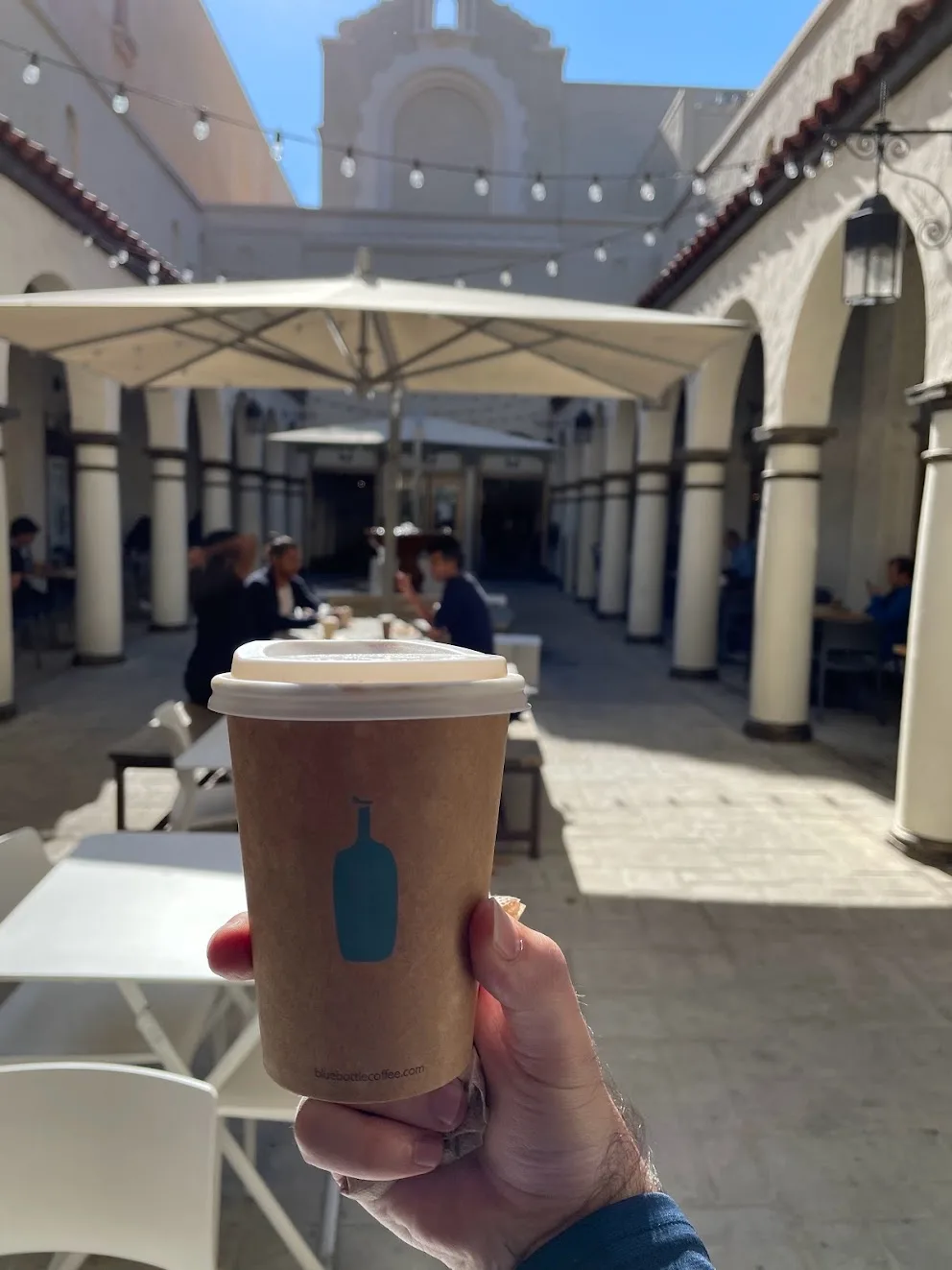
Palo Alto. The room was the best part.
The company that would only sell you two-day-old coffee
James Freeman started Blue Bottle in Oakland in 2002, roasting in a rented shed and selling at farmers markets. He had been a professional clarinetist.
The thing that made the company famous was a rule. In May 2008 the San Francisco Chronicle’s Tara Duggan wrote a piece on the new Bay Area roasters and put it plainly: “Blue Bottle will only sell coffee within 48 hours of roasting it.” Other roasters in that article thought ten days was the outer limit. Blue Bottle was operating at a fifth of that.
Freeman did not invent the idea. George Howell was putting dates on every barrel and every retail bag at the Coffee Connection in Harvard Square from 1975, selling coffee no more than five or six days old, and says nothing comparable happened in the US for another two decades. Howell sold the Coffee Connection to Starbucks in 1993. Blue Bottle picked the standard back up and made it a brand.
What made it work was that it was inconvenient. A 48-hour rule means throwing coffee away. It means you cannot ship far, cannot wholesale much, cannot keep a deep inventory. The constraint was the product.
The sale before the sale
Here is the part that reframes everything: the transformation started five years before Nestle.
In October 2012 a group of investors led by Bryan Meehan bought a controlling stake. Oliver Strand read the SEC filing for the New York Times and reported the price at more than $19.6 million. Two more rounds followed: $25.75 million in January 2014 led by Morgan Stanley Investment Management, then $70 million in June 2015 led by Fidelity.
The money did what money does. Blue Bottle bought Tonx and Handsome Coffee Roasters in April 2014, picked up Perfect Coffee in February 2015, opened in Tokyo, put cold brew in cans, and in October 2016 launched Perfectly Ground, sachets of pre-ground coffee with a six-month shelf life. Days later it announced cafes for Washington, Miami and Boston.
Jonathan Kauffman covered all of this for the Chronicle in October 2016 and called the company “a test case for how big the beyond-Starbucks generation of coffee companies can grow without sacrificing their standards.” Meehan’s answer in that piece has aged interestingly. “We don’t talk about ‘expansion,’” he said. “The thing we talk about is improvement.”
Two details from that period deserve to survive, because they complicate the sellout reading. Blue Bottle shut down its wholesale business in June 2015 over quality concerns, walking away from revenue. And its cafes have never ground beans for customers, which is a small daily act of stubbornness most chains gave up long ago.
By August 2017 the famous rule was already gone. Tim Carman reported in the Washington Post, three weeks before the acquisition became public, that blends would now be served for four days and single origins for a week.
What Nestle bought
On 14 September 2017 Nestle announced it had acquired a majority stake, describing the move as entry into “the fast-growing, super premium coffee shop segment.” Meehan stayed as CEO and Freeman became Chief Product Officer. The release disclosed no price and no percentage. The figures everyone quotes are press reports: the Financial Times said 68 percent, Bloomberg said around $425 million, and TechCrunch put the valuation north of $700 million.
The release did give one hard number. Blue Bottle had 29 cafes at the end of 2016 and expected 55 by the end of 2017. On the day of the announcement the company’s own blog said it had 41 shops in five cities.
That same blog post is the most useful thing Blue Bottle has ever published about itself. “New investment in 2012, with Bryan coming on as a partner, brought a shift in majority holdings,” it says, “but it did not foreshadow less delicious coffee.”
They had already sold. Nestle was the second buyer.
Forty-eight hours became a hundred days
Blue Bottle’s help center now says an unopened bag stays “vibrant and delicious for up to 100 days after roasting”, thanks to a hermetic seal and a one-way valve, and recommends brewing within 14 days once opened.
Forty-eight hours to a hundred days is a tidy way to tell this story, and it is also a bit of a cheat, because the two numbers measure different things. The 2008 rule was about how long from the roaster to your cup. The 100 days is sealed shelf life in a bag full of almost no oxygen.
The science supports the packaging claim. Oxygen is what drives staling, and food scientists model sealed shelf life and post-opening shelf life as two separate quantities, the second one known as secondary shelf life (Anese, Manzocco and Nicoli, 2006). That is exactly why “100 days sealed” and “14 days open” sit together without contradiction.
Fresher is also not automatically better. Roasted coffee keeps releasing CO2 for more than four weeks, and the release rate is highest in the first day or two (Smrke et al., 2018). At 48 hours off roast a bag is at its most turbulent. This is why serious roasters today tell you to wait: Black and White suggest 10 to 12 days, Tim Wendelboe recommends one to five weeks, Hydrangea says their coffees peak at weeks four to six. Ruby tells customers to finish within 90 days, which is within a rounding error of Blue Bottle’s 100. More on this in our guides to coffee freshness and resting coffee after roasting.
So the 100-day number is defensible. What changed is the standard the company holds itself to, and Blue Bottle publishes that too. Its own shipping pages say coffee is never roasted the same day you order it, that the goal is to hand it to a carrier one to three business days after roasting, and that you should expect five to ten business days from order to door.
Howell was selling five-day-old coffee across a counter in Cambridge in 1975. Blue Bottle in 2026 publishes a five-to-ten-day pipeline to your porch. Same target, incompatible logistics.
Two addresses on two bags
I did not have to look any of this up to see it. It was in my kitchen.
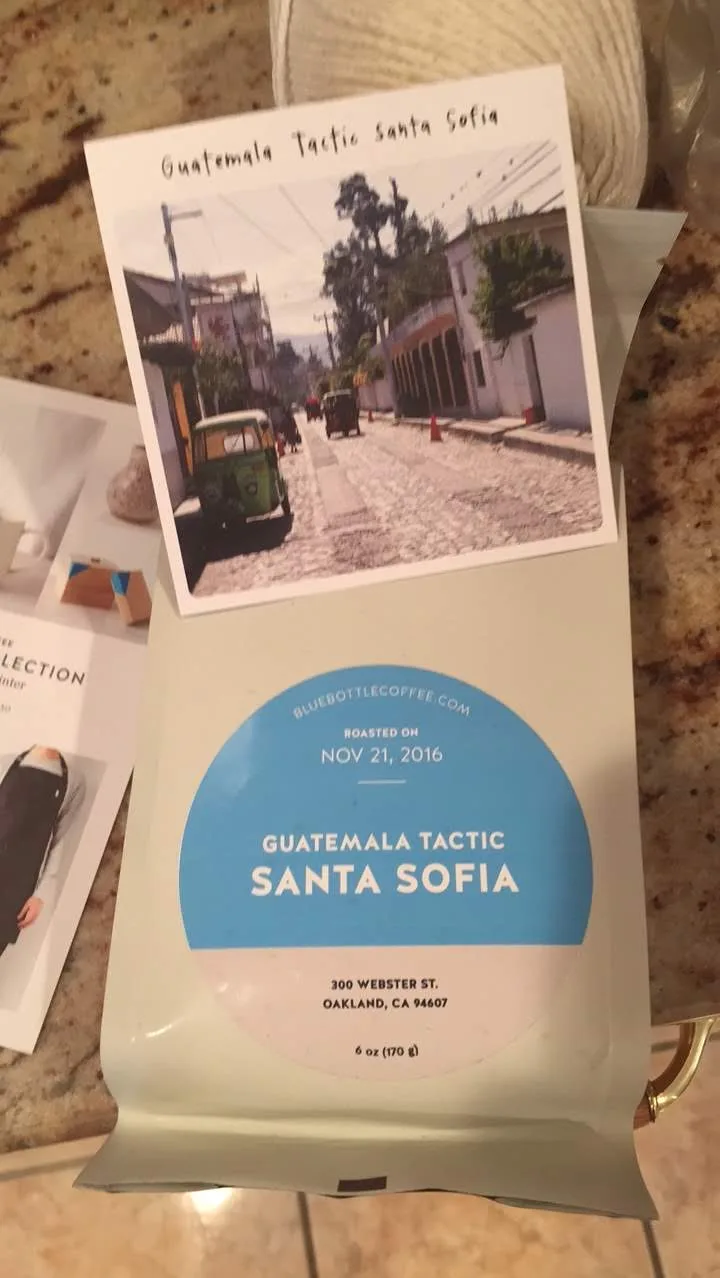
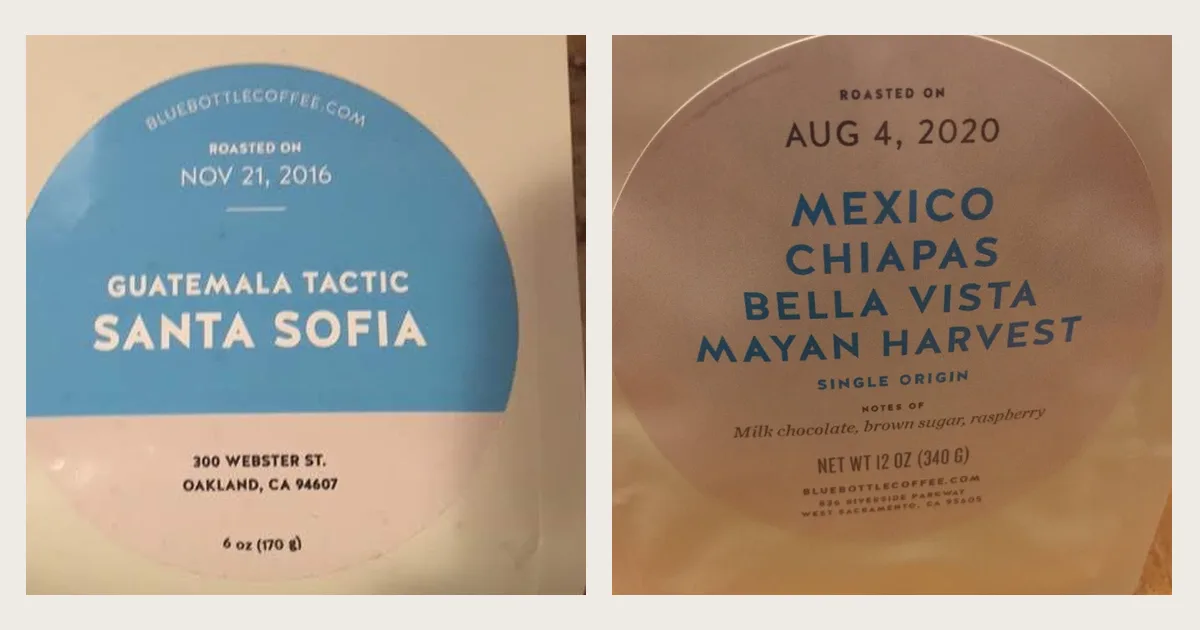
November 2016. Roasted at 300 Webster Street in Oakland.
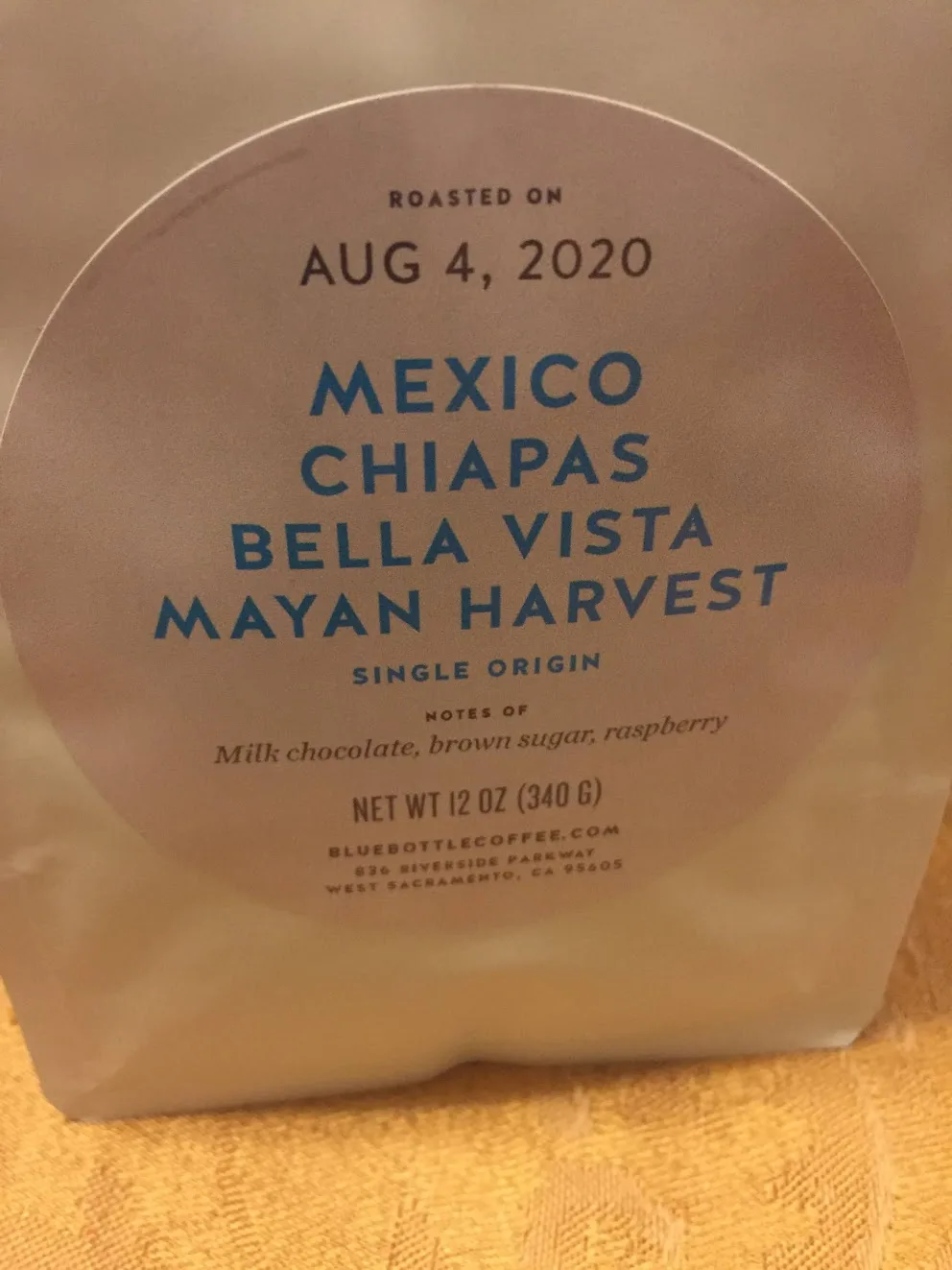
August 2020. Roasted at 836 Riverside Parkway in West Sacramento.
Blue Bottle opened a packaging and shipping operation in West Sacramento in 2018 and finished moving California roasting there toward the end of 2019, drawing production out of Los Angeles and Oakland. The Oakland roastery at 300 Webster went month to month and closed in November 2021.
Every bag I own from 2020 onward carries the Riverside Parkway address. The consolidation is on the label, and I bought both ends of it without noticing.
Notice the other thing on both labels. ROASTED ON, in large type, on the front. Whatever else changed, Blue Bottle never stopped telling you the one number that matters most, which is more than the grocery aisle does with its best-by dates.
Did the coffee get worse
My answer is yes, and I want to be careful about how much that is worth.
What I taste in current Blue Bottle is flat. Baked, low on acidity, sweet in a dull way that does not go anywhere. Nothing is technically wrong with it. It just sits there.
Here is the evidence pointing the other direction.
In 2022, at 103 cafes, then-CEO Karl Strovink argued the opposite case directly: “By the measure of the quality scores of the coffee we source, the sophistication of our green buying and roasting teams, and all the training we put in, the quality of our coffee and culinary products is increasing.” Serious Eats, in a guide updated in February 2026, signed up for ten subscriptions and named Blue Bottle the best individual roaster option it tested. In June 2026, five Food and Wine editors tasted seven canned cold brews with the labels hidden and ranked Blue Bottle Bright first overall.
Here is the evidence pointing my way, with its limits attached.
Blue Bottle workers have been organizing. Six Boston-area cafes voted 38 to 4 in May 2024, and Berkeley plus three Oakland stores voted 22 to 5 in July 2025, the first in California, under the Blue Bottle Independent Union. In November 2025 about 120 workers across nine cafes struck for four days over a first contract. Alex Reyes, a ten-year employee and a Berkeley shift lead, told the Chronicle that training and product standards had slipped since 2017. That is one worker’s account inside a labor dispute, and the stated motivations in that reporting were mostly cost of living and health benefits. Read it as what it is.
The gap in all of this is that nobody has run the experiment. There is no blind sensory comparison of Blue Bottle coffee before and after 2017, no evidence in the public record that Nestle ordered cheaper green coffee or changed a roast profile. I cannot tell you Nestle did this to my cup.
One small thing did stick with me. Coffee Review previewed its 2025 national-brands tasting report by naming its targets: “(We’re looking at you, Starbucks, Peet’s, Blue Bottle, Counter Culture, Whole Foods, et al.)” The published report covers six brands and Blue Bottle is not among them, or mentioned anywhere in it. Coffee Review has not published a rated review of a Blue Bottle coffee in years. I do not know why. It is an absence, and I am reporting it as one.
The frontier moved
Somebody gave me the Radiant Coffee Set for Christmas. Three single origins, all roasted 19 January 2021, sold on a card promising “stunning florality and fruitiness.”
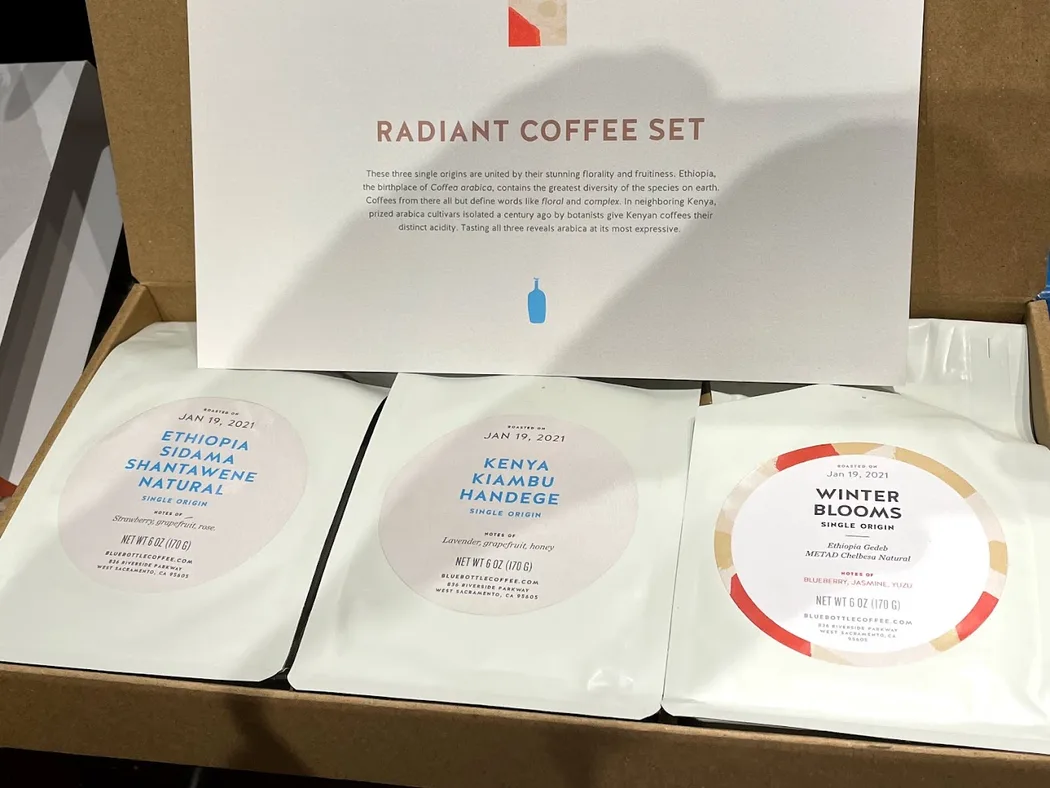
Three single origins, one roast date, a card promising florality.
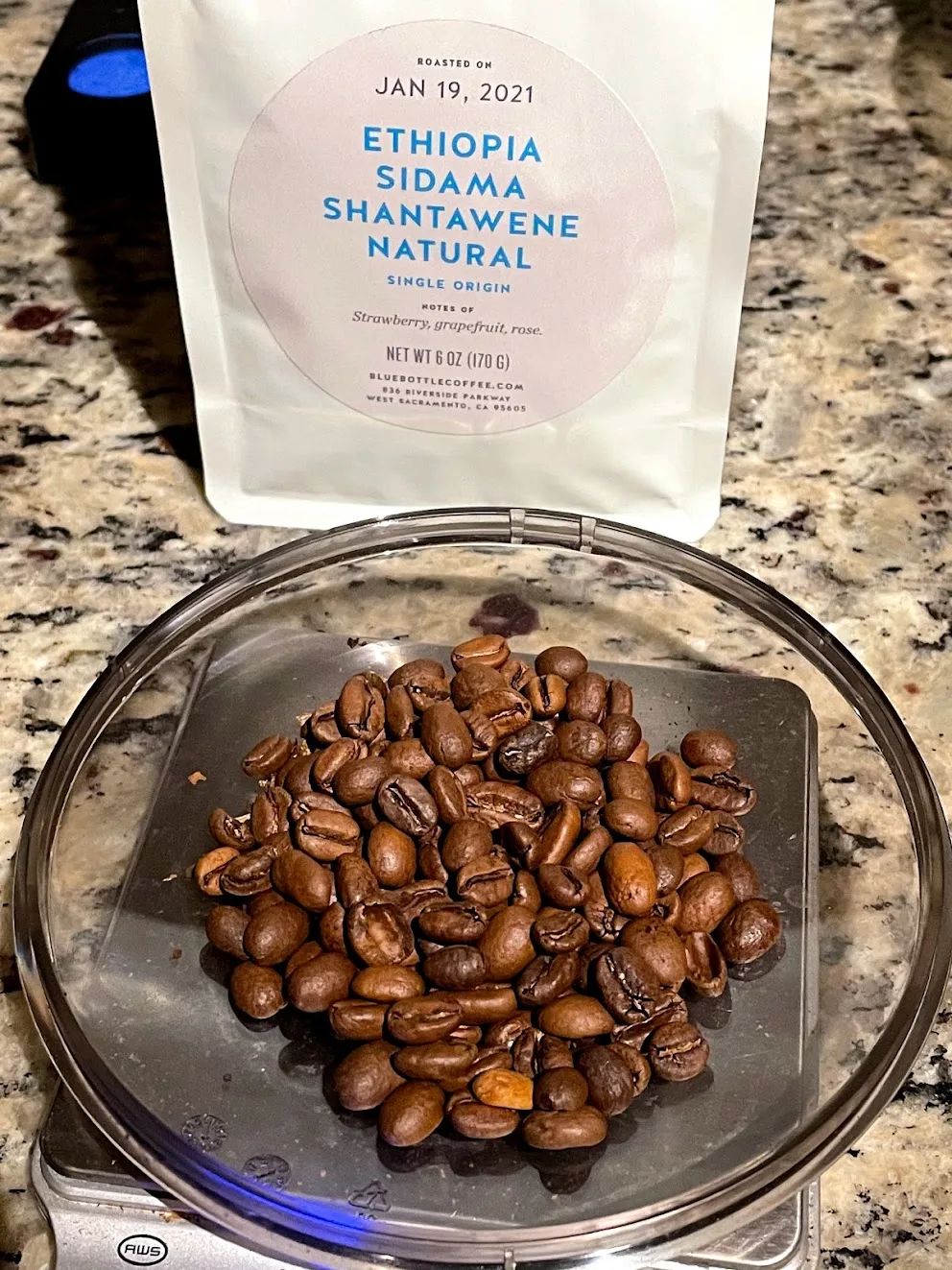
A natural Ethiopian sold on strawberry and rose. I could not find them in the cup.
Look at the current lineup and the aesthetic is clear enough. Playlist and Opascope are labelled light roast. Three Africas and Bella Donovan are medium. Giant Steps and Hayes Valley Espresso are dark. Bella Donovan’s page manages to say “Medium Roast” at the top and “Roasted dark for sweetness and body” further down, which tells you something about how much weight those words carry.
That is a coherent house style. It is also the house style of 2012.
Specialty coffee has moved a long way since then. A drinker who spent the last decade working through Nordic-style roasting, unusual varieties and increasingly strange processing can find a well-made Blue Bottle blend dull now even if the coffee is identical to what it was in 2014. Blue Bottle helped win the argument for roast dates, single origins, scales and pour-over, and those ideas are table stakes today. Winning made it ordinary. Our guide to the three waves of coffee covers how fast that shift happened.
Both things can be true. The coffee changed and so did I.
The rooms are still beautiful
Kauffman saw this in 2016 and described it better than I can. Blue Bottle, he wrote, “bathes in white space, which dominates the company’s packaging. Each cafe is polished in the manner of a high-end eyeglass store, not a corporate restaurant chain. There are no brand messages in sight, only customers snapping Instagrams.”
Ten years later that is still exactly right, and it is the part that scaled cleanly. You can reproduce tile, timber, lighting, ceramics and the correct shade of blue across a hundred rooms. Reproducing the feeling of finding somebody obsessive doing something nobody else nearby is doing turns out to be harder.
The obsessive streak is still in there somewhere. Blue Bottle Studio, Freeman’s eight-seat coffee omakase with nel drip and coffee-leaf infusions, ran in Los Angeles for 40 days in 2023. The US version has no location or booking now. The concept survives as a five-seat room in a restored machiya in Kyoto, open seasonally.
Nestle leaves
On 1 December 2025 Reuters reported that Nestle was exploring a sale of Blue Bottle under new chief executive Philipp Navratil, as part of a move away from operating physical retail.
On 23 April 2026 Nestle confirmed in its quarterly sales release that it had agreed to sell Blue Bottle to Centurium Capital, the private equity investor that has been Luckin Coffee’s controlling shareholder since 2022. The deal covers the cafes and most of the packaged business. Nestle kept the rights to Blue Bottle-branded Nespresso pods. Terms were not disclosed.
Nestle’s half-year report confirms the sale closed at the end of May 2026, filed among the group’s non-significant disposals.
You will see people do arithmetic on what Nestle lost. The arithmetic does not work, because the 2017 stake, the asset bundle and the 2026 price were never all disclosed. What can be said is narrower and stranger. Nestle bought Blue Bottle in 2017 specifically to get into the super premium coffee shop business, and in 2026 it sold the coffee shops and kept the pods.
Who still works that way
The early Blue Bottle proposition was legible: a printed roast date, a short window, small volumes, and enough disclosure that you knew what you were drinking. Plenty of roasters still run that way, and they publish the policy so you can check it.
Around Seattle, Olympia Coffee roasts Monday to Friday and ships the same day it roasts, and publishes what it pays through Fair For All, with a floor of $3.50 per pound. Kuma roasts and ships within 24 hours and paid an average of $3.54 a pound on its recent Colombians. Herkimer roasts and ships the same day.
Nationally, George Howell is still roasting daily to order 50 years after he started dating bags. Passenger prints the roast date on the bottom of the bag and has published a transparency report every year since 2022. Mother Tongue discloses the price paid on all of its coffees. Onyx ships within 24 hours of roasting and puts green cost, cup score and lot size on the product page, though it leads with a batch code rather than a printed roast date, so on the specific test of a date on the bag it only half qualifies. I went through a lot of their coffee in the advent calendar.
Prodigal does the most interesting thing anyone is doing with this: it lists several roast dates per coffee and lets you pick. And Tim Wendelboe roasts to order, flushes the bags with nitrogen, tells you to drink it between one and five weeks, and has published what he paid producers every year since 2010.
Any company can do this at any size. It costs you distribution, which is the whole reason it is worth telling people about.
Track it in BeanBench
I drank Blue Bottle for ten years and kept almost no notes. What I have is a shoebox of photographs, which is how I can tell you the address on a bag from 2016 and nothing at all about how the coffee in it tasted. The thing I actually want, a record of when my palate moved and what moved it, does not exist, because I never wrote it down.
In BeanBench you can log a bag with its roaster, roast date, days off roast, dose, grind and rating, then look back over a year of entries and see what you have actually been reaching for. From here, read coffee freshness for what the roast date does and does not tell you, how to buy good coffee beans for what to look for on a bag, or the three waves of coffee for how the industry Blue Bottle helped build ended up leaving it behind.
Frequently asked questions
Did Nestle ruin Blue Bottle?
There is no evidence for that. No public record shows Nestle ordering cheaper green coffee or changing roast profiles, and nobody has run a blind sensory comparison of Blue Bottle before and after 2017. What is documented is that Blue Bottle was already scaling hard for five years before Nestle arrived, and that Nestle kept the same management in place.
When did Blue Bottle stop selling coffee within 48 hours of roasting?
Gradually, and before the Nestle deal closed. The Washington Post reported in August 2017, three weeks before the acquisition was announced, that blends would be served for four days and single origins for a week. Today the company says an unopened bag stays good for up to 100 days.
Who owns Blue Bottle now?
Centurium Capital, the private equity investor that is also Luckin Coffee's controlling shareholder. Nestle disclosed the agreement in April 2026 and its half-year report confirms the sale closed at the end of May 2026. Nestle kept the rights to Blue Bottle-branded Nespresso pods.
Is a 100-day freshness claim reasonable?
For a sealed bag, yes. Oxygen drives staling, and a hermetic seal with a one-way valve keeps most of it out. Food science treats sealed shelf life and post-opening shelf life as two separate measurements. The 48-hour rule was measuring something else entirely, which was how long from roast to your cup.
Which roasters still work the way early Blue Bottle did?
Olympia Coffee, Kuma and Herkimer around Seattle; George Howell, Passenger, Onyx and Mother Tongue nationally; Tim Wendelboe in Oslo. The things to look for are a printed roast date, a published roast and ship schedule, and disclosed prices paid to producers.
Does Blue Bottle still print roast dates on its bags?
Every bag I own does, in large type on the front, running from 2016 through 2022. That is the single most useful thing a roaster can put on a bag and Blue Bottle has never stopped doing it.