The Onyx Coffee Advent Calendar, Reviewed
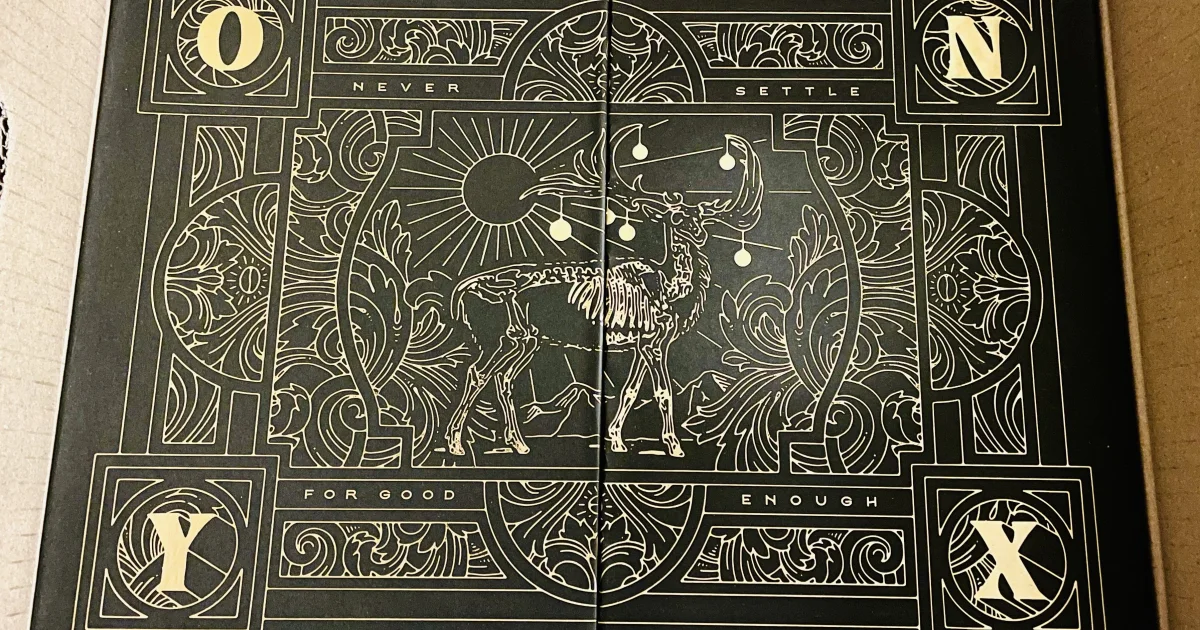
What is inside the Onyx Coffee Lab advent calendar, why the 24-coffee lineup rewards brewing it in pairs, how to avoid the one-door-a-day trap, and who should skip it.
My wife gave me the Onyx Coffee Lab advent calendar for Christmas. It is the best coffee gift I have received. I have never looked up what it cost and I do not plan to. What I can tell you is what is in the box, and who should own one.
What is in the box
Twenty-four numbered doors, fanned out on a hinge like a deck of cards. Behind each one is a foil bag of whole beans, nitrogen flushed, about 56 grams. That is roughly 1.3 kg of coffee in total, and Onyx describes a single bag as enough for a pot or one Chemex.
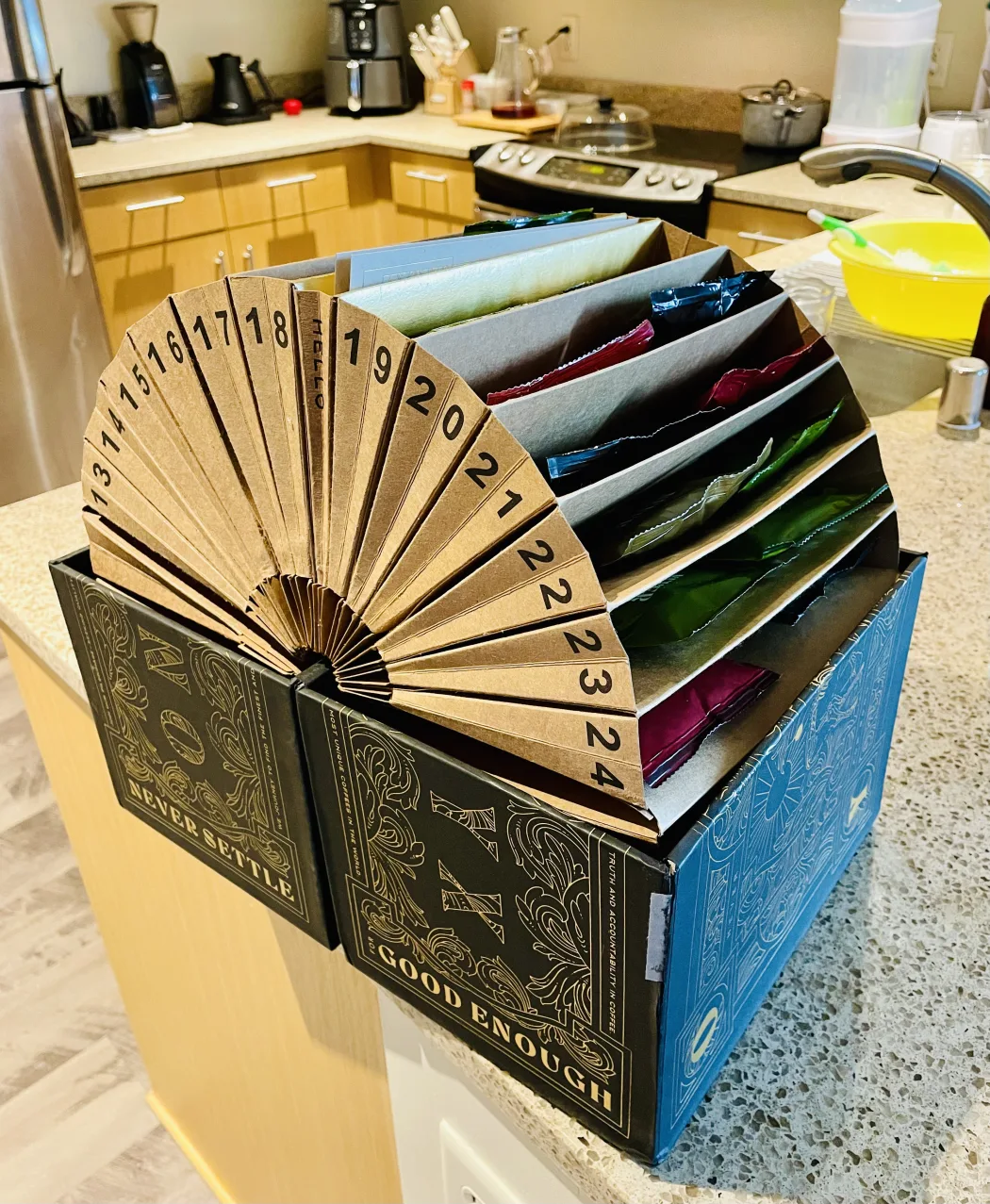
Doors 13 to 24, still sealed. Each divider holds one bag.
Two details make this different from most calendars I have seen. The coffee is whole bean, so you grind each morning and can match the grind to your brewer. And 56 grams is a real amount. At a 20 to 25 gram dose there is enough for a second attempt, which matters when you are brewing something you have never tasted.
The version I have was the sixth edition, released in 2023. Onyx has run it every year since, and Sprudge’s writeup of the seventh confirms the same 2 oz whole bean format.
The lineup is the product
The insert lists all 24 coffees with variety, process, and region.
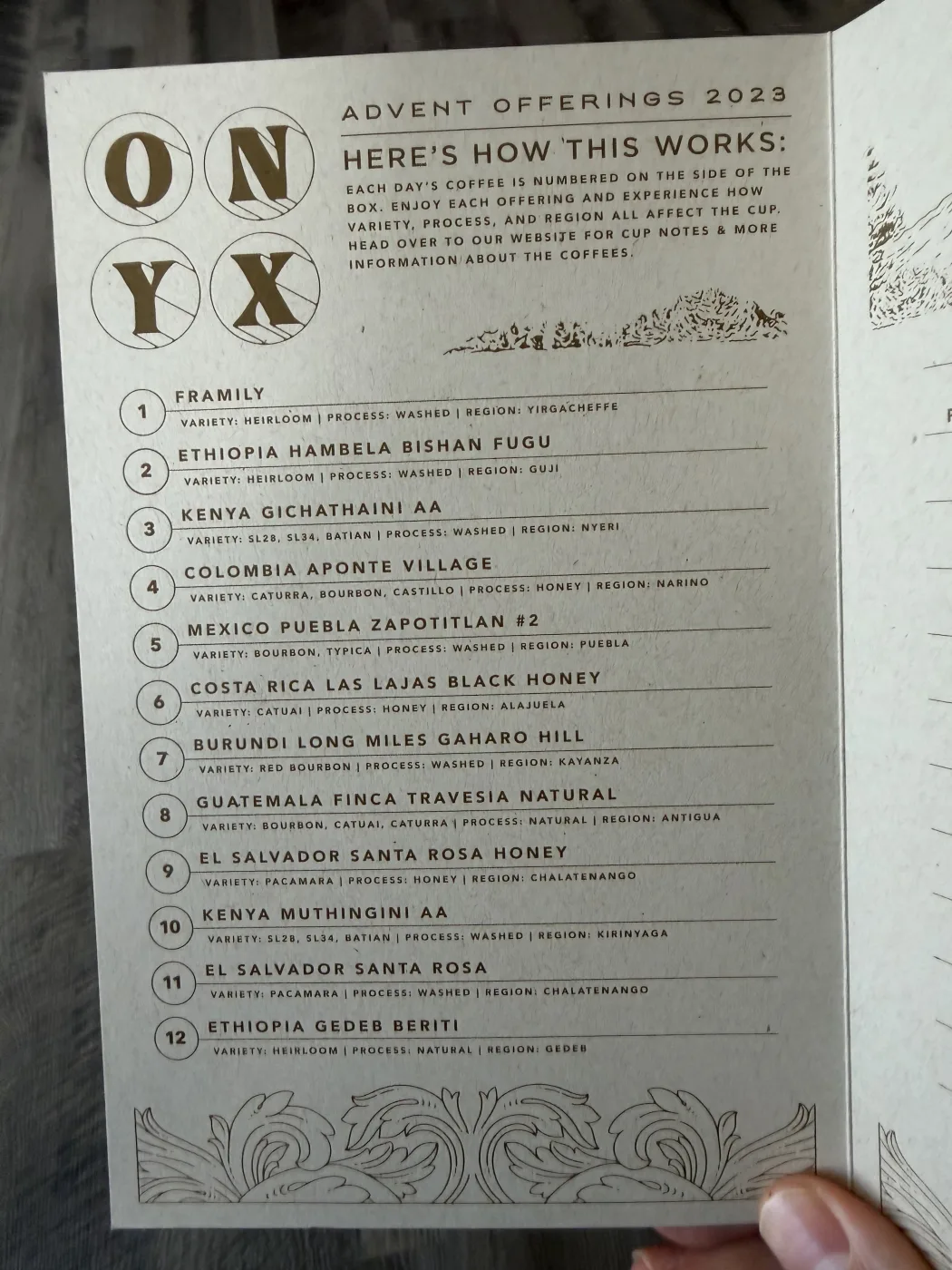
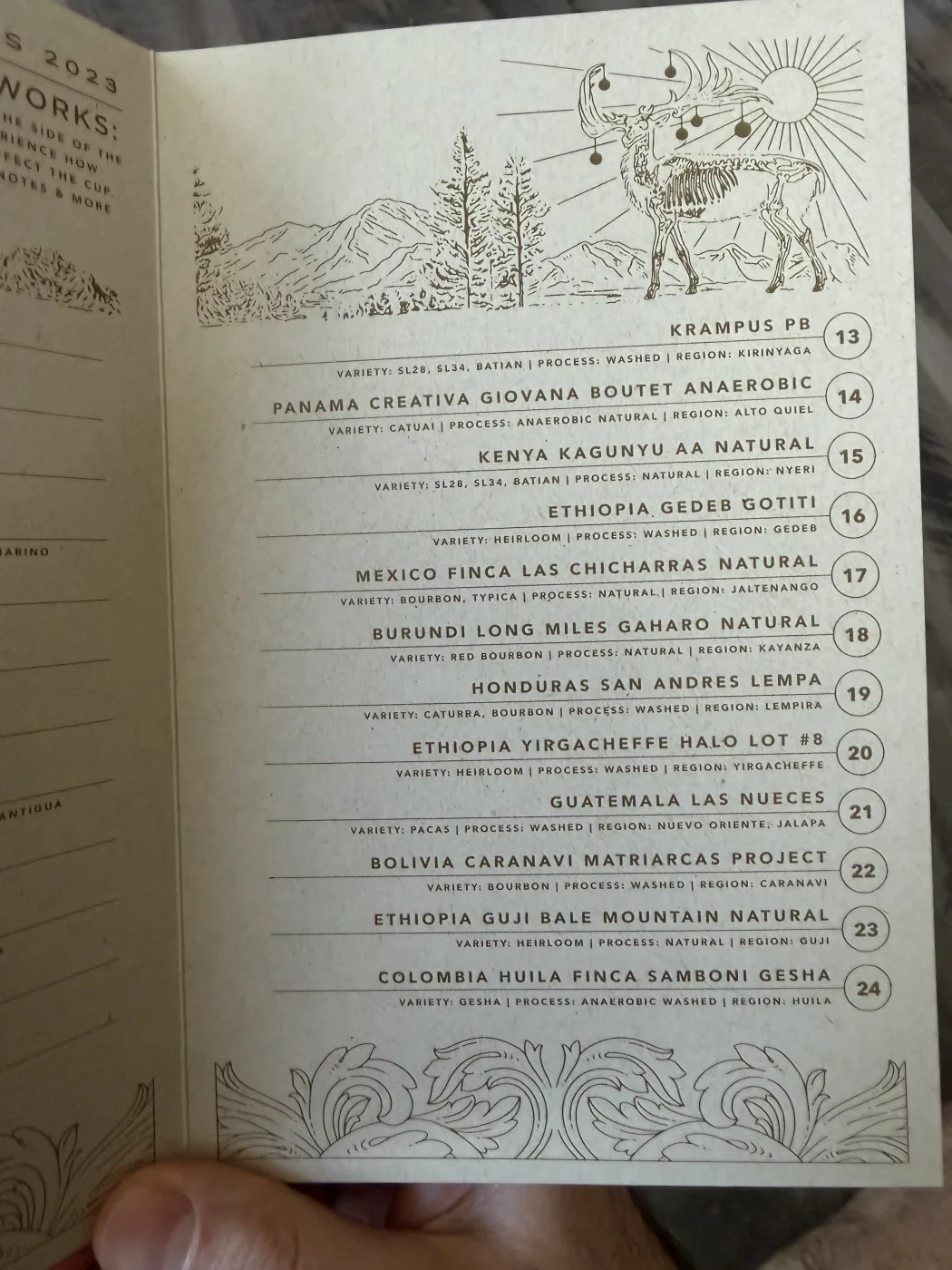
Twenty-four distinct coffees across eleven origins. Five Ethiopian single origins, four Kenyan-sourced coffees, two each from El Salvador, Burundi, Mexico, Guatemala and Colombia, and one each from Costa Rica, Panama, Honduras and Bolivia. By process, thirteen washed, six natural, three honey, and two anaerobic. Door 1 is Framily, an Onyx blend. Door 24 is a Colombian Gesha from Finca Samboni, which is a deliberate way to end.
Read the list closely and the sequencing turns out to be doing something. Several coffees are matched pairs, separated by a week or two of doors:
| Doors | What is shared | What changes |
|---|---|---|
| 7 and 18 | Long Miles, Gaharo, Kayanza, Burundi, Red Bourbon | Washed against natural |
| 9 and 11 | Santa Rosa, Chalatenango, El Salvador, Pacamara | Honey against washed |
| 3 and 15 | Nyeri, Kenya, SL28 and SL34 | Washed against natural |
| 12 and 16 | Gedeb, Ethiopia, heirloom | Natural against washed, at two different stations |
Brew doors 7 and 18 back to back and you are running a controlled comparison on the same beans from the same farm, with processing as the only large variable. That is the exercise a cupping table exists for, and the calendar hands it to you already portioned. Doing that once taught me more about processing methods than reading about them had.
If you want per-coffee starting points for the 2023 lineup, Fellow published brew recipes for the whole set.
The packaging is a brewing course
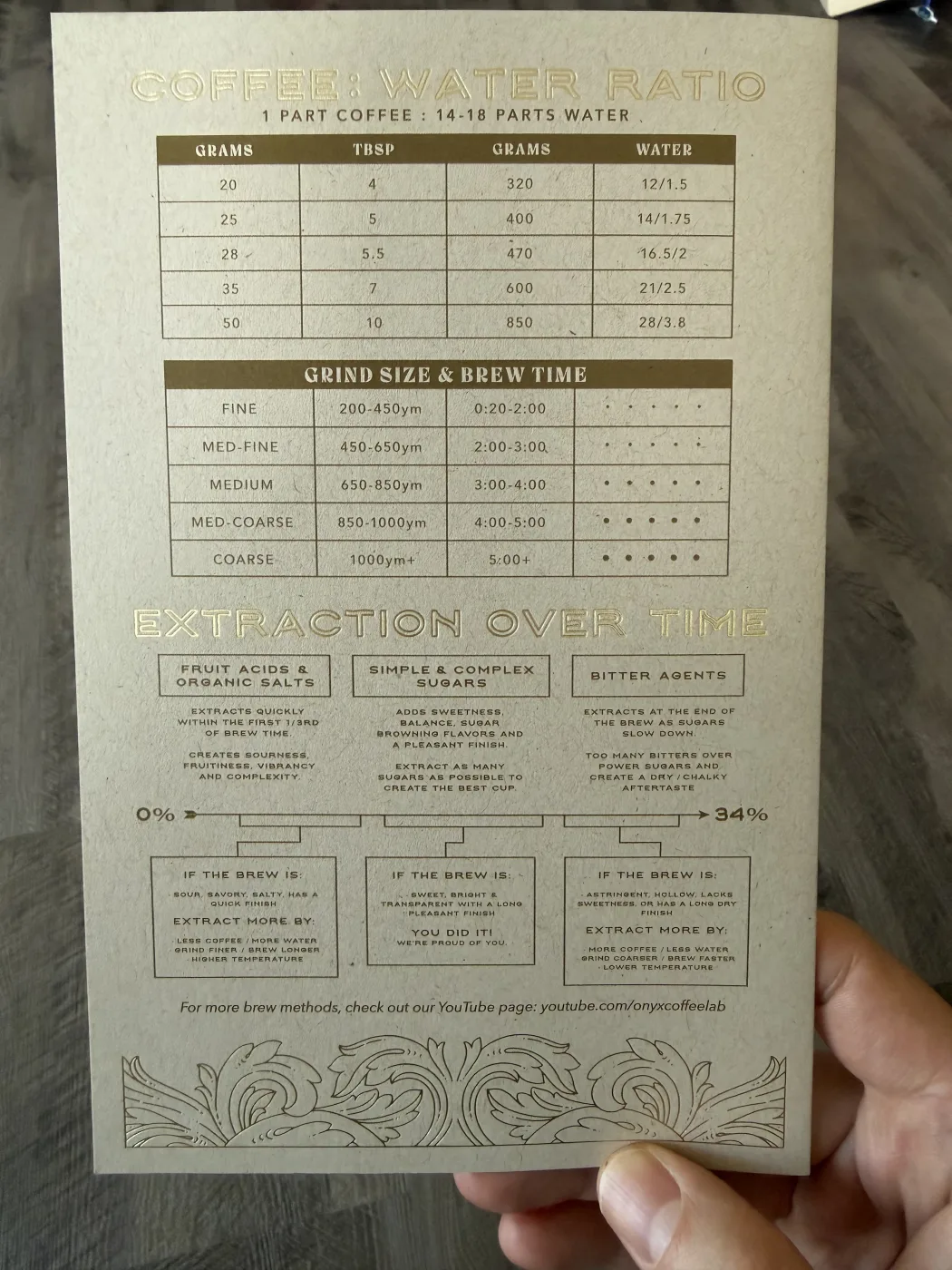
The insert card carries a coffee-to-water table at 1:14 to 1:18, a grind size chart with micron ranges and target brew times, and a diagram of what extracts when.
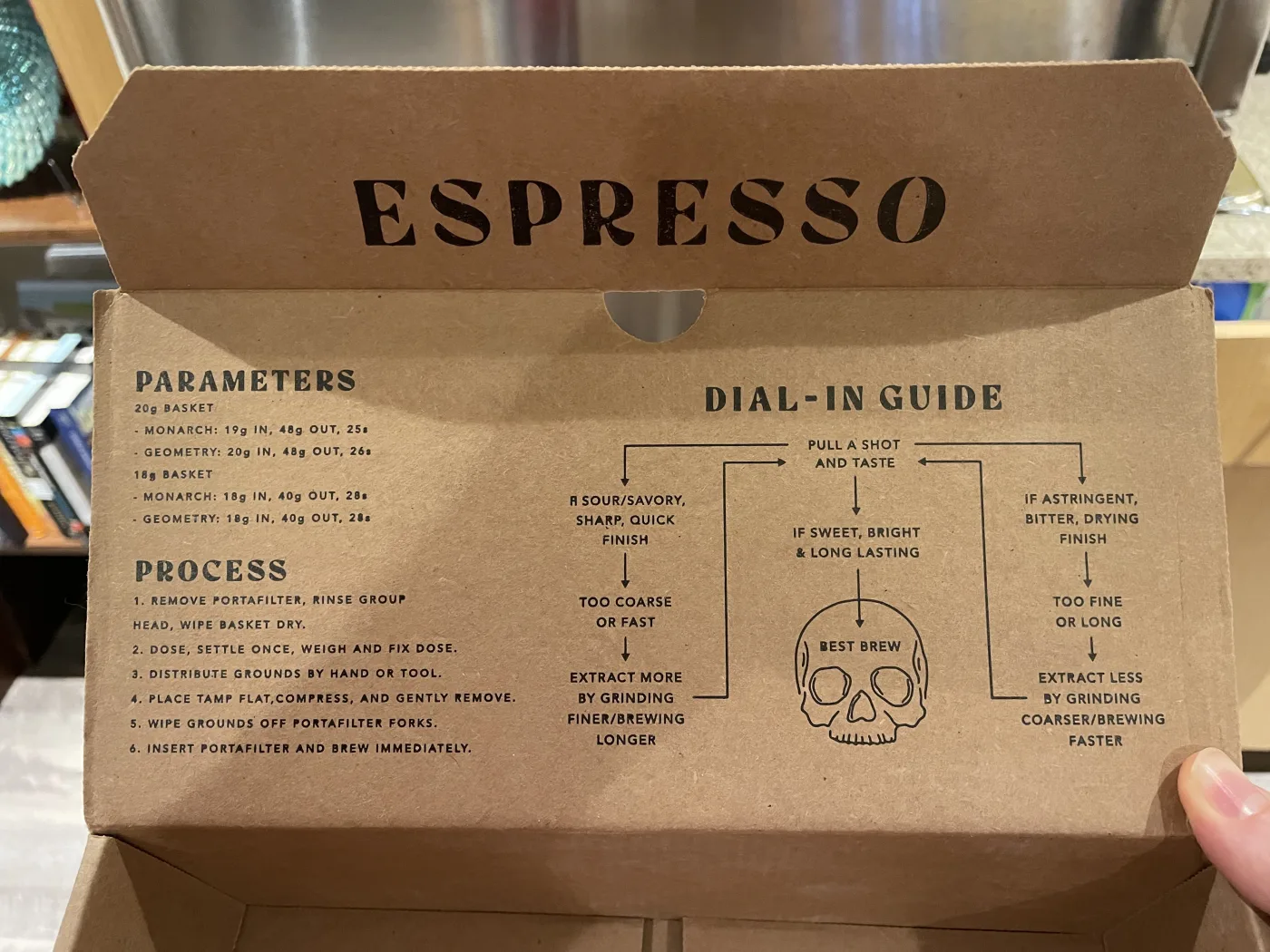
The shipping carton is printed on the inside too, and this is the part I did not expect. The interior panels carry a brewing control chart plotting extraction against strength, the aroma and taste wheel, cross sections of a coffee cherry, a flavor lexicon, and origin maps with elevation bands. The two flaps are dial-in guides.
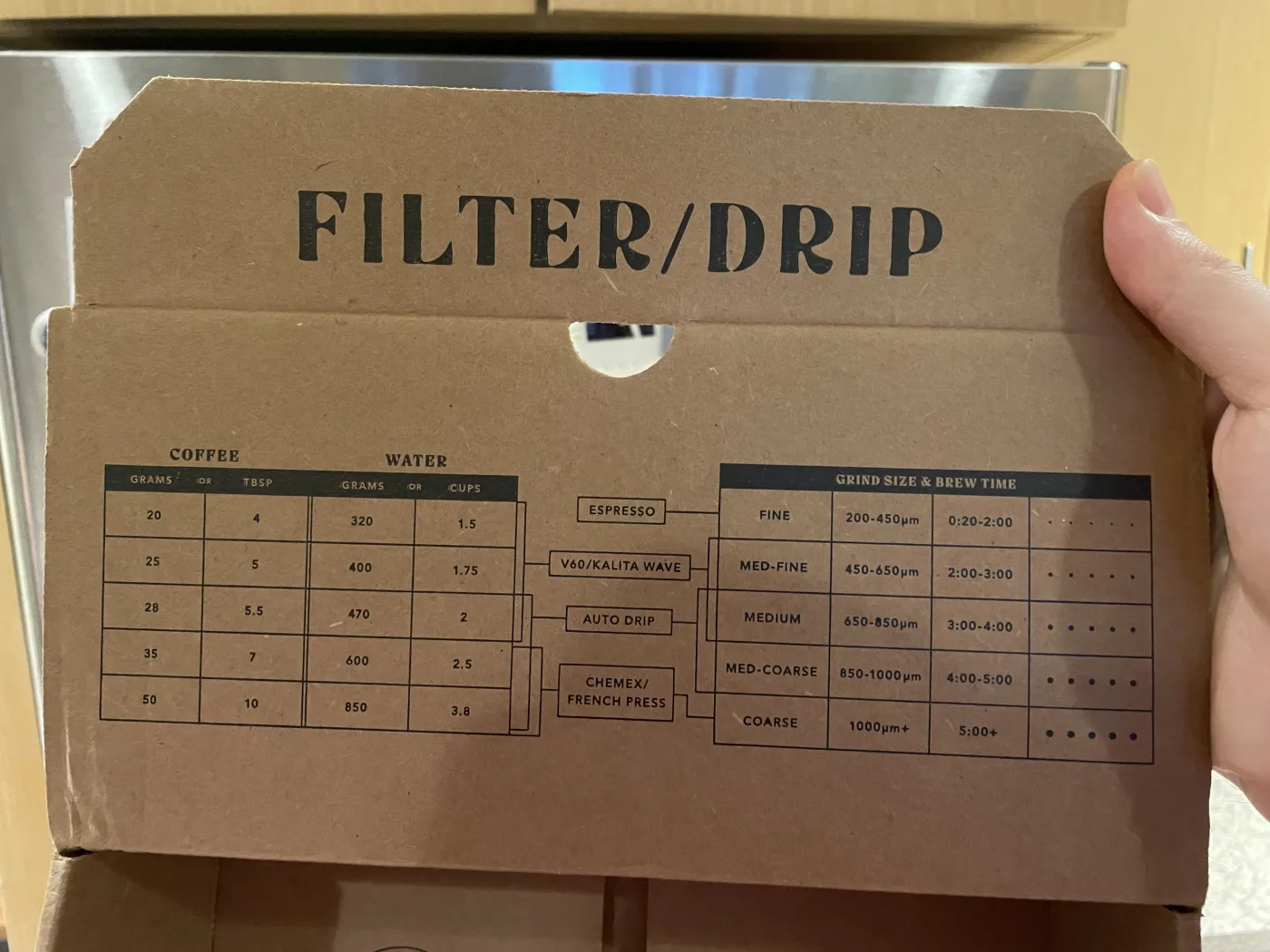
The filter flap. The espresso flap opposite gives basket weights and shot targets.
A beginner could work from this box for a year. It is the most useful packaging I own, and throwing out the carton would be a mistake.
How I actually drank it
I brew 32 to 42 grams of beans on a normal day. A 56 gram bag is more than one day of that and less than two. Opening a door every morning would mean either wasting coffee or brewing a second cup I did not want, every day for 24 days.
So I ignored the calendar part. I numbered the bags, put them in the freezer, and worked through them in order at my own pace. The sequence survived, including the matched pairs. The December deadline did not.
This works well because the bags arrive already portioned and sealed, which is exactly the condition our freshness guide recommends for freezing: rest the coffee to a window you like, freeze in small airtight portions, and avoid repeated thaw cycles. Twenty-four sealed 56 gram bags are close to the ideal case. The full method is in the resting guide.
If you get one of these, do this on day one. It also means a calendar given in late December, or opened in January, loses nothing.
What is harder than it looks
Brewing an unfamiliar coffee every session is genuinely difficult. You get one shot at a first impression with no prior knowledge of how it grinds or how it drinks, and by the time you have an opinion you are on to the next one.
Memory is where it broke down for me. The reviewers at Low Key Coffee Snobs hit the same wall and put it plainly: they could not remember afterwards what they had liked and disliked, and wished they had kept notes. I recognize that completely. Twenty-four coffees in sequence blur unless you write something down at the time. The matched-pair comparisons are worthless if you cannot recall what door 7 tasted like by the time you open door 18.
Their other criticism is fair as well. It is 24 coffees from one roastery, so you are getting one company’s sourcing and one roasting style across the whole box.
Who should get one
Buy it for someone who brews pour-over and owns a grinder. Onyx ships a filter recipe with each day, the coffees are roasted for it, and the processing pairs pay off when you brew them side by side. It suits people who want breadth, and it works well as palate training.
The roaster is a large part of why I recommend it. Onyx has a real competition record, with Andrea Allen and Elika Liftee winning the 2020 US Barista Championship and US Brewers Cup in the same year. They also publish trade and pricing data for the coffees they sell, including what they paid and how each lot scored.
Who should skip it
Skip it for an espresso-only drinker. Onyx’s recipes here are pour-over, and 56 grams leaves almost no room to pull a shot, adjust, and pull again. The espresso flap on the carton gives targets for Onyx’s espresso blends rather than for these coffees, which tells you what the box is aimed at.
Skip it for anyone without a grinder, since every bag is whole bean. And skip it for the drinker who would rather live with one coffee for a week and learn it properly, because this box is built on the opposite instinct.
What to buy instead
For the espresso drinker or the one-coffee-at-a-time person, an Onyx subscription gets the same sourcing in bag sizes you can dial in. Sey runs a subscription that never repeats a coffee, which scratches the variety itch across a year. For someone with no grinder and no gear, Cometeer ships frozen capsules that need neither. And if the appeal was tasting widely rather than tasting Onyx, The Roasters Pack puts multiple roasters in one box.
If you do want the Onyx calendar, buy it early. Recent editions have gone on sale in October, pre-orders for the 2024 box opened on October 7, and the 2025 edition is already listed as sold out.
Track it in BeanBench
The memory problem is the one real flaw in this format, and it is fixable. Twenty-four coffees arrive faster than any of us can hold them, and the comparisons only work if door 7 is still legible to you when door 18 comes around.
In BeanBench you can log each day against the coffee, with the origin, process, variety, dose, grind, and your own tasting notes and rating, then sort the whole calendar by what you scored highest. That turns a box of 24 unknowns into a list of coffees you know you want to buy again. From here, read processing methods for what the washed and natural pairs are doing, how to cup coffee at home for tasting two coffees side by side, or SL28 and SL34 for the Kenyan varieties that show up four times in this box.
Frequently asked questions
How much coffee is in the Onyx advent calendar?
Twenty-four bags of whole bean coffee at about 56 grams each, roughly 1.3 kg in total. Onyx describes one bag as enough for a pot or a single Chemex. At a 20 to 25 gram dose, most days give you two brews rather than one.
Is the coffee whole bean or pre-ground?
Whole bean, sealed in nitrogen-flushed bags. You need a grinder to use it, which rules the calendar out as a gift for someone who buys coffee ready-ground.
Do you have to open one door a day?
No. The doors are numbered and the bags are already portioned, so you can number them, freeze them, and work through the sequence at whatever pace you drink coffee. That also solves the problem of receiving one as a gift after December.
Is the Onyx advent calendar good for espresso?
It leans toward filter. Onyx ships a pour-over recipe with each day, and 56 grams gives you very little room to dial a shot, adjust, and pull again. Espresso-only drinkers will get less out of it than pour-over brewers.
When does the Onyx advent calendar go on sale?
Recent editions have gone on sale in October. Pre-orders for the 2024 calendar opened on October 7 that year, and the 2025 edition is listed as sold out on the Onyx site, so waiting until December is too late.
What coffees were in the 2023 Onyx advent calendar?
Twenty-four distinct offerings across eleven origins, including five Ethiopian single origins, four Kenyan-sourced coffees, and a Colombian Gesha at door 24. Thirteen were washed, six natural, three honey, and two anaerobic.
Is a coffee advent calendar worth buying?
It depends on how the recipient brews. Someone with a grinder who brews pour-over and wants to taste widely will get a lot out of it. Someone who drinks espresso only, has no grinder, or prefers to spend a week learning one coffee will get less.