Chili Crisp Latte: What Happens When You Put Sichuan Chili Oil in Espresso
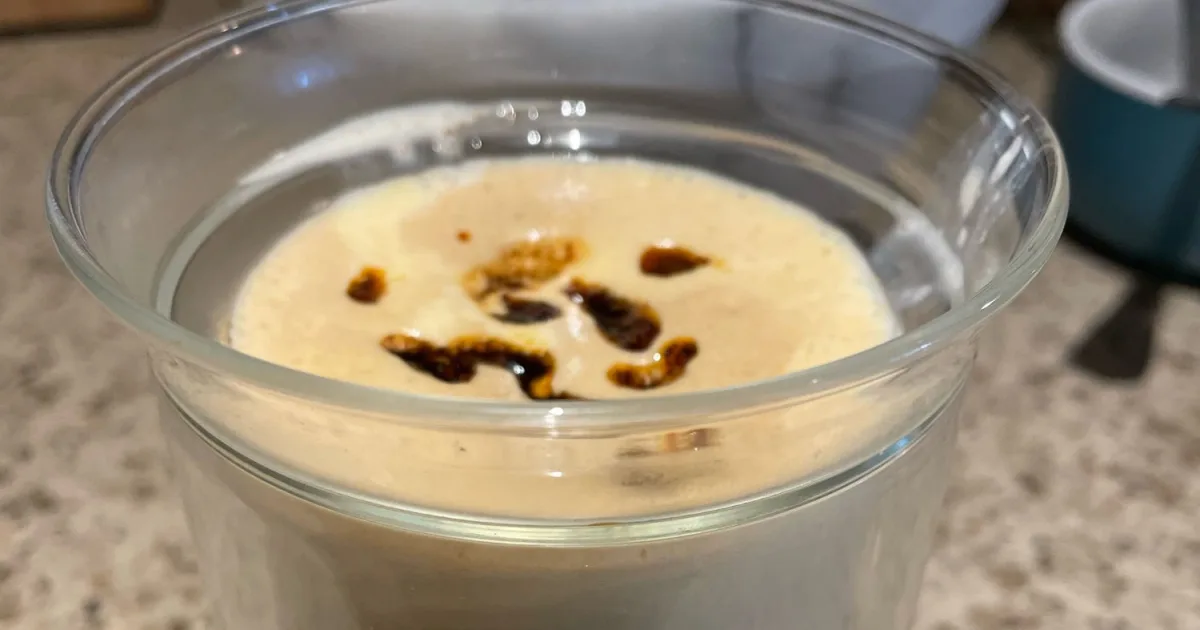
Espresso, frothed milk, and Fly By Jing chili crisp. What capsaicin and Sichuan pepper do to a latte, why the oil fights the foam, and which cafés already sell one.
I started putting chili crisp on vanilla ice cream a few years ago, which is a well-traveled idea by now. Last year I took the next step and put it in a latte.
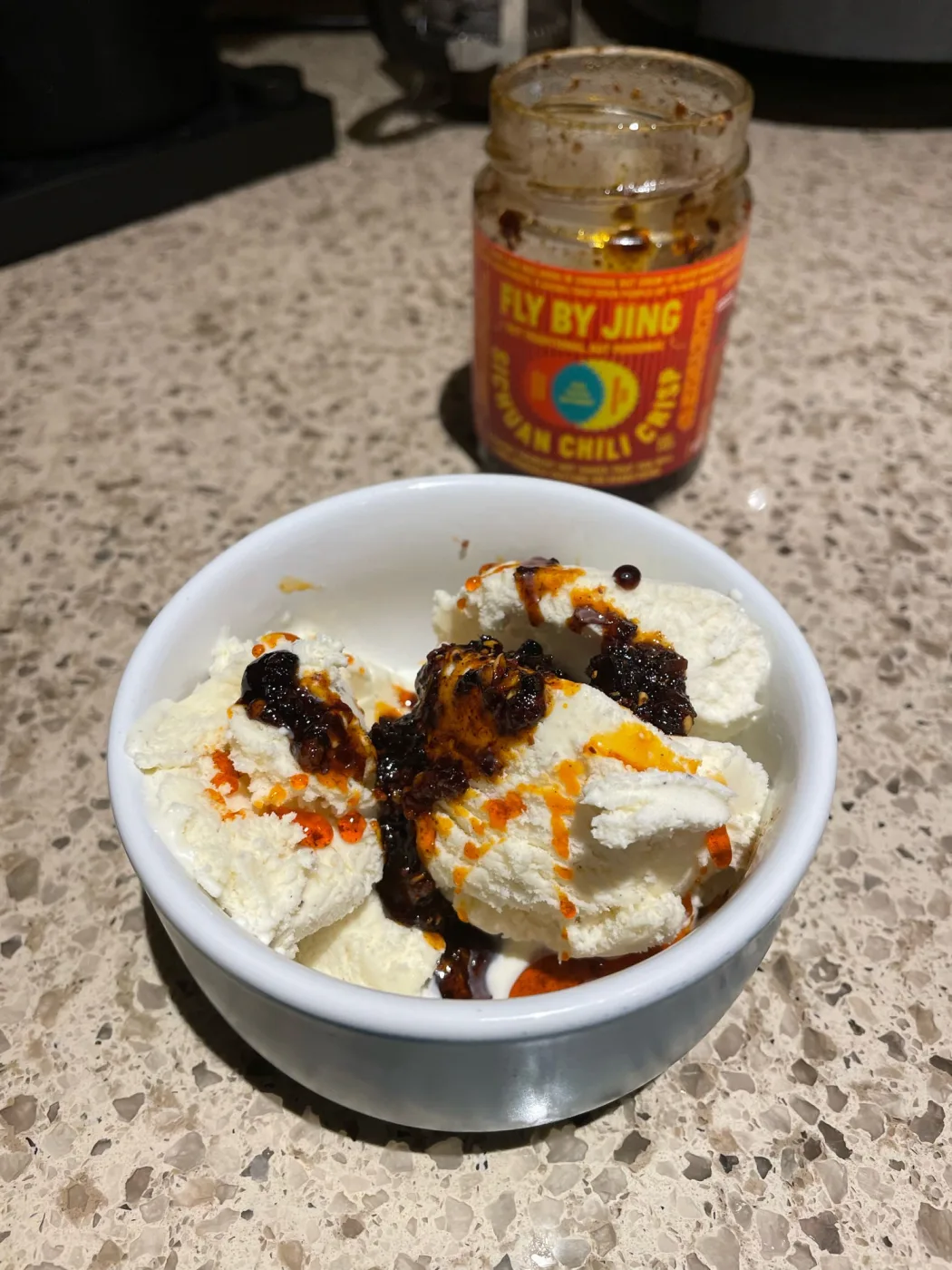
The gateway. Chili crisp on vanilla is a well-established move by now.
The build was simple. A double shot of Olympia Coffee’s Morning Sun, whole milk frothed in a French press because I do not own a steam wand, and about half a teaspoon of Fly By Jing Sichuan Chili Crisp spooned over the top. Sweet, creamy, savory, hot, slightly numbing, and much more drinkable than it had any right to be.
This guide covers what is actually in a jar of chili crisp, how the heat and the tingle reach you through a system that has nothing to do with taste, why the oil in the jar is the hardest part of the drink to work around, how to build one, and which cafés are already selling something close to it, which is a shorter list than you might guess.
What is actually in the jar
Fly By Jing lists the ingredients of its Sichuan Chili Crisp in this order: rapeseed oil, soybean oil, dried chili pepper, fermented soybean, garlic, shallots, mushroom powder, ginger, sesame oil, salt, Sichuan pepper, seaweed powder, and spices (product page).
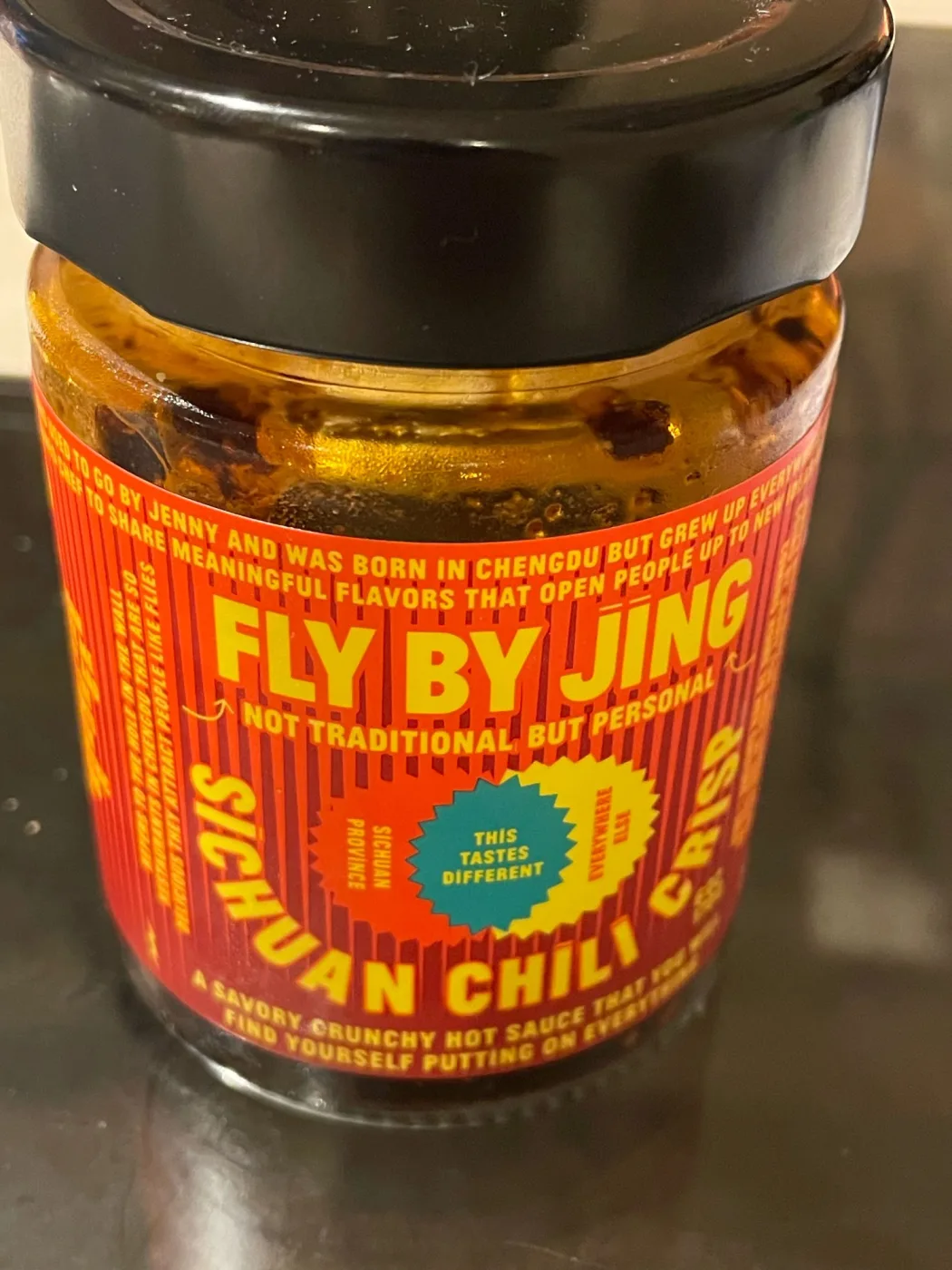
The solids sink and the oil floats, which is the whole problem in one photo.
Two things follow from that list. The first two ingredients are oil, which turns out to be the whole technical problem with the drink. And a handful of the rest are there for savory depth rather than heat. Fermented soybean, mushroom powder, seaweed powder, and salt all carry glutamate or amplify it. A jar of chili crisp is a heat delivery system sitting on top of a stock cube.
The savory half explains why the drink works at all. Coffee already lands in the roasted and earthy corner of the flavor map, and our tasting notes families give earthy and savory, umami included, a bucket of their own. The official arabica reference is stingier. The 2016 SCA flavor wheel has nine top-level families and umami is in none of them, and its one brothy descriptor sits in the taint neighborhood under Other. Umami became a family of its own with the 2025 canephora wheel, where tomato, shoyu, and mushroom finally sit together (Carvalho et al., Scientific Reports). Adding glutamate to a milk drink is closer to salting caramel than to pouring hot sauce in a cup.
Heat and tingle arrive through the trigeminal nerve
Chili heat arrives through the trigeminal nerve, the system that reports temperature, touch, and pain across the mouth and face. Your taste buds sit that one out. Capsaicin opens TRPV1, the same ion channel that noxious heat above about 43°C opens (Caterina et al., Nature), so the burn arrives on the channel your mouth uses to report a too-hot drink, with no rise in temperature behind it. That is a separate pathway from the bitter receptors that do the work in coffee, which run on a family of about two dozen TAS2R genes.
Sichuan pepper works by a different mechanism, and the difference is measurable. The compound is hydroxy-alpha-sanshool. In 2008, Bautista and colleagues showed in Nature Neuroscience that it excites sensory neurons by inhibiting two-pore potassium channels, specifically KCNK3, KCNK9, and KCNK18. Capsaicin opens a channel and lets ions in. Sanshool blocks a channel that normally leaks potassium out, and the neuron fires because its brake is gone.
The tingle itself runs on touch hardware. A 2010 study found that sanshool stimulates virtually all D-hair afferents, the ultrasensitive light-touch receptors, along with other mechanoreceptive fibers (Lennertz et al., Journal of Neuroscience). The buzzing on your lips is real mechanoreceptor firing with nothing mechanical causing it.
One finding from the psychophysics is directly useful at the table. Tingle intensity builds when a sanshool derivative is reapplied every 30 seconds and fades when doses are 30 minutes apart, and it is not blunted by prior capsaicin or mustard oil exposure, which rules out the TRPV1 and TRPA1 pathways (Albin and Simons, PLoS One). That was five applications over about two minutes rather than a whole latte, so it points a direction rather than fixing a dose. It matched my cup. The buzz was more noticeable near the end than at the first sip.
Milk is why any of this is comfortable. Free capsaicin concentration falls as protein concentration rises, and in a study of 89 people, maximum burn intensity fell with it, more steeply with casein than with whey isolate (Farah et al., Journal of Food Science). Fat, protein, and serving temperature each contribute on their own (Gaiser et al., 2024). The popular explanation, that casein binds capsaicin and carries it off, is shakier than its confidence suggests: a double-blind placebo-controlled trial found no significant difference between casein, whey, and lactose rinses (Journal of Sensory Studies, 2024). Milk helps. Which part of the milk does the helping is still open.
The oil is the hard part
Microfoam is a protein-stabilized foam. Milk proteins gather at the boundary between air and liquid and hold the bubble walls together. Fat competes for that same boundary, because the hydrophobic end of a milk protein will attach to a fat droplet as readily as to air. Liquid fat spreading across a foam film also drags liquid away from the spreading front, thinning the wall until it tears. Above roughly 40°C, liquid fat can also coat bubble surfaces and slow coalescence, so the effect runs in both directions (Perfect Daily Grind), but a droplet of free oil sitting in a thin protein film is a weak spot in that film.
Chili crisp runs around 60 percent fat by weight, which the nutrition panel shows and the ingredient order only hints at. Stir it into the milk before or during frothing and the foam struggles.
This is also why the ice cream version tells you nothing about the latte. Ice cream is a frozen fat emulsion with no protein-stabilized foam in it, so chili oil over a scoop costs you nothing structurally. A latte is the case where the oil has something to wreck. The dessert that got me here was a poor guide to the drink.
The workaround is order of operations. Build the drink, then spoon the chili crisp onto finished foam. Oil on the surface stays on the surface. Free oil in the pitcher makes stable microfoam harder to build and quicker to collapse.
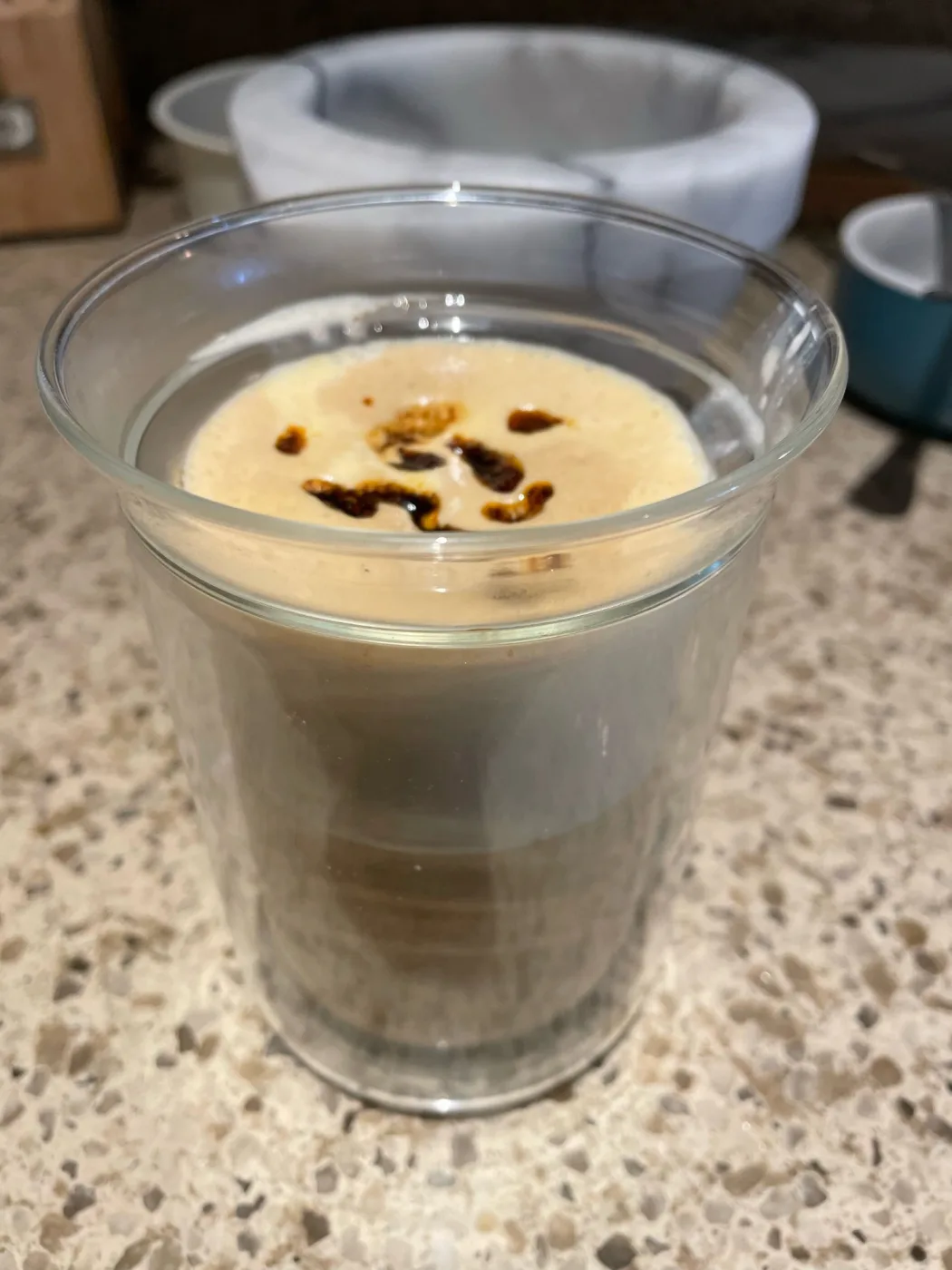
Chili crisp floated on top after the milk went in. The foam is still holding.
How to build one
The original was made by eye, so treat the numbers below as a place to start and adjust from there. Amounts are for an 8 oz drink.
| Ingredient | Amount |
|---|---|
| Espresso | 18 g dose, 36 to 40 g in the cup |
| Whole milk | 150 to 180 g |
| Sichuan chili crisp | 1/2 to 1 tsp |
| Honey or brown sugar (optional) | 1/2 to 1 tsp |
- Pull the shot straight into the serving glass.
- Heat the milk to about 60 to 65°C. Past that it starts tasting cooked, which is a bad trade in a drink that already has a lot happening.
- Froth. Without a steam wand, a French press does the job: pour the hot milk in no more than a third full, plunge fast for 30 to 45 seconds, tap the base on the counter to break the big bubbles, then swirl until it looks glossy.
- Pour the milk into the glass.
- Spoon the chili crisp on top. Take mostly oil for a smoother drink, or include the crunchy bits if you want texture that lasts to the bottom.
- If your jar is garlic-heavy, leave the big garlic pieces in the jar. Garlic is the single ingredient most likely to read as a mistake in a coffee.
Allergens. Fly By Jing’s Sichuan Chili Crisp lists soy and sesame. With whole milk in the glass, that is soy, sesame, and dairy in one drink.
On sweetener. Half a teaspoon is plenty. It gives the heat something to sit against, and past that the sweetness flattens the savory half that makes the drink interesting.
A variation with a cost. For heat that shows up earlier in each sip, stir a quarter teaspoon into the espresso before the milk goes in, and expect thinner foam in exchange. That is the tradeoff the previous section describes, and it is worth trying once so you can taste both sides of it.
Iced. Shake espresso, milk, sweetener, and chili crisp over ice. This is the version where the oil stops being a structural problem, because there is no foam to protect. It will still separate, so shake it again if the glass sits. The heat reads a little sharper without hot milk rounding it off.
On the coffee. Morning Sun is a Latin America blend that Olympia describes as having “flavors of dark chocolate, roasted hazelnut, and vanilla” (product page), and it sells in their signature espresso bundle alongside Big Truck and Sweetheart. That chocolate-and-nut direction is the right one here. Milk covers small extraction faults but not large ones, and a sour or bitter shot has nowhere to hide once you add a condiment with this much going on. A delicate, floral light roast is the wrong direction; the chili crisp will bury it.
What it tasted like
Savory first. That is the thing worth knowing before you make one, because it is the opposite of what the jar suggests. Sweet and creamy from the milk, then savory, and the heat and the numbness came in behind that and both stayed light. Much more drinkable than it had any right to be.
The order explains why it works. If the chili had led, this would be a hot drink with a stunt in it. Because the glutamate lands first, the heat arrives as a finish on something that already tastes like a drink, and the closest familiar reference point is a salted caramel latte with a slow burn underneath. The numbing sits at the edge of noticeable, which is about right at half a teaspoon.
I would not make it every day. I did genuinely enjoy it.
How rare is this, actually
I posted this drink with a line about being surprised more cafés did not offer it. The answer, having gone looking: very few do, and the ones that do are almost all in China or in Chinese-concept cafés abroad. Spiced coffee turns up here and there in the US, usually as a syrup. The version with the condiment spooned in stays a home drink.
The clearest example is 5:59+ Cafe & Bistro, a Chengdu chain whose first international outlet opened on Orchard Road in Singapore. It sells an Old Chengdu Mala Coffee for S$9.80, spiced with dried chilli and star anise (Eatbook), served with mala foam and a whole Sichuan chilli pepper (MiddleClass).
Closer to home, Seattle already had one. Rachel’s Bagels and Burritos in Ballard lists a Chili Crisp Latte on its standing latte menu, pulled on Kuma beans (their menu). It runs on a syrup. Their menu marks it “szechuan pepper syrup” and their ordering page calls it chile crisp syrup, and the jar does not go in by the spoonful either way. Rachel’s also makes its own everything chili crisp and sells it by the jar, so the drink named after it goes through a syrup by choice. In Kansas City, Café Cà Phê runs a Vietnamese espresso with cayenne syrup, and its Sichuan-peppercorn drink is matcha rather than coffee (their menu).
A handful of cafés out of tens of thousands is not a category. I could not find one putting the condiment itself into a coffee. Every example I turned up routes the chile through a syrup or a powder. The closest to solids in the glass is Jingshi Coffee in Ganzhou, whose iced latte carries sliced fresh peppers and chilli powder and was moving around 300 cups a day (SCMP). Fly By Jing has not done it either, as far as I can tell. Their recipe page is six savory dishes, and their collaborations have gone to ice cream twice, once as a Jeni’s scoop-shop topping from July 2024 and once as an ice cream sandwich at The Musket Room in June 2024, plus chocolate, salad, and ketchup. No coffee collaboration that I could find.
The savory coffee wave in the US has gone somewhere else entirely. A 2026 Fresh Cup roundup names Tomat in Los Angeles doing a koji miso latte, Maman in New York doing salted tahini honeycomb, and Discourse Coffee in Milwaukee doing a ramen latte with pork fat and bone broth. Founder Ryan Castelaz described the goal as wanting it “to drink like a latte, but we also wanted it to be like a bowl of ramen.” Across that piece and a second 2026 roundup, roughly a dozen cafés get named, and none of them is doing chili. The direction is fermented and salty.
The chains have tried heat and backed off. Starbucks ran a Chile Mocha in fall 2016, espresso and cocoa with an ancho and cayenne topping, and pulled it after a single season (Tasting Table). The closer parallel is Oleato, which put Sicilian olive oil into arabica coffee starting in Italy in February 2023, went US-wide in January 2024, and came off US and Canada menus starting 7 November 2024, while continuing in China, Italy, and Japan (CNBC). A global chain spent 21 months putting oil in espresso drinks and stopped in its home market.
So this is a novelty, and the reasons it stays one are legible. Oil in espresso drinks has been tried at chain scale and did not hold. The current appetite for savory coffee points at miso and salt. And a drink that needs the condiment floated on top, eaten reasonably fast, and strained if the jar is garlic-heavy is a hard thing to put on a menu and serve two hundred times a day. So the correction to my original post is narrow: the idea has occurred to other people, a few went further with it, and one of them was a mile from my house.
Where this sits next to infused coffee
Worth drawing one line clearly. Putting chili crisp in a finished drink is a bar decision, which is a different thing from the argument about flavoring coffee during processing. Nobody is confused about where the chili came from when you can see it floating on the foam. The disclosure problem that makes co-fermented competition coffee contentious does not apply to a condiment you spoon on yourself.
There is also house precedent for seasoning a coffee. A few drops of saline rescues a bitter iced coffee because sodium suppresses bitterness more than it touches sweetness, which is covered in the cold brew guide. Salt in coffee is an accepted technique. Chili crisp is the same move with the volume turned up.
Track it in BeanBench
If you try this, log it like any other brew, because the variables that matter are the ordinary ones. In BeanBench you can record the dose, yield, milk weight, and rating, and put the chili crisp amount and whether you stirred it in or floated it on top in the notes. Two or three attempts is enough to find your own amount, and the difference between half a teaspoon and a full one is larger than it sounds.
For the parts underneath the novelty, coffee extraction covers why a shot that is off cannot be fixed with additions, the tasting notes primer has the savory and spice families this drink lives in, and the beer and coffee palate guide goes into the bitter receptors that the trigeminal system runs alongside.
Frequently asked questions
What does a chili crisp latte taste like?
Sweet and creamy first, then savory, then a slow heat that builds over the drink rather than hitting at the front. The Sichuan pepper adds a faint buzzing numbness on the lips. The savory part comes from the fermented soybean, mushroom powder, and seaweed powder in the jar, which carry glutamate, so it reads closer to a salted caramel drink with heat than to a hot-sauce novelty.
Does chili crisp ruin milk foam?
It does if you add it before or during frothing. Chili crisp runs around 60 percent fat by weight, and free oil competes with milk protein for the air-water boundary that holds bubble walls together. Build the drink first and spoon the chili crisp onto finished foam, and the foam survives.
Do any cafés actually sell chili coffee?
A few, and it is rare. 5:59+ Cafe & Bistro in Singapore, an outpost of a Chengdu chain, sells an Old Chengdu Mala Coffee spiced with dried chilli and star anise and served with mala foam. In Seattle, Rachel's Bagels and Burritos in Ballard sells a Chili Crisp Latte built on a syrup, and Café Cà Phê in Kansas City pours a Vietnamese espresso with cayenne syrup. I could not find a café putting the condiment itself into a coffee, so the spooned version stays a home drink.
Why does Sichuan pepper make your mouth tingle?
The compound is hydroxy-alpha-sanshool, and it works by blocking two-pore potassium channels that normally leak potassium out of a sensory neuron. With that brake removed the neuron fires. It stimulates light-touch receptors in particular, so the brain reads a buzzing vibration that has no mechanical cause.
Does milk actually reduce chili burn?
Milk helps, and the reason is not fully settled. Free capsaicin drops as protein concentration rises, and burn intensity drops with it, more steeply with casein than whey. But a double-blind trial found no significant difference between casein, whey, and lactose rinses, and fat and serving temperature each contribute on their own. Treat casein-binds-capsaicin as one candidate explanation rather than the answer.
Can you make a chili crisp latte iced?
Yes, and it is the easiest version. Shake espresso, milk, sweetener, and chili crisp together over ice. There is no foam to protect, so the oil that causes all the trouble in a hot latte stops being a structural problem. It will still separate, so shake it again if the glass sits. Expect the heat to read a little sharper without the hot milk rounding it off.