
Cold Brew Concentrate: Ratios, Steep Time, and How to Dilute
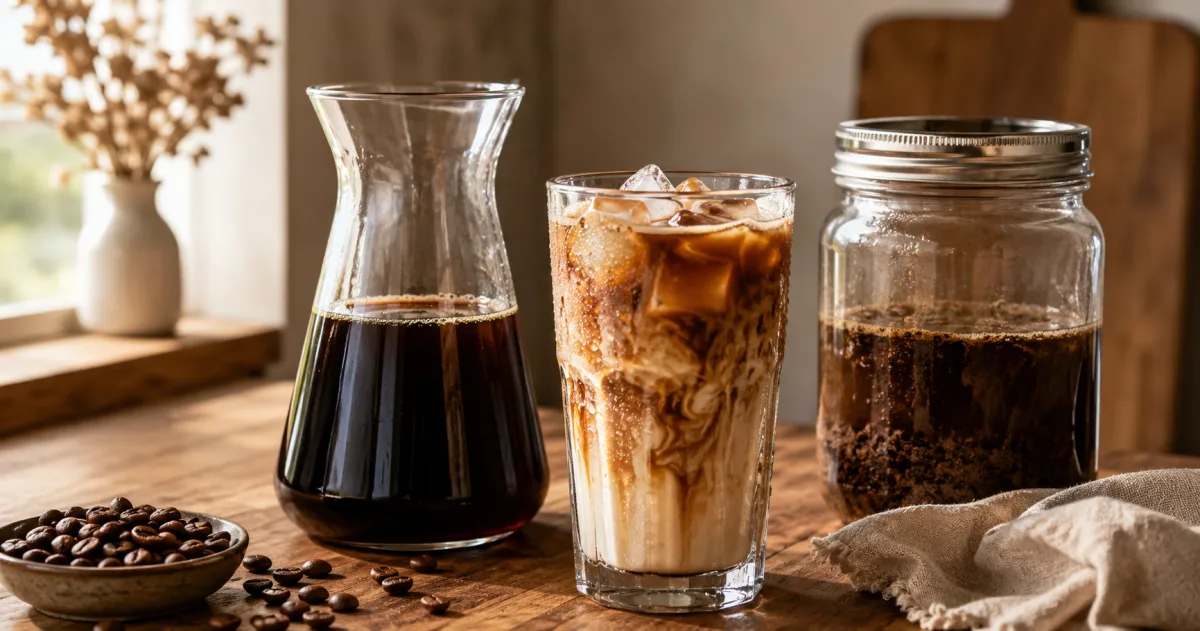
How to make cold brew concentrate: the 1:5 ratio, steep time, and exactly how to dilute it, plus storage, grind, troubleshooting, and brighter iced-coffee alternatives.
Cold brew concentrate is the easy way to keep iced coffee on hand all summer. The quick answer: use a 1:5 ratio, one gram of coffee for every five grams of water, steep it 12 to 24 hours in the fridge, then dilute it 1:1 or 1:2 to serve. This guide explains the ratios, steep time, and exact dilution math behind that, plus grind, storage, troubleshooting, and a few brighter iced-coffee methods worth trying. For the timed steps, use the Cold Brew Concentrate recipe.
What is cold brew concentrate?
Cold brew is coffee steeped in cool or room-temperature water for several hours rather than brewed with heat. Concentrate means you brew it strong, at a ratio meant to be watered down before drinking. It helps to keep three things separate:
- Cold brew concentrate: strong, made to dilute. A 1:5 ratio is a good default.
- Ready-to-drink cold brew: weaker, brewed close to drinking strength, around 1:10 to 1:12.
- Iced coffee: brewed hot, then chilled over ice. A different method with a brighter flavor, covered near the end of this guide.
Concentrate is the most flexible. You make one batch, then mix each glass to the strength you want with water, milk, or tonic.
The simple cold brew concentrate ratio
Start with 1 part coffee to 5 parts water, by weight. That is 100 g of coffee to 500 g of water for a standard batch. Scale it to the size you want:
| Batch | Coffee | Water | Makes |
|---|---|---|---|
| Small | 50 g | 250 g | a few glasses |
| Standard | 100 g | 500 g | a small pitcher |
| Large | 200 g | 1,000 g | a week of iced coffee |
A quick note on notation, because this is where cold brew gets confusing. Brew ratios are written coffee:water by weight, so 1:5 means 1 g of coffee per 5 g of water. Dilution ratios are written concentrate:water, so a 1:1 dilution is equal parts concentrate and water or milk.
Concentrate vs ready-to-drink ratios
The ratio sets how strong the concentrate is and how much you will dilute it.
| Ratio | What it is | Best for |
|---|---|---|
| 1:4 to 1:4.5 | Very strong concentrate | Milk drinks, a heavy body |
| 1:5 | Standard concentrate | The best default |
| 1:6 to 1:8 | Milder concentrate | Easier to drink black |
| 1:10 to 1:12 | Ready-to-drink | Usually no dilution |
These are common starting points across the industry. The National Coffee Association lists 1:4 to 1:5 as a quick cold brew range, and Counter Culture uses 1:8 as a standard that you dilute later, with 1:4.5 for a stronger brew and 1:11 for a ready-to-drink one. Pick a ratio by how you plan to drink it, then adjust to taste.
How long to steep
Steep time controls how much the coffee extracts. The practical range is 12 to 24 hours in the fridge, and a good default is 16 to 20 hours for most batches.
| Steep time | Result | When to use |
|---|---|---|
| 8 to 12 hr | Brighter, lighter | Lighter roasts, ready-to-drink |
| 12 to 18 hr | Balanced | Most home batches |
| 18 to 24 hr | Fuller, heavier | Concentrate for milk drinks |
| 24 hr and up | Often muddy or woody | Rarely worth it |
The last hours matter less than many recipes suggest. Research on cold brew has found that caffeine and chlorogenic acids extract largely within the first several hours (Scientific Reports, 2017), and roast level shapes the flavor more than a few extra hours of steeping. The takeaway: taste your brew rather than treating 24 hours as a magic number.
How to dilute cold brew concentrate
This is where most cold brew guides stop short. Dilution is what turns concentrate into a drink, so here is the math for a standard 240 g glass, about 8 ounces before ice.
| Strength | Concentrate | Water or milk | Ratio |
|---|---|---|---|
| Strong | 160 g | 80 g | 2:1 |
| Balanced | 120 g | 120 g | 1:1 |
| Lighter | 80 g | 160 g | 1:2 |
| Latte-style | 80 to 120 g | 120 to 180 g milk | to taste |
Two things to remember. Ice keeps diluting the drink as it melts, so a glass that tastes right at the first sip can taste thin ten minutes later. If you pour over a lot of ice, start a little stronger. Milk and sweeteners read as dilution too, so a latte-style drink usually wants more concentrate than a watered one.
Grind and filtering
Grind medium-coarse, a little coarser than you would for pour-over. Counter Culture suggests about a 7 on a 10-point coarseness scale. Too fine and the brew turns muddy and over-extracted, too coarse and it comes out weak and sour even after a long steep.
How you filter sets the body. A paper filter gives a clean, clear cup. Cloth, metal, or cheesecloth let more oils and fine particles through for a heavier, fuller texture. Neither is better, so choose by the cup you want. See grind size for more on dialing it in.
Fridge vs room temperature
You can steep cold brew on the counter or in the fridge. Room temperature extracts faster, so a counter steep reaches the same strength in less time, but it is harder to keep consistent and gives bacteria a warmer place to grow. The fridge is slower, cleaner, and more repeatable, which is why it is the better default at home. If you steep at room temperature, keep it shorter and move it to the fridge once it is strained.
How long cold brew concentrate lasts
Store the concentrate black, in a clean sealed container, in the fridge. It is best within about a week. Some equipment makers claim up to two weeks, though flavor fades and local food-safety guidance varies, so a week is the safe, good-tasting window. Keep it black until you serve it, and add milk, cream, sweeteners, or syrups only in the glass. Those additions shorten how long it keeps and taste better made fresh.
Troubleshooting
| Problem | Likely cause | First fix |
|---|---|---|
| Too weak | Ratio too low or steep too short | Use more coffee (toward 1:4) or steep longer |
| Too bitter | Over-extracted or ground too fine | Grind coarser, steep less, or dilute more |
| Too muddy | Fines, or grind too fine | Grind coarser, filter through paper |
| Too sour or flat | Under-extracted or steep too short | Steep longer, or grind a little finer |
| Too strong | Concentrate undiluted | Add more water or milk when serving |
| Too caffeinated | Concentrate is strong by nature | Dilute more, or use less per glass |
Change one variable at a time: ratio for strength, steep time for extraction, grind for clarity and body, dilution for the final glass. The bitter or dry and sour coffee guides go deeper on those faults.
If you like cold brew, try hot-brewed iced coffee
Cold brew is smooth, sweet, and easy to keep on hand, and it shines with milk. If you drink your coffee black, it is worth trying iced coffee brewed hot. The method is sometimes called Japanese-style iced coffee or flash brew: you brew hot coffee directly onto ice so it chills the instant it is made (Serious Eats). Hot water pulls out aromatic compounds that cold extraction leaves behind, and chilling fast locks them in, so the cup comes out brighter and more expressive of the coffee’s origin.
The trick is that the ice is part of your brew water. Replace roughly a third of the water with ice and brew the rest hot, at a slightly stronger ratio so the melt brings it to normal strength.
| Final drink | Coffee | Hot water | Ice |
|---|---|---|---|
| 250 g | 15 to 19 g | 150 to 165 g | 85 to 100 g |
| 500 g | 30 to 38 g | 300 to 330 g | 170 to 200 g |
When I am drinking coffee black, I usually prefer iced pour-over to cold brew. Cold brew is smooth and convenient, and iced pour-over brings out more of the citrus, florals, and stone fruit I look for in a good coffee. We will cover Japanese-style iced pour-over in its own guide soon.
My Clever Dripper iced coffee
My own iced-coffee default is a Clever Dripper immersion brew, inspired by James Hoffmann’s iced Clever method. For a half-litre to share, I grind 37.5 g of coffee a little finer than pour-over, brew it with 330 g of freshly boiled water, steep about five minutes, then drain it over 170 g of ice. That works out to 75 g of coffee per litre, about 1:13.3 once the ice melts. Because it is brewed hot and chilled at once, it keeps the aromatics of good filter coffee, and the immersion brewer makes it forgiving. It is an immersion brew rather than a pour-over, but it belongs to the same hot-brewed iced family. Try it with the Iced Clever Dripper recipe (or the single-cup version).
Do not want a concentrate? Hoffmann’s 2025 cold brew
In 2025, James Hoffmann published a cold brew method that skips concentrate on purpose. He brews at 75 g of coffee per litre, about 1:13.3, close to drinking strength, with a fine grind nearer a moka pot or AeroPress setting, steeps 12 hours in the fridge, then decants the clear liquid off the settled grounds instead of filtering. The result is a ready-to-drink cold brew with less waste per glass and no dilution math. You can follow it with the Hoffmann Cold Brew recipe.
The tradeoff is that it does not give you a concentrate to mix with water, milk, or tonic, so it solves a different problem from a 1:5 batch. His recipe also includes an optional advanced step: about ten drops of beverage finings to help the grounds settle for a cleaner pour. Finings are not needed for normal cold brew, and if you try them, use only products meant for food and drink and follow the package dose. Hoffmann’s ten drops adapt a beer product that is normally dosed for around 23 litres, so it is a coffee-specific tweak rather than standard use.
A finishing tip: saline for bitter iced coffee
A few drops of saline can rescue iced coffee that tastes bitter, harsh, or hollow. James Hoffmann popularized using a controlled 20 percent saline solution rather than a pinch of salt, because a measured few drops are easy to dose without making the coffee taste salty. In one example, about 0.3 g of that solution noticeably improved a low-quality instant coffee. The science holds up: sodium suppresses bitterness more than it touches sweetness, so a trace of salt makes the sweeter notes easier to taste (Breslin and Beauchamp, Nature).
Treat saline like seasoning. It helps when a cup is bitter, when a dark roast tastes roasty, or when a lot of ice has thinned the drink and exposed the bitterness. Skip it when the coffee is already sweet and clean, when it is sour or under-extracted (salt does not fix that, so adjust grind, ratio, or steep time instead), when you are tasting a new coffee honestly, or when you are watching your sodium. If you can taste the salt, you used too much.
Cold brew vs iced pour-over: which should you make?
| Choose cold brew if | Choose hot-brewed iced coffee if |
|---|---|
| You want a make-ahead batch | You want coffee in a few minutes |
| You like smooth, mellow, chocolatey flavors | You like bright, aromatic, origin-specific flavors |
| You drink it with milk | You drink it black |
| You want low perceived acidity | You want more tasting-note clarity |
| You want easy dilution control | You enjoy brewing fresh each time |
One note on acidity: a sensory study found that, matched to the same strength and serving temperature, people rated cold brew as less sour and less bitter than hot-brewed immersion coffee (Foods, 2022). Tasting less sour is not the same as being lower in acidity by measurement, so think of it as a difference in how the cup comes across.
Track it in BeanBench
Cold brew is forgiving, but small changes in ratio, steep, and dilution add up, so it pays to write them down. Brew with the Cold Brew Concentrate recipe, then log the ratio, steep time, grind, dilution, and tasting notes in BeanBench. After a couple of batches you will have your own summer default, and a record of how to change it.
From here, read up on grind size and extraction, or browse the full recipe list.
Frequently asked questions
What is cold brew concentrate?
Cold brew made at a strong ratio, meant to be diluted before drinking. A 1:5 ratio (1 g of coffee to 5 g of water) is a good default. You steep it 12 to 24 hours in the fridge, then water it down 1:1 or 1:2 to serve.
What is the best ratio for cold brew concentrate?
1:5 by weight is a reliable default. Use 1:4 to 1:4.5 for a stronger concentrate aimed at milk drinks, or 1:6 to 1:8 for a milder one that is easier to drink black. For ready-to-drink cold brew with no dilution, go around 1:10 to 1:12.
Is 1:4 or 1:5 better for cold brew?
1:5 is the easier default and still strong enough to dilute. 1:4 makes a heavier, more intense concentrate that suits milk drinks and stands up to lots of ice. Both work, so pick by how you will serve it.
How much should I dilute cold brew concentrate?
Start with 1:1, equal parts concentrate and water or milk. Use 2:1 (more concentrate) for a stronger glass, or 1:2 for a lighter one. Remember that ice keeps diluting the drink as it melts.
How long should cold brew concentrate steep?
12 to 24 hours in the fridge, with 16 to 20 hours a good default. Caffeine and much of the flavor extract in the first several hours, so longer steeps add less than people expect. Taste and adjust.
Should cold brew steep in the fridge or on the counter?
The fridge is the better default: slower but cleaner and more repeatable, with less risk of spoilage. Room temperature extracts faster, so if you steep on the counter, keep it shorter and refrigerate once strained.
Can you drink cold brew concentrate without diluting it?
You can, but it will be very strong and high in caffeine. Concentrate is made to be watered down. If you want to drink it straight, brew a weaker ready-to-drink ratio around 1:10 to 1:12 instead.
How long does cold brew concentrate last in the fridge?
Keep it black and sealed, and it is best within about a week. Add milk or sweeteners only when you serve it, since those shorten how long it keeps.
Is cold brew stronger than regular coffee?
Concentrate is much stronger before dilution, in both flavor and caffeine. Once you dilute it to drinking strength, a glass is similar to other coffees. The caffeine depends on how much concentrate you use, not on the cold brewing itself.
What grind size should I use for cold brew?
Medium-coarse, a little coarser than pour-over. Too fine makes it muddy and bitter, too coarse makes it weak and sour. Adjust from there based on your filter and taste.