The Coffee World Cup: Ranking the 2026 World Cup Field by Coffee
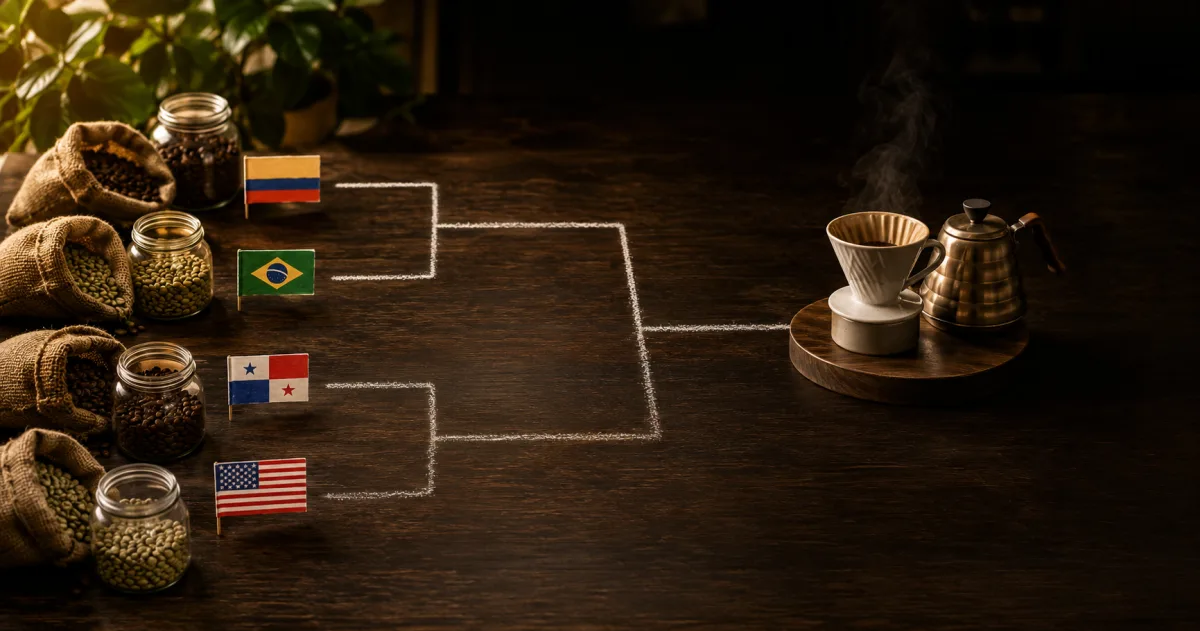
A bracket that ranks every 2026 World Cup country by coffee: growing, roasting, and peak cup. Colombia wins our balanced mode, Panama runs the Cinderella story.
The 2026 World Cup final is Argentina against Spain this Sunday, played across a tournament hosted by the United States, Canada, and Mexico. Neither finalist would make it out of the group stage in a bracket judged on coffee. So here is that other bracket.
The rules are simple. Take all 48 countries that qualified for 2026 and rank them by how they grow, roast, and drink coffee, then run a tournament. This guide walks through the scoring, the top seeds, and the champion. You can also run the bracket yourself and change what counts, which changes who wins.
How we scored each country
Every country carries four scores from 0 to 100.
| Category | What it rewards | Weight in Balanced mode |
|---|---|---|
| Origin pedigree | Real growing: production, terroir, traceable lots | 35% |
| Specialty ceiling | Peak cup: Gesha, Chiroso, SL varieties, Cup of Excellence lots | 25% |
| Roasting and cafe reputation | Roasters, baristas, competitions, brew culture | 25% |
| Narrative | Upset potential, surprise, the “I want to try that” factor | 15% |
Production volume only seeds the field here. If tonnage decided everything, Brazil would win before the first whistle. The interactive bracket ships with four modes that move these weights around:
- Balanced spreads the weight across all four categories.
- Origin Purist puts 60% on growing reputation.
- Roaster Snob puts 60% on roasting and cafe culture.
- Chaos puts story and peak cup first and treats production as a footnote.
Who actually made the field
Before the bracket, a caveat that shapes everything: some of the best coffee countries on earth did not qualify. Ethiopia, the birthplace of Arabica, is out. So are Kenya, Guatemala, Vietnam, Indonesia, and Costa Rica. A World Cup of coffee with Ethiopia and Kenya in it looks very different, and probably ends with one of them lifting the trophy.
They stayed home, so this bracket ranks who made the field. That clears a real path for the countries that did qualify and can actually grow: Colombia, Brazil, Panama, Mexico, Ecuador, and the Democratic Republic of the Congo.
The top seeds
Four countries separate from the pack in Balanced mode.
Colombia. The third-largest producer in the world, forecast at 13.4 million 60-kilogram bags for the 2026/27 crop, up 7.2% on better weather. Colombia has the rare full package: scale, a national coffee brand casual drinkers already know, washed-Arabica clarity, regional range from Huila to Nariño, and rising specialty varieties like Chiroso. It is the best all-around team in the field.
Brazil. The production giant, growing about 35% of the world’s coffee (63.0 of a record 178.8 million bags in the 2025/26 marketing year, per USDA FAS). Brazil brings Arabica and robusta breadth and an increasingly serious specialty scene. Its one weakness in a specialty-fan bracket is the perception that big can mean commodity, which makes it a great favorite to root for or against.
Panama. Tiny by volume, with a tournament-winning special move. World Coffee Research rates Panamanian Gesha’s quality potential as exceptional when it is grown and managed well at high altitude. Best of Panama auctions keep proving the point: a washed Gesha from Hacienda La Esmeralda sold for $13,705 per pound in 2025. Panama has the highest ceiling of anyone here.
United States. A minor green-coffee origin outside Hawaii and Puerto Rico, but the best roasting, cafe, equipment, and competition ecosystem in the field. This is the team with a loaded bench and questionable terroir. It wins any bracket that weights the cup over the farm.
Origin powers and roasting powers
The field splits into two kinds of coffee country, and the bracket mode decides which kind wins.
On the origin side, Mexico is a top-ten exporter with washed Arabica from Chiapas, Oaxaca, and Veracruz and a fast-improving specialty scene. Ecuador is a smaller rising origin worth seeking out, and the Democratic Republic of the Congo grows some of the most exciting washed Arabica in Africa on the hills above Lake Kivu. Cote d’Ivoire is one of Africa’s larger robusta producers, the backbone of a lot of everyday blends.
On the roasting side, Japan belongs near the top for pour-over precision and kissaten history, even though it grows almost nothing. Norway is the home of Nordic light roasting; Oslo’s Tim Wendelboe topped Roastful’s 2024 ranking of specialty roasters. Australia has won four World Barista Championships, more than any other country, on the strength of its cafe culture. Sweden, the Netherlands, Switzerland, and England round out a deep bench of roasting nations.
A few countries carry pure story. Haiti was once among the world’s biggest coffee exporters and still has heirloom Typica in its mountains. Saudi Arabia grows UNESCO-recognized Khawlani coffee in the Jazan highlands. Cape Verde grows a little prized coffee on the volcanic slopes of Fogo. Turkiye gave the world an entire brewing method. None of them will win, but they are the reason the early rounds are fun.
The bracket
Balanced mode seeds the top 16 and lets the higher score win each round. The four number-one seeds hold serve into the Final Four:
| Seed | Country | Balanced score |
|---|---|---|
| 1 | Colombia | 79.5 |
| 2 | Brazil | 78.5 |
| 3 | Panama | 77.2 |
| 4 | Mexico | 59.3 |
| 5 | United States | 53.5 |
| 6 | Ecuador | 49.3 |
| 7 | DR Congo | 48.4 |
| 8 | Australia | 47.9 |
The gap between the top three and everyone else is the whole story of the bracket: Colombia, Brazil, and Panama are in a different weight class from the rest of the field once Ethiopia and Kenya are out. Mexico grabbing the four seed, ahead of the United States, is the mode rewarding a country that both grows and roasts.
Switch modes and the bracket reshuffles. Origin Purist hands the top seed to Brazil. Roaster Snob sends the United States, Norway, Australia, and Japan to the Final Four and drops the growing nations down the board. Chaos crowns Panama outright. The interactive version redraws all of it as you change what you care about.
The champion is Colombia
Brazil is the statistical favorite. Colombia is the editorial one, and for a specialty-coffee audience that is the more interesting answer.
Colombia wins the balanced final because it does everything well. It has the scale to matter, the national identity that a casual reader already pictures, the washed-Arabica clarity that defines approachable specialty coffee, the regional diversity to keep it interesting, and enough specialty innovation to satisfy the nerds. Brazil wins the volume argument and Panama wins the single best cup, but Colombia wins the whole coffee, which is what this bracket is really scoring.
Panama earns the Cinderella run. In Chaos mode, where peak cup and story outweigh production, its Gesha beats everyone. That is the Panama story: it will never out-produce Brazil, but on its best day it pours the best cup at the table.
Run the bracket yourself
The Coffee World Cup bracket lets you pick the mode, watch the champion change, and see which countries you should drink next based on who won. A Colombia result points you toward a washed Huila or Nariño lot. A Panama result sends you down the Gesha rabbit hole. A Roaster Snob run points you at whoever your favorite local roaster is importing this week.
Track it in BeanBench
The best way to settle a coffee argument is to drink your way through it. Get your bracket champion, then buy a bag from that country and log it in BeanBench: the origin, process, variety, roaster, and what you actually tasted. Do that for Colombia, Brazil, and Panama and you will have your own answer, backed by cups rather than weights on a spreadsheet.
From here, learn what those origin labels mean in coffee varieties and processing methods, read up on Nordic-style coffee for the roasting side of the bracket, or pick a recipe to brew your champion.
Frequently asked questions
Which country has the best coffee in the 2026 World Cup?
It depends on what you value. If you weigh growing, peak cup, roasting, and story evenly, Colombia comes out on top thanks to scale, washed-Arabica clarity, and specialty depth. If you only count green-coffee production, Brazil wins. If you only count roasting and cafe culture, the United States and the Nordic countries lead. If you chase the single highest cup on earth, Panama and its Gesha win.
Why does Colombia beat Brazil in the coffee bracket?
Brazil is the bigger producer and the statistical favorite, growing about 35% of the world's coffee. Colombia wins the balanced version of this bracket because it pairs large scale with a clear national identity: high-grown washed Arabica, a producer network readers already recognize, and rising specialty varieties like Chiroso. Brazil takes the title in Origin Purist mode, where raw production matters most.
Which strong coffee countries did not qualify for the 2026 World Cup?
Several origin heavyweights missed the field, including Ethiopia, Kenya, Guatemala, Vietnam, Indonesia, and Costa Rica. The bracket can only rank countries that qualified, which clears an easier path for Colombia, Brazil, and Panama.
Is Panama coffee really that good?
Panama grows very little coffee by volume, but its Gesha (also spelled Geisha) is among the most sought-after coffee in the world. World Coffee Research rates the variety's quality potential as exceptional at high altitude, and a washed Gesha from Hacienda La Esmeralda sold for $13,705 per pound at the 2025 Best of Panama auction.
Which country has won the most World Barista Championships?
Australia, with four titles. Denmark and the United Kingdom have three each, and the United States and Norway have two each. That is one reason cafe-culture countries dominate the bracket's Roaster Snob mode even without growing much coffee.
Which World Cup countries actually grow coffee?
Colombia, Brazil, Panama, Mexico, Ecuador, and the Democratic Republic of the Congo are the meaningful Arabica growers in the field. Cote d'Ivoire is a large robusta producer, and Ghana, Haiti, Cape Verde, and Saudi Arabia grow smaller amounts. Most of the rest are roasting or cafe countries rather than origins.
How is the coffee bracket scored?
Each country gets a 0 to 100 score on four dimensions: origin pedigree, specialty ceiling, roasting and cafe reputation, and narrative. A mode weights those four, the top 16 seed into a single-elimination bracket, and the higher score wins each matchup. The football qualification is real; the coffee scores are one opinionated take.