The Fermentation Project Tasting Kit: One Coffee, Four Fermentations
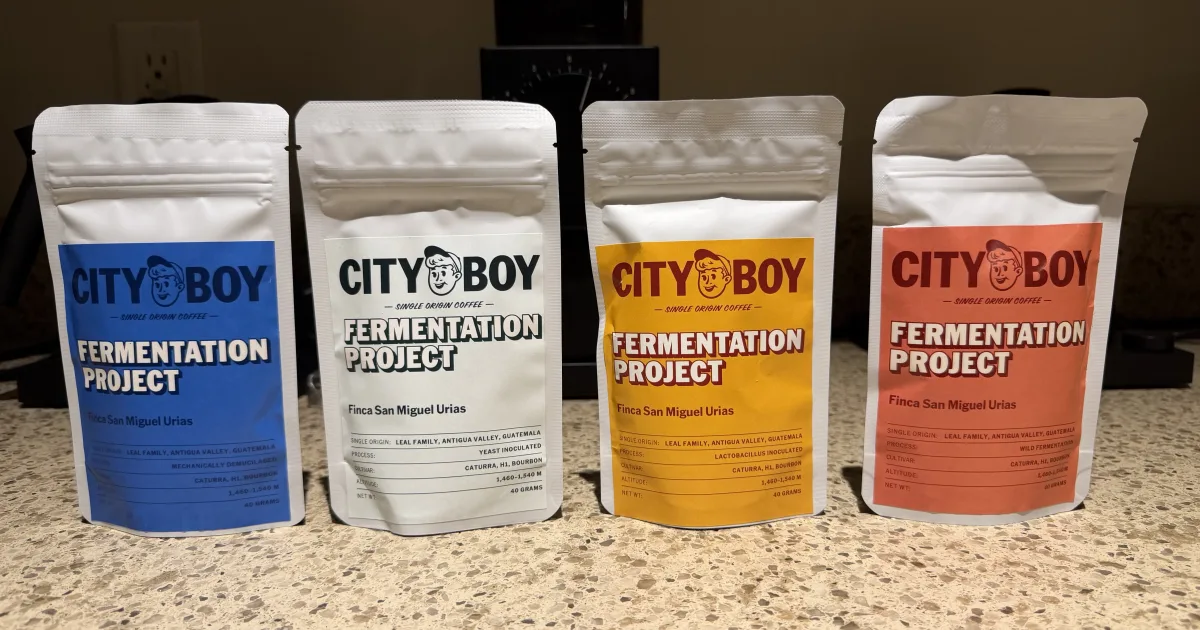
What is in the City Boy Coffee kit for James Hoffmann and Lucia Solis's Fermentation Project, which bag is which, and how to taste the four side by side.
Four 40 g bags from City Boy Coffee arrived this week. Same coffee in all four. They are my kit for the Fermentation Project, a worldwide tasting run by James Hoffmann and fermentation consultant Lucia Solis, in which one lot from a farm in Antigua, Guatemala was split four ways at the wet mill before anything else happened to it. Each portion was processed differently, and everything after that was kept the same. Hoffmann hosts the live tasting on his YouTube channel on Saturday, October 3, and I will be tasting along at home. I have no connection to the project beyond buying a kit.
This page covers what is in the kit, which bag is which, and how I plan to taste them. I will add my results after the livestream.
What is in the kit
| Detail | |
|---|---|
| Farm | Finca San Miguel Urias, operated by Rueda Farms |
| Producers | Hector and Lilian Leal |
| Region | Antigua Valley, between Ciudad Vieja and San Miguel Dueñas |
| Altitude | 1,460–1,540 masl |
| Varieties | about 85% Caturra, 15% H1, a small amount of Bourbon |
| Roaster | City Boy Coffee, Long Island City, New York |
| Format | four 40 g bags, whole bean, light roast |
| Price | $24 (City Boy lists a green price of $7.00/lb) |
The details come from City Boy’s product page, which also says the kit is sized for “sixteen cups of comparison”: the live event plus three more sessions on your own.
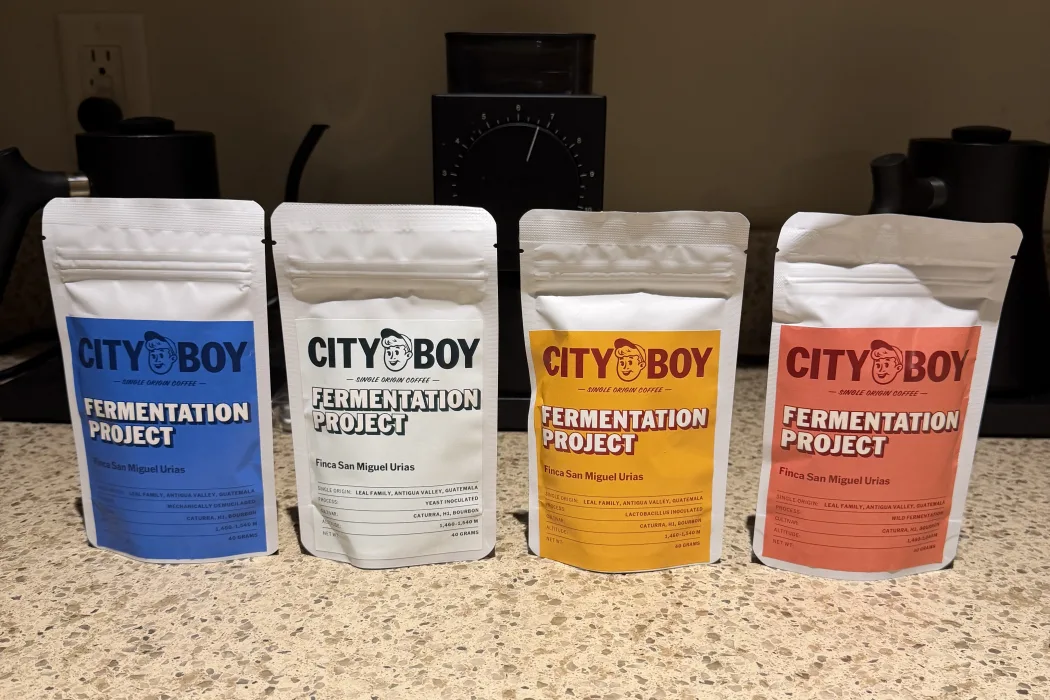
Left to right: demucilaged, yeast, Lactobacillus, wild.
Which bag is which
The label color is the only visual difference, and the process is printed in small type on each label. The descriptions below are from the Fermentation Project site.
| Bag | Process | What was done |
|---|---|---|
| Blue | Mechanically demucilaged | Mucilage removed by machine, with no fermentation. This is the control. |
| White | Yeast inoculated | 48 hours with an added Saccharomyces yeast, meant to increase flavor precursors |
| Yellow | Lactobacillus inoculated | 48 hours with added Lactobacillus, meant to increase organic acids |
| Orange | Wild fermentation | 48 hours with only the microbes already on the fruit, the traditional method most coffees go through |
Hoffmann and Solis filmed the processing in Guatemala, and our coffee fermentation guide covers what the yeasts and bacteria do inside the tank. In this kit, the demucilaged bag shows what this coffee tastes like with fermentation taken out, and the other three show what each kind of fermentation added.
How I am tasting it
I am cupping it instead of brewing pour-over. With four cups on the table made the same way, the only thing that changes from cup to cup is the coffee, and that is the whole point of this kit. Our home cupping guide has the full method. The numbers I am using:
| Parameter | Setting |
|---|---|
| Coffee per cup | 10 g |
| Water per cup | 160 g (1:16) |
| Water temperature | about 93 °C (200 °F) |
| Grind | medium-coarse, the same setting for all four |
| Steep | 4:00, then break the crust and skim |
| First taste | 8–10 minutes in, then again as it cools |
The 10 g dose works out neatly: each 40 g bag covers the livestream plus three more sessions, which is how City Boy sized the kit. If you want a guided timer, the SCA Cupping Protocol recipe runs the same steep and crust break.
Grind each coffee separately and purge the grinder between them with a few beans of the next coffee. A gram of the wild ferment left in the burrs can blur the control.
Taste blind if you can
The bag colors give away which cup is which, and knowing that the yellow cup is the Lactobacillus lot makes it easy to taste acidity you expect to find. Ask someone to pour the four coffees into cups marked on the bottom, shuffle them, and not tell you which is which until you have written your notes.
If you are tasting alone, put a numbered sticky note under each cup before you shuffle them, and do not turn the cups over until every cup has a note.
What to listen for
Taste the control first, then compare each of the others to it. Questions I will be asking:
- Is one cup noticeably brighter or more sour than the control?
- Does one smell more fruity or floral before you taste it?
- Does any cup taste boozy, vinegary, or funky?
- Do any two cups taste the same to you? That is a result too.
I have not tasted these yet, so I am not going to guess at flavor notes here.
My prediction
I expect the Lactobacillus bag to taste the most different from the control. Its stated purpose is to push organic acids, and acidity is the easiest change for me to pick out on a cupping table. I will report back.
Results
This section will be updated after the October 3 tasting.
Log it in BeanBench
Four cups of the same coffee are hard to keep straight from memory a week later. In BeanBench you can log each bag as its own coffee, record a check-in with dose, grind setting and notes for each session, and see how your impressions change across the four tastings the kit is sized for.
Sources
- The Fermentation Project, James Hoffmann and Lucia Solis
- Pre-order: Fermentation Project, City Boy Coffee
- James Hoffmann on YouTube, where the live tasting streams
Frequently asked questions
What is the Fermentation Project?
A worldwide tasting from James Hoffmann and fermentation consultant Lucia Solis. One lot of coffee from Finca San Miguel Urias in Guatemala was split four ways at the wet mill and processed differently: mechanically demucilaged with no fermentation, wild fermentation, Lactobacillus inoculated, and yeast inoculated. Roasters around the world bought the green coffee as a set of four and roasted it for a shared live tasting.
When is the Fermentation Project live tasting?
Saturday, October 3, 2026, as a livestream on James Hoffmann's YouTube channel. Anyone with a kit can taste along at home.
Which bag in the City Boy kit is the control?
The blue bag, labeled mechanically demucilaged. Its mucilage was removed by machine instead of by fermentation, so it is the baseline to compare the other three against. White is yeast inoculated, yellow is Lactobacillus inoculated, and orange is wild fermentation.
How should I brew the Fermentation Project kit?
Cupping is the easiest way to compare them: 10 g of coffee to 160 g of water at about 93 °C, steeped for four minutes, the same for all four cups. Each 40 g bag then covers four tastings. Our home cupping guide walks through it step by step.
Can I still buy the Fermentation Project kit from City Boy Coffee?
City Boy's listing was sold out as of September 30, 2026. Other roasters bought sets of the same green coffee, so check the project site for who else roasted it.