The Best Specialty Coffee Books for Home Brewers
Three coffee books I have read cover to cover, what each one is actually good at, which to buy first, and whether the World Atlas third edition is worth the upgrade.
Most lists of the best coffee books cover ten or twelve titles, which is more books than the person writing the list has usually read. This one covers three. They are the three on my shelf, I bought them, and I have read each one cover to cover. At the end I name the books I would buy next, and I say plainly that I have not read them.
The short version
- The World Atlas of Coffee if you want to understand where coffee comes from and why it tastes the way it does.
- How to Make the Best Coffee at Home if you want your next brew to be better.
- Craft Coffee: A Manual if you learn best from a structured written curriculum and you brew filter.
The rest of this article is why, and which one to buy first.
The three books compared
| Book | What it teaches | Reader level | Actionable | Main weakness |
|---|---|---|---|---|
| The World Atlas of Coffee | Origins, varieties, processing, trade, plus a brewing primer | Any | Low | The brewing sections date faster than the geography |
| How to Make the Best Coffee at Home | Equipment, grinding, technique across every common method | Beginner to intermediate | High | Broad rather than deep; you outgrow it |
| Craft Coffee: A Manual | Filter brewing across ten devices, with vocabulary and mechanics | Beginner | High | Filter only, and its 2017 gear advice has aged |
The World Atlas of Coffee
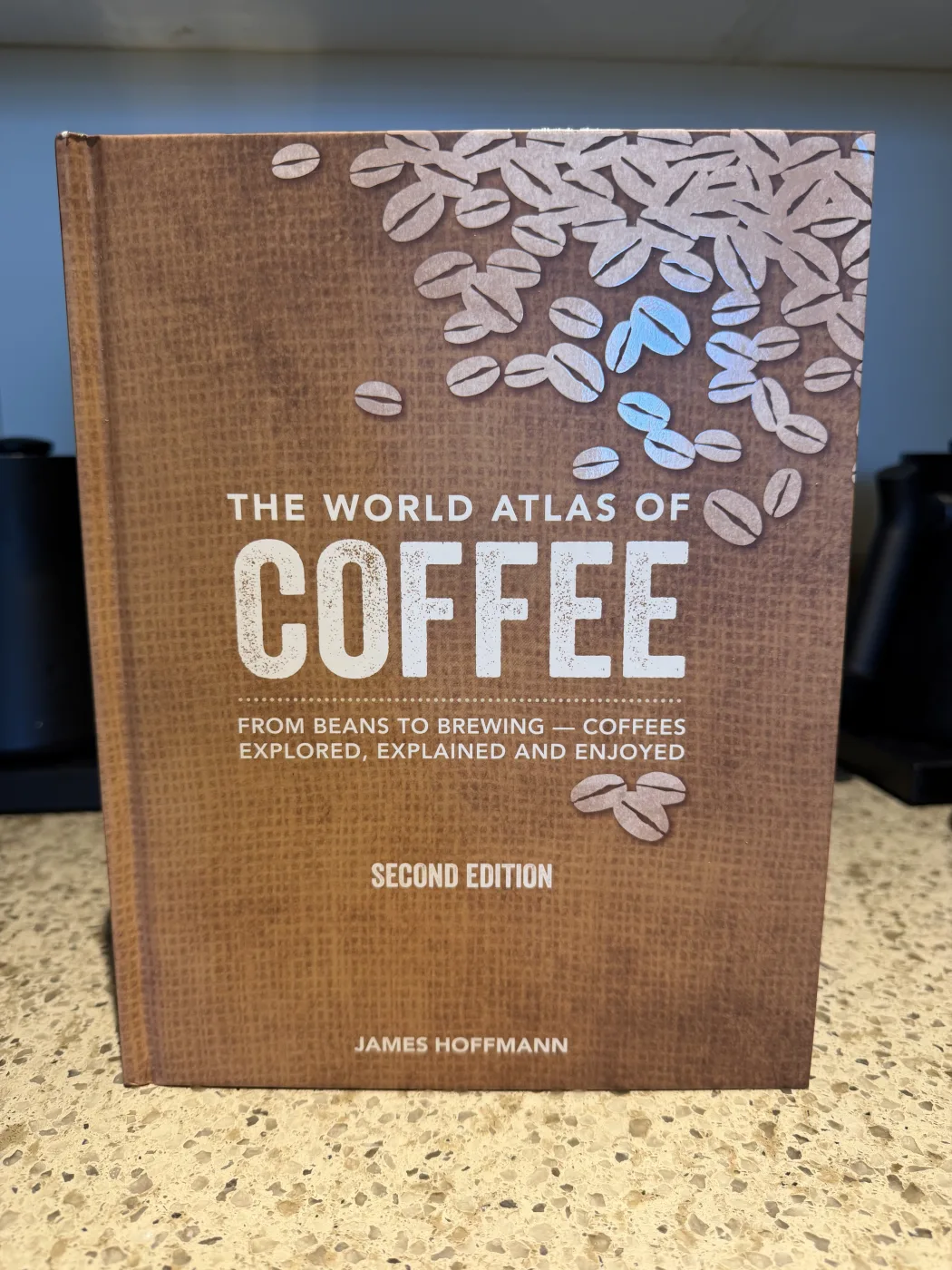
The Atlas is the book I go back to most. It is also the one I would hand to someone who likes coffee but has never thought about where it comes from. Roughly the first third covers the plant, varieties, processing, and trade. The rest is a country-by-country tour.
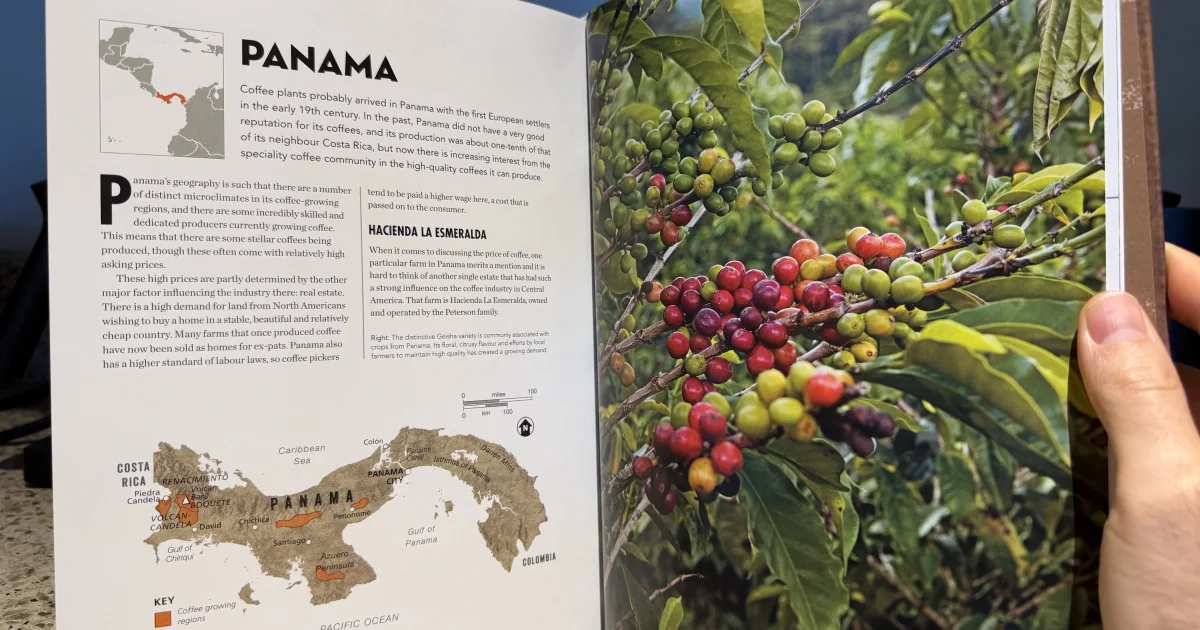
The country pages are what make it work. The photo at the top of this article is the Panama spread from my copy. It carries a map with the growing regions marked, a short history of how coffee arrived, a note on why Panamanian coffee costs what it does, and a paragraph on Hacienda La Esmeralda. Read it, and the next Panamanian Gesha on a shelf means more than its price tag.
I picked up that habit during lockdown. Travel was off the table, so I did it through the bag instead. I would order coffee from a region I had never been to, find it on the Atlas map, and read the country pages while I drank it. I know how that sounds. It was the most interesting part of a lot of flat weeks, and I still do it years later. A bag turns up from somewhere new and the book comes off the shelf. The origin line stopped being decoration a long time ago.
It has two limits. The brewing chapter is the part most likely to feel dated, because equipment and technique move faster than agricultural history. And the country profiles generalize by necessity. “Ethiopian coffee” covers enormous genetic and geographic range, so the regional flavor descriptions work as orientation rather than as a prediction about the bag in front of you.
Second edition or third
My copy is the second edition, from 2018. A third edition arrived on 9 October 2025. The publisher lists over 35 countries, new chapters on decaffeination and steep and release brewers, and Australia, Japan and Puerto Rico among the added origins.
If you are buying your first copy, buy the third. If you already own the second, the upgrade is worth it when you care about origin coverage. It is a weak reason to upgrade if what you actually want is better brewing instruction, because the book below does that job better.
How to Make the Best Coffee at Home
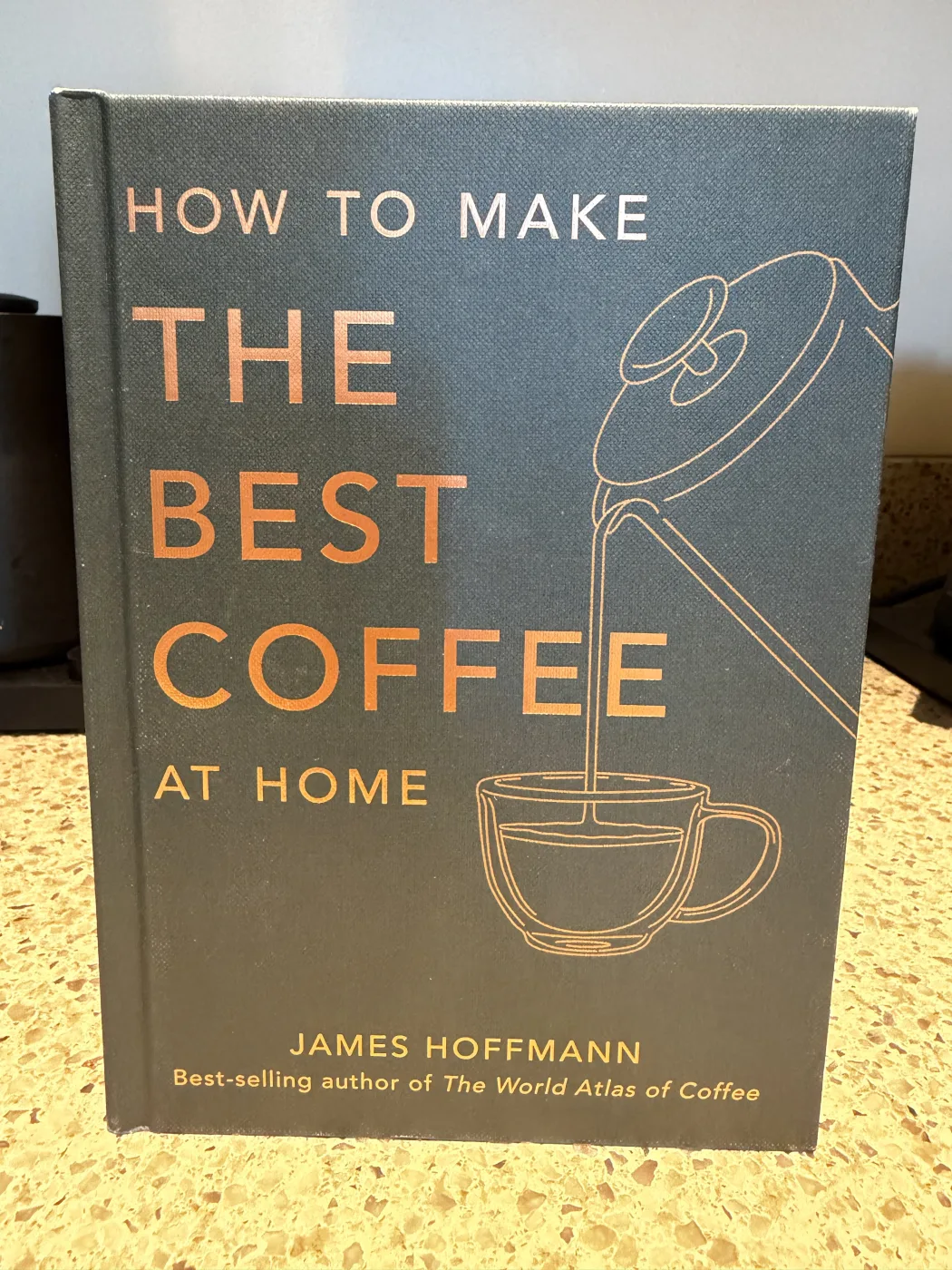
This is the most useful of the three if you measure usefulness by how much your coffee improves. It came out in 2022 and covers equipment, grinding, water, the major brewing methods, espresso, and milk drinks.
What Hoffmann does well here is rank the variables. Coffee advice tends to present every choice as equally critical. A beginner ends up believing kettle geometry matters as much as buying fresh coffee. It does not. Fresh beans, a grinder that grinds consistently, reasonable water, an accurate dose, and a recipe you repeat will carry you most of the way. The book is clear about which purchases earn their attention, and comfortable telling you when something does not matter much.
It is broad rather than deep, which is the trade. Get interested in flow dynamics, particle distributions, or water chemistry and you will finish it wanting more. The recipes drift too, since Hoffmann keeps revising his own methods on video. The principles hold up better than the numbers, so treat the recipes as starting points.
This is the book I would give a new home brewer.
Craft Coffee: A Manual
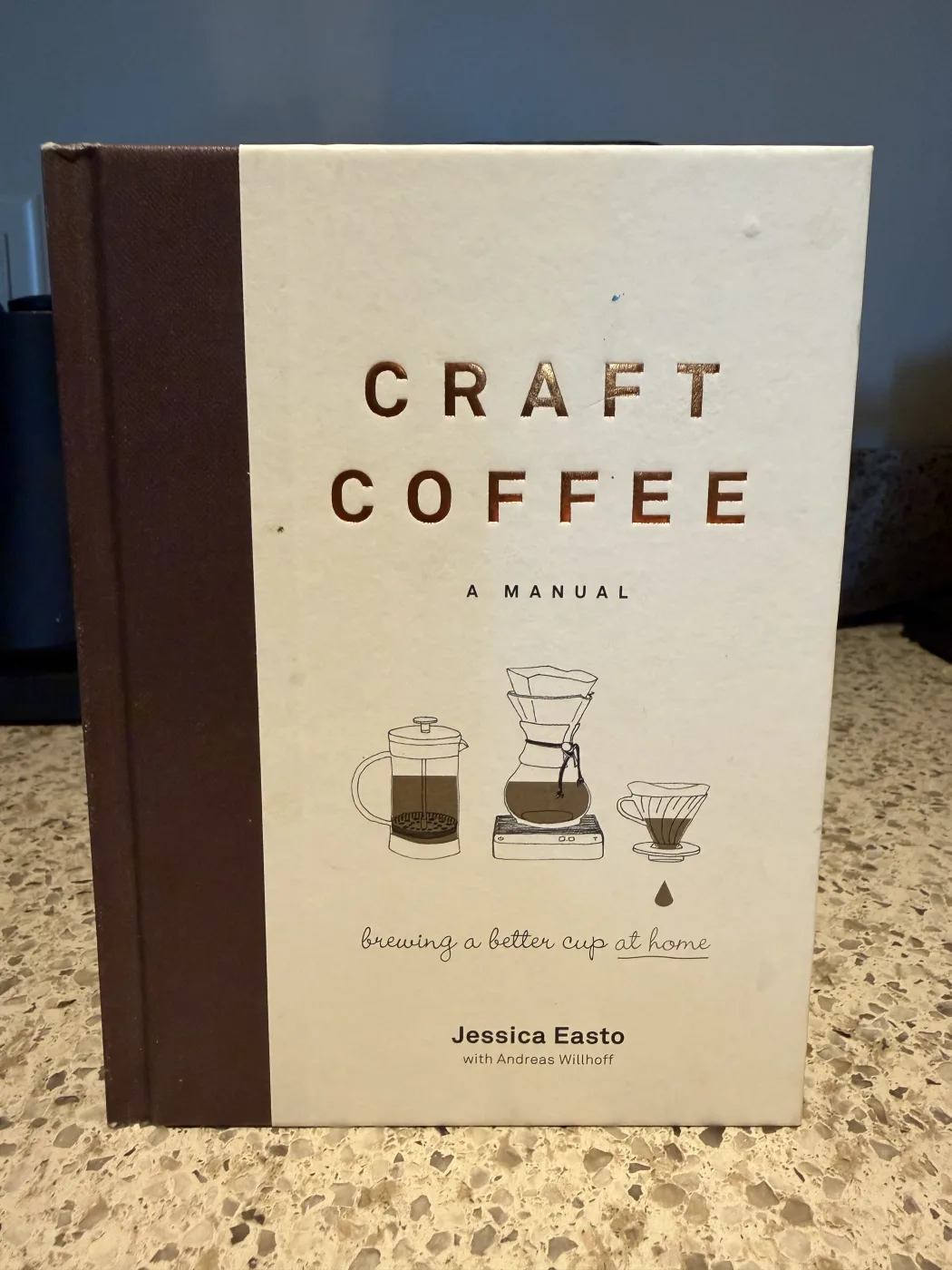
Jessica Easto’s 2017 manual, written with Andreas Willhoff, is the most methodical of the three. It teaches filter brewing across ten devices and builds up the vocabulary and the mechanics without assuming you already speak specialty coffee. If you like a textbook that starts at the beginning and proceeds in order, this is that book.
Its best idea is that you are trying to find out what you like rather than converge on one correct cup. I keep the book for that framing. A brew log is only worth keeping if it connects a deliberate change to your own taste, and Easto teaches that habit directly.
Be clear on the scope: this is a filter book by design and it excludes espresso. Some of the 2017 equipment thinking has also aged, particularly around grinders and agitation.
Most people do not need both this and Hoffmann’s home brewing book. They cover similar ground and Hoffmann’s is newer and shorter. Buying both mostly buys you a second teaching style, which is worth it to some readers and not to others.
Which one to buy first
Buy How to Make the Best Coffee at Home first if you already drink good coffee and want to make it better. It is the fastest path from reading to a better cup.
Buy The World Atlas of Coffee first if the thing you want is understanding. It is also the better gift of the two, and the better book for someone who drinks coffee out rather than brewing it.
Buy Craft Coffee first only if you know you prefer working through a structured manual and you brew filter.
A reasonable path is Hoffmann’s home guide, then the Atlas, then one of the technical books below once you are already controlling dose, grind, ratio, and temperature.
What I have not read
These are the books I would buy next. I have not read them, so treat what follows as my reasoning about where to go, and not as a review.
- The Physics of Filter Coffee, Jonathan Gagné, published by Scott Rao in 2020 and often catalogued as 2021. I will buy it next. Gagné’s filter analysis is the most careful measurement work I have leaned on, and I cited it in the Sibarist filters piece. The appeal is understanding why a brew stalls or channels instead of memorizing a fix.
- The Physics of Espresso, Jonathan Gagné, published August 2025. Same approach, applied to espresso.
- Water for Coffee, Maxwell Colonna-Dashwood and Christopher H. Hendon. A second edition shipped in 2025. One caution first. The popular story that magnesium brings out fruit while calcium adds body is less settled than it is usually sold, and our water guide covers that evidence. Water is worth understanding. The mineral folklore deserves more skepticism than it gets.
- The Coffee Dictionary, Maxwell Colonna-Dashwood, 2017, with a 2025 reissue. An A to Z reference for the terms that turn up on bags and menus. A shelf book rather than a read.
- The Monk of Mokha, Dave Eggers, 2018, and Uncommon Grounds, Mark Pendergrast, most recently revised in 2019. The first is narrative nonfiction about Mokhtar Alkhanshali and Yemeni coffee. The second is the broad history. Neither will improve your brewing.
If you are a roaster, Scott Rao’s Coffee Roaster’s Companion (2014) and Coffee Roasting Best Practices (2020) are the standard pair, foundations then advanced. Roasting knowledge will not improve your V60 the way a better grinder does, so buy them for the job rather than for general interest.
Track it in BeanBench
Reading changes what you pay attention to, and attention fades unless you write it down. After a brewing book, set one baseline recipe and change a single variable at a time. After the Atlas, tag your coffees by country, region, process, and variety. Then check whether your ratings match the preferences you think you hold. Mine did not, and finding that out was worth more than the reading was.
In BeanBench you can log every brew with the coffee, dose, grind, water, time, and your own notes and rating, so the reading turns into evidence about your own taste. From here, read processing methods and coffee varieties for what the Atlas covers, how to cup coffee at home for tasting two coffees side by side, or choosing a brewer before you spend on gear.
Frequently asked questions
What is the best coffee book for a beginner?
How to Make the Best Coffee at Home by James Hoffmann. It is short, current, and organized around the decisions that change your cup most, so it improves your next brew rather than your general knowledge. Buy The World Atlas of Coffee second if you want to understand where the coffee came from.
Is the World Atlas of Coffee third edition worth upgrading to?
If you care about origins, yes. The third edition arrived in October 2025 and the publisher lists over 35 countries, new chapters on decaffeination and steep and release brewers, and Australia, Japan and Puerto Rico as added origins. If you own the second edition and mainly want better brewing instruction, skip it and buy How to Make the Best Coffee at Home instead.
Do you need both of James Hoffmann's books?
They do different jobs, so owning both is reasonable. The World Atlas explains where coffee comes from and why it tastes the way it does. How to Make the Best Coffee at Home explains what to do about it on your counter. If you only buy one, pick based on which question you are actually asking.
Is Craft Coffee: A Manual good for espresso?
No. It is a filter book by design and says so, covering pour-over, immersion, and cold brew across ten devices. Espresso is out of scope. Look elsewhere if espresso is your main brew method.
Do you need Craft Coffee if you already own Hoffmann's home brewing book?
Probably not. They overlap heavily and Hoffmann's is newer. Craft Coffee is the more methodical, workbook-style read, so it suits people who prefer structured written instruction. Owning both mostly buys you a second teaching style.
What is the best coffee book about water?
Water for Coffee by Maxwell Colonna-Dashwood and Christopher H. Hendon is the standard reference, and a second edition shipped in 2025. Read our own water guide first, since the popular story about magnesium and calcium is less settled than it is usually presented.
Which coffee book should I read if I do not brew at home?
The World Atlas of Coffee. It works as a book you browse rather than follow, and the country profiles make the information on a cafe menu or a bag of beans much easier to read.