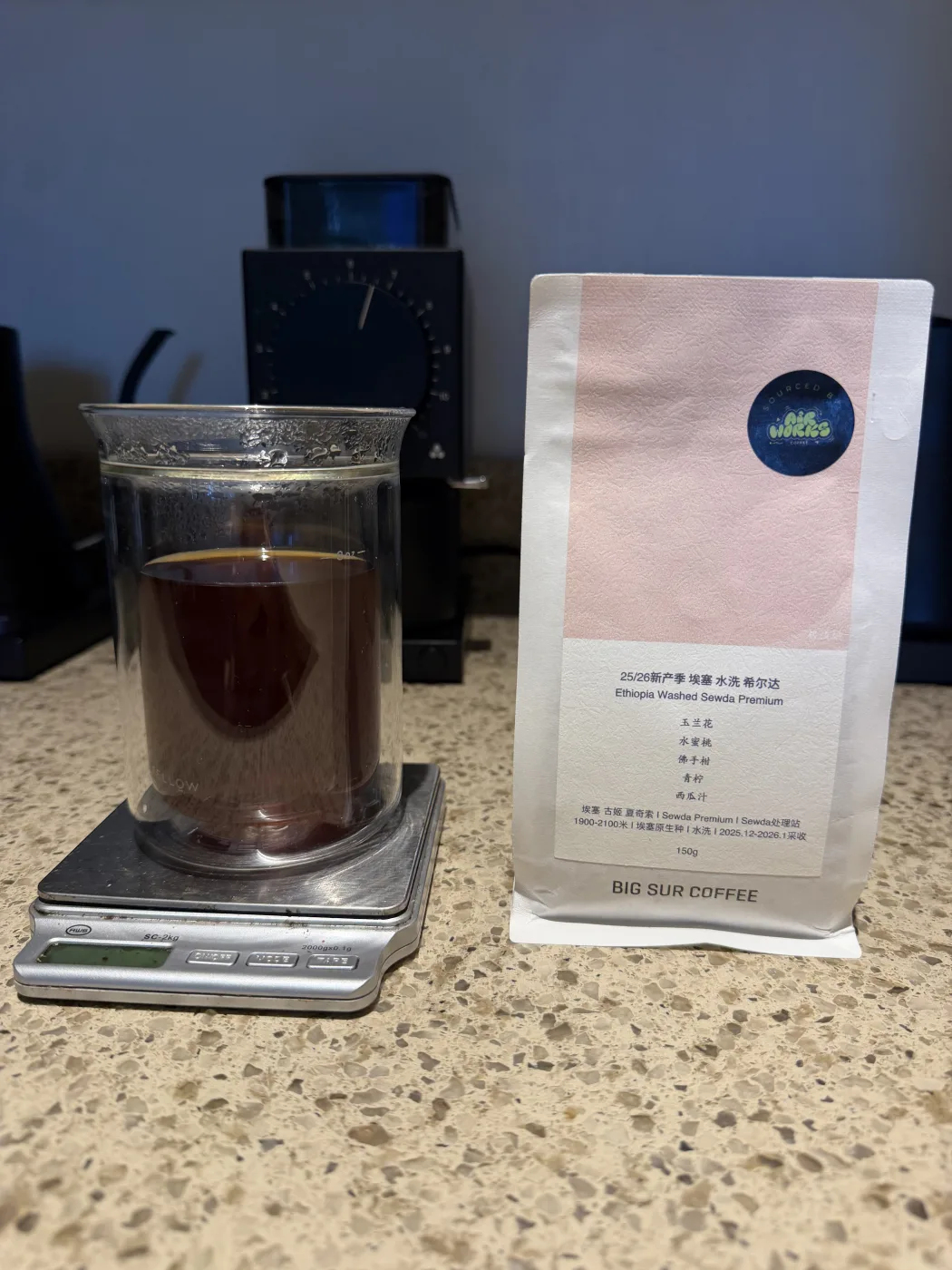
A washed lot from a Guji station its other buyers know for naturals, roasted in Shanghai by Big Sur. Four of the five notes on the bag turned up in the cup.
In the cup
The bag prints five flavor notes and I found four. Peach and florals came up first and together, the way they do in a clean washed Ethiopian. Lime was underneath it, as plain citrus acidity.
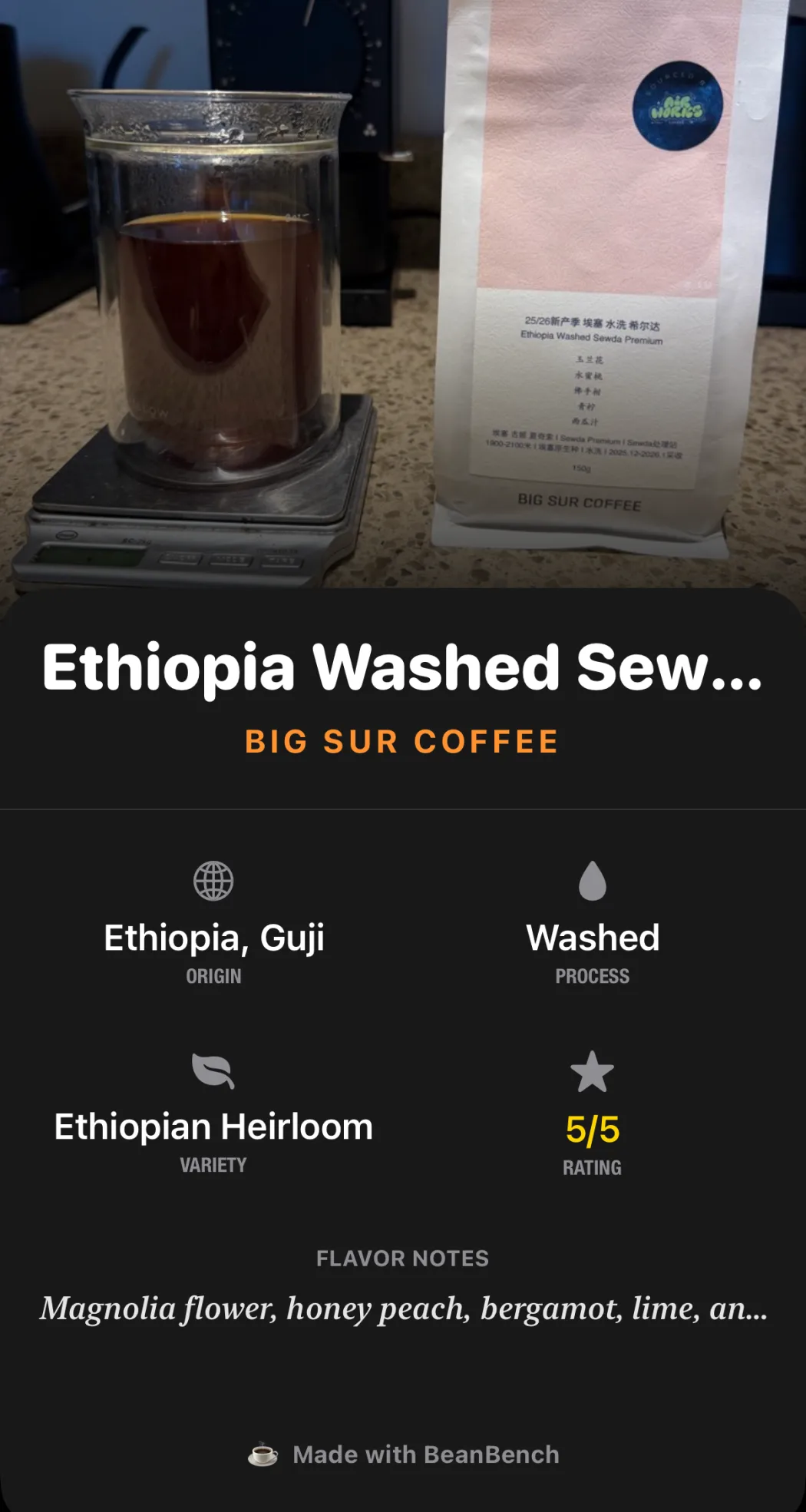
Five stars in the log. I have gone back to it enough times since the first brew to trust the rating.
The coffee
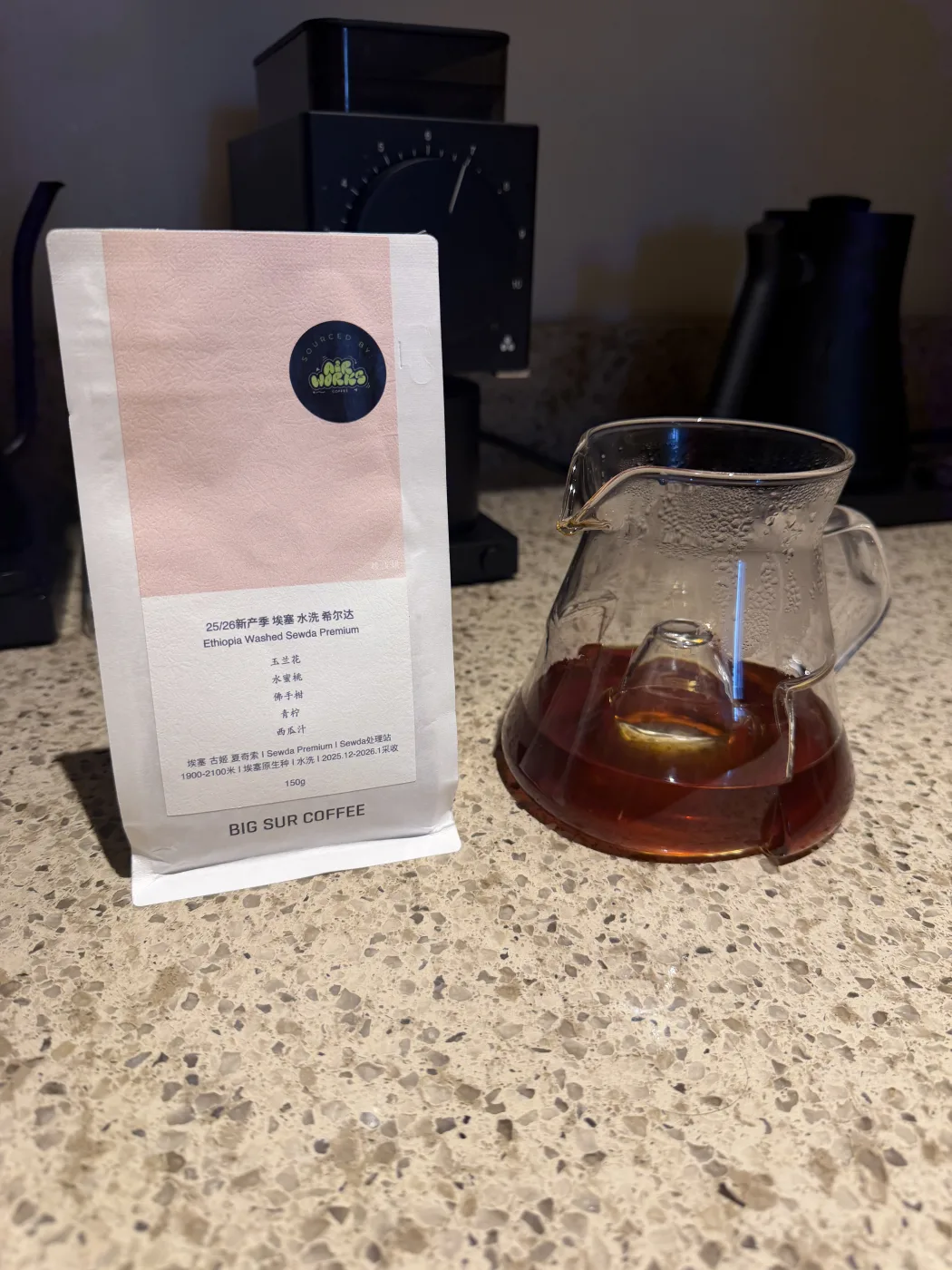
Sewda is a washing station in Benti Korba, a village in the Oddo Shakisso woreda of Guji. Big Sur prints the essentials on the bag and repeats them on its product page: 1,900 to 2,100 metres, Ethiopian heirloom, washed, harvested December 2025 into January 2026, 150 grams to a bag.
The card in the box adds the line that matters. “During our 2026 origin trip to Ethiopia, Testi prepared a cupping session of 28 outstanding washed coffees. In the blind selection process, Sewda once again stood out and was selected for our 2026 harvest lineup.”
Testi Coffee is the company Faysel Abdosh Yonis has run since he began exporting in 2009, which makes this the second Testi coffee in two weeks. The triple fermentation came from a brand new station in Hambela Wamena named after him. This one comes from an established mill three woredas over. Both bags arrived in the same Airworks order, at the same price, and both ended up at five stars, which is a strange way to learn that a company can be good at two opposite things.
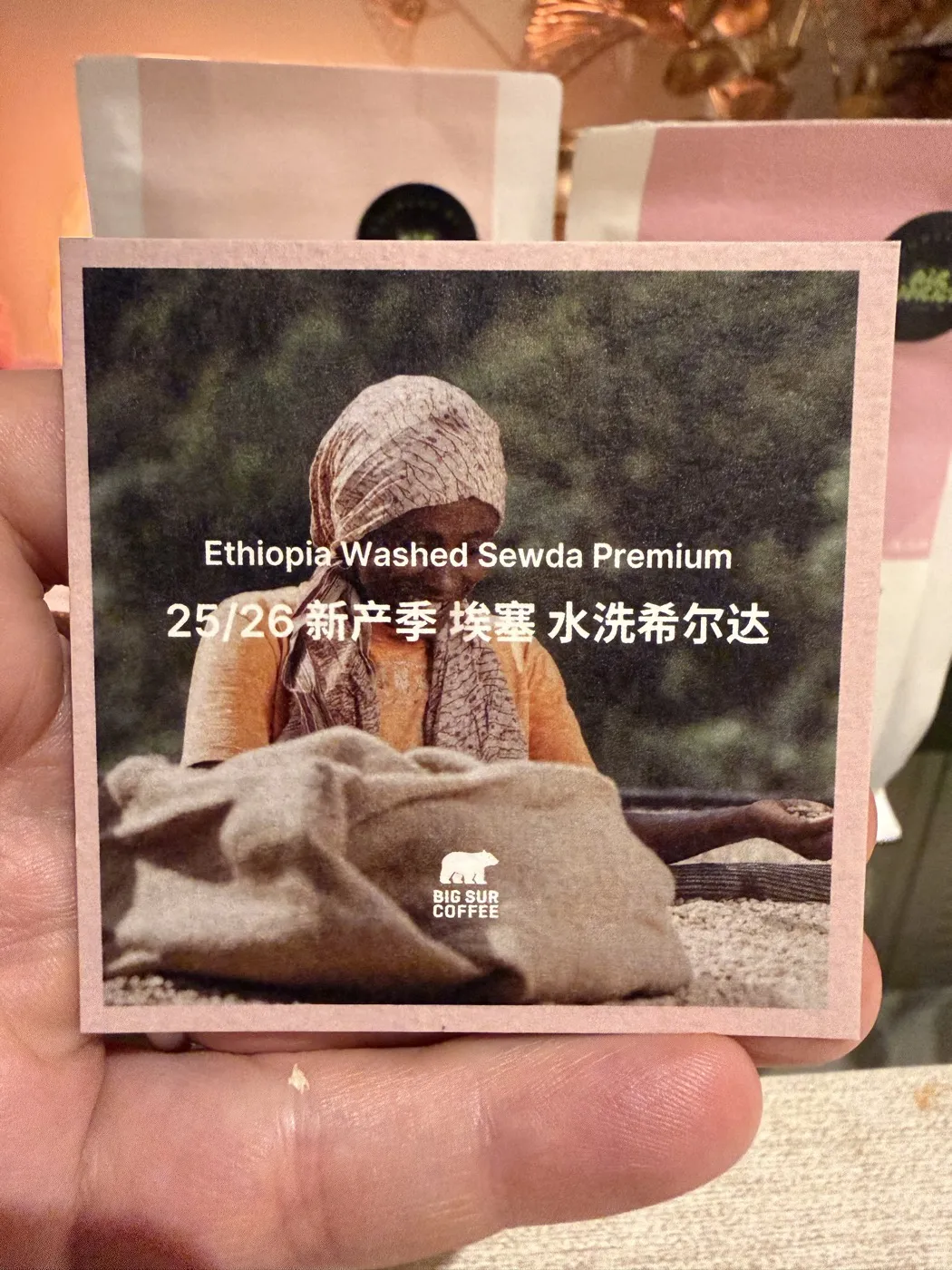
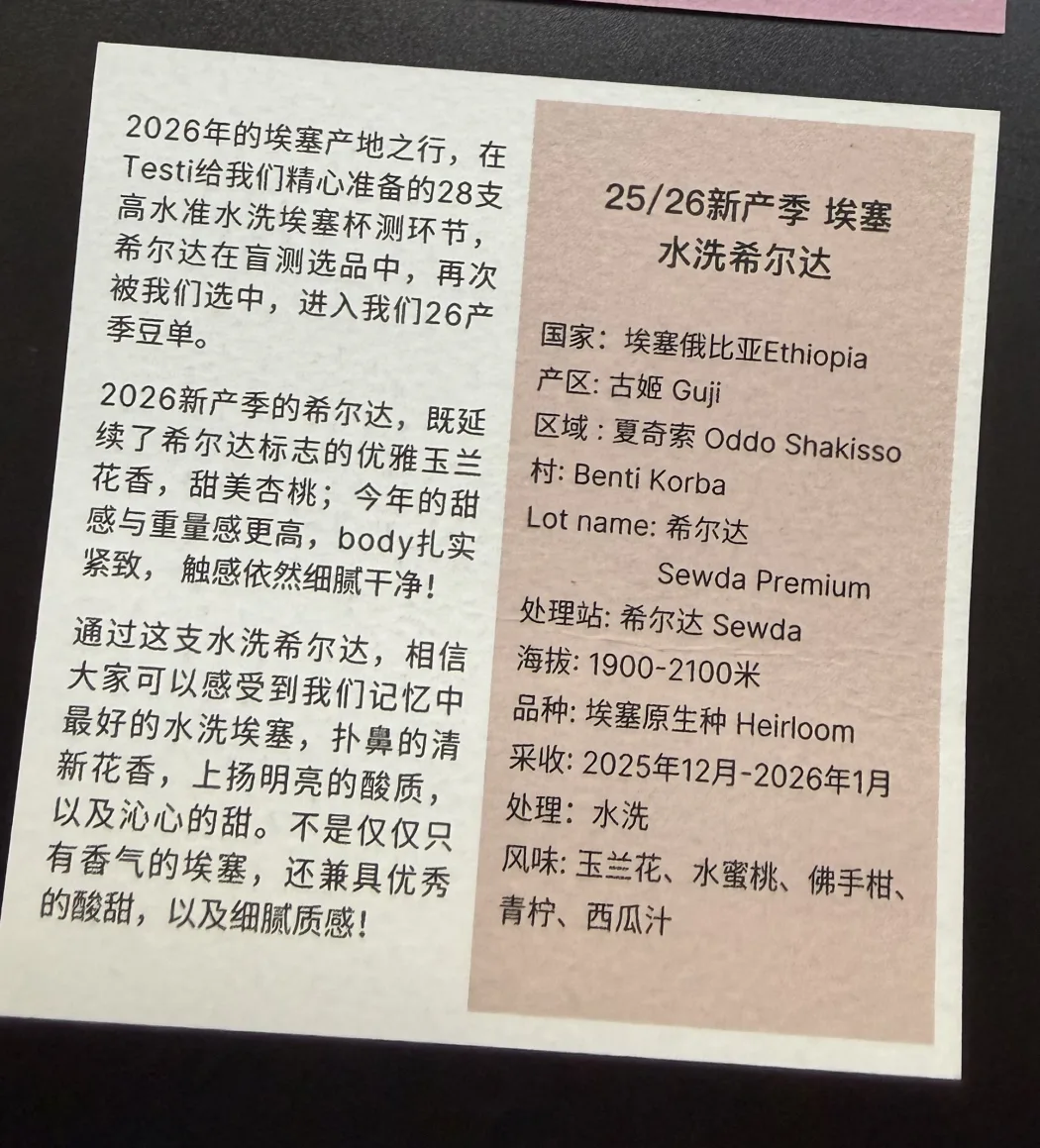
The card that came in the bag, front and back. The lot name, 希尔达, is Big Sur’s transliteration of Sewda.
The route ran Testi in Guji, Big Sur in Shanghai, and Airworks in Seattle, who buy finished roasted bags from international roasters and fly them in. I covered how that works in the Faysel Abdosh write-up and at more length in the Seattle pour-over meetup piece.
What Sewda usually makes
Every other roaster I can find selling Sewda is selling a natural. Offshoot in Australia and Mountain Air in Asheville both list it anaerobic natural. Coffee Kilimanjaro in Italy lists it natural. Bear Lake publishes a transparency report for a Sewda natural that quotes the station’s own documentation: “Sewda was set up to process and dry naturals (fruit-dried) coffees.”
So a washed Sewda cuts against what the mill is known for, and it is worth saying carefully what that does and does not mean. Mills add processing lines all the time. Big Sur’s own card puts 28 washed coffees on Testi’s cupping table, so the washed program is real and it is not small. The unusual part is how rarely the washed version travels. The only other I can find on Airworks is a Sewda Washed from the Chinese roaster Nai Zui at $20 a bag, also sold out.
The published numbers around the station disagree too. Bear Lake counts 500 small producers delivering to Sewda and puts the altitude at 1,850 to 2,100. Coffee Kilimanjaro counts 350 members, 140 women and 210 men. Big Sur says 1,900 to 2,100. Three buyers, one mill, three answers. That spread is the ordinary condition of Ethiopian origin information rather than evidence that any of them is careless.
Washed is the category built to get out of the way. Fruit comes off before drying, the mucilage ferments and rinses away, and what reaches the cup is supposed to come from the seed. Our guide to processing methods covers where that sits among the rest, and coffee fermentation covers what the tanks actually change. A station built for naturals is built around the opposite instinct: leave the fruit on and let it dry into the seed. Sewda does both, and this bag is the quiet one.
Two smaller things on the label. The variety line reads Ethiopian heirloom, a placeholder covering a large number of research-station selections alongside genuine landraces, which the last Big Sur pick went into at length and our guide to coffee varieties maps out. And Airworks’ listing at the time called this lot G1, the top ECX export grade, which by the usual trade description allows at most three full defects per 300 grams in a washed coffee. Big Sur’s own page and the bag print no grade at all.
How I brewed it
A V60 on our house recipe: 16 g of coffee to 256 g of water, 1:16, at 96 °C, ground at 6⅔ on a Fellow Ode Gen 2. Total time 3:34, with 1:44 of that in drawdown.
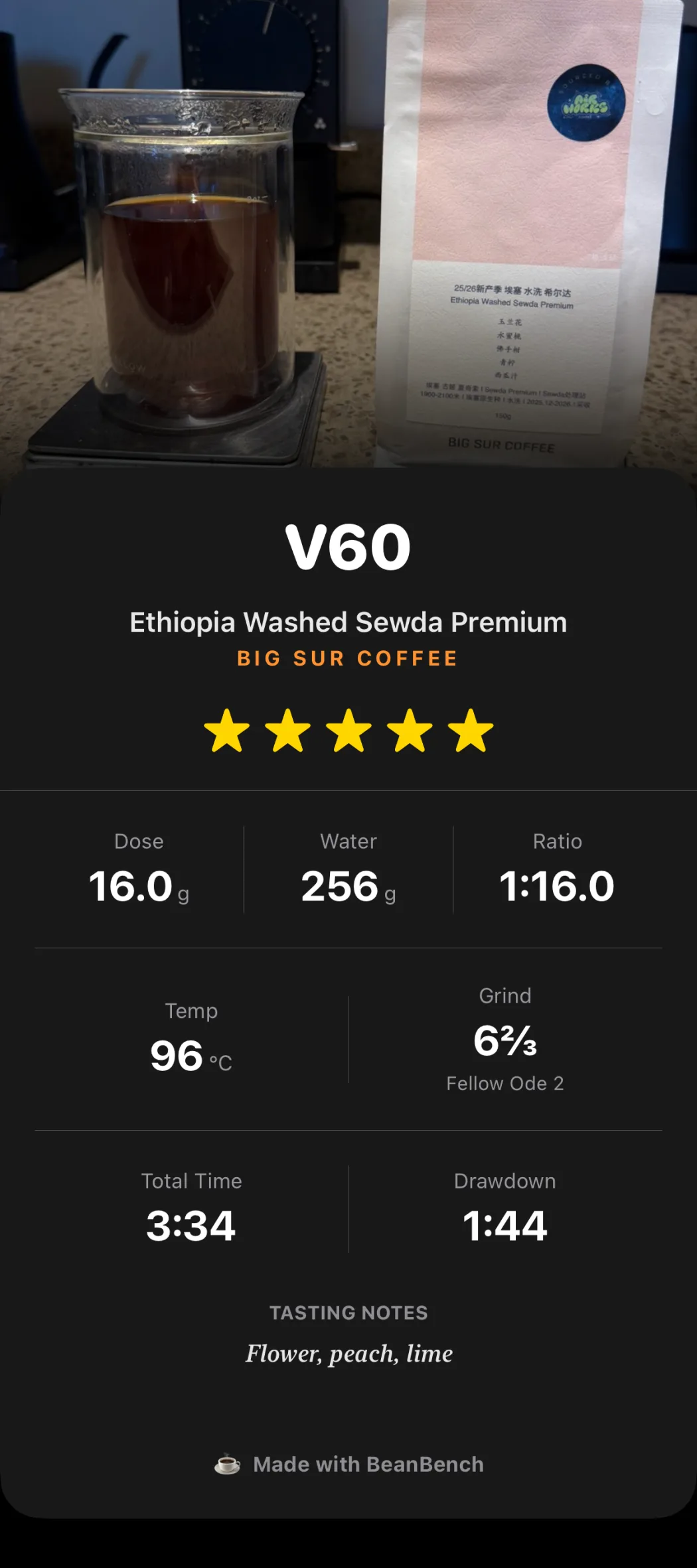
The Faysel Abdosh ran 2:26 total with a 36-second drawdown at the same number on the same grinder. Sixty-eight extra seconds of drawdown between two Guji coffees from one roaster is a wide gap, and the freezer is the most likely reason.
This bag was roasted on 24 June. I rested it about four weeks, froze it, and ground it straight from frozen on 20 August. That is the routine our resting guide recommends, and it carries the reason: Uman et al. (2016) found that colder beans fracture into a narrower particle size distribution at a smaller mean size. So 6⅔ off frozen is a finer grind than 6⅔ at room temperature, and a finer bed drains slower. Coming off frozen, expect to open the grinder up a step to land the drawdown you had before. Our resting guide does not currently say that part.
Two brews prove nothing on their own. These two coffees differ in roast and in density as well as in temperature at the burrs. The direction still fits.
Nominally the bag was 57 days off roast when I brewed it. In practice it was closer to four weeks of aging, because a freezer holds the clock where it is.
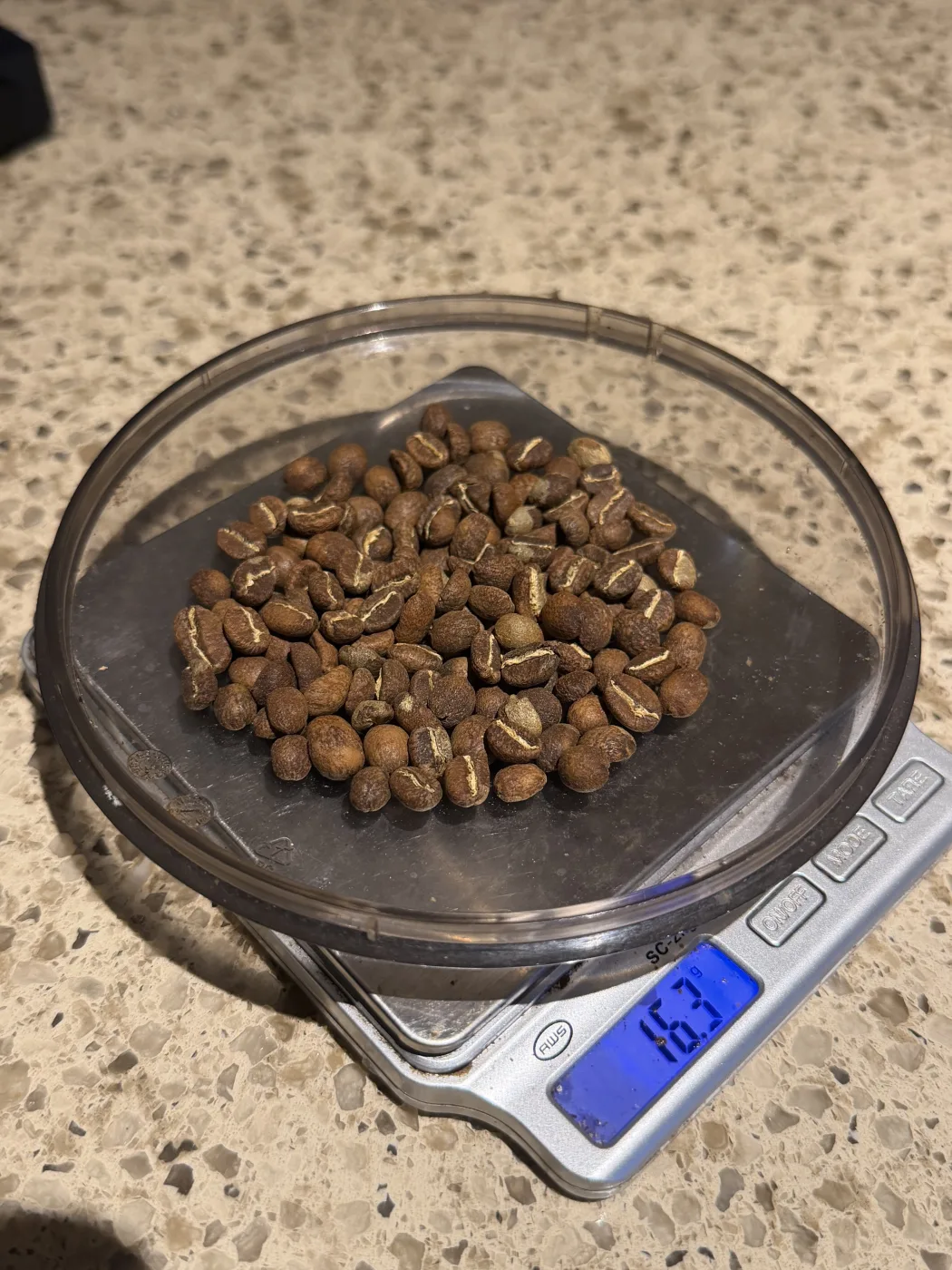
Big Sur prints no roast level on this bag, which the last one did. The beans read light on sight: pale tan, with silverskin still sitting in the center cut.
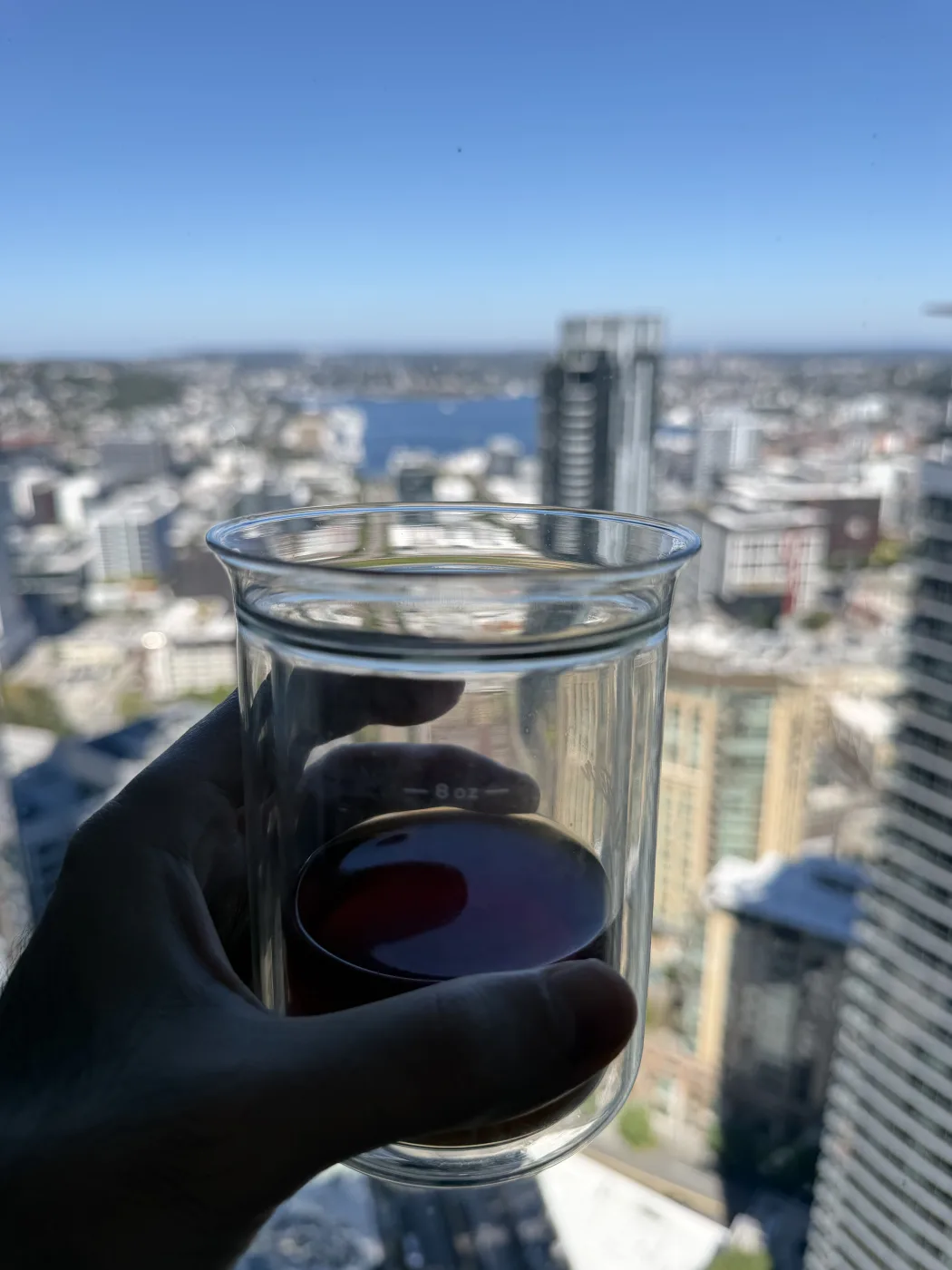
The second brew went into an Avensi Wave Cyclone from Icosa Brewhouse, which is a story for its own post once I have more than two brews through it.
What it cost
Airworks sold it at $26.50 for 150 g, about $177 a kilo, the same price the triple fermentation carried in the same order; that listing is gone now. Big Sur lists this coffee on its own site at $15 for the same bag. The gap is the flight and the paperwork. Both are sold out now, which is the usual state of things by the time I finish drinking a bag.
Big Sur and Airworks are both on our Favorites page.