
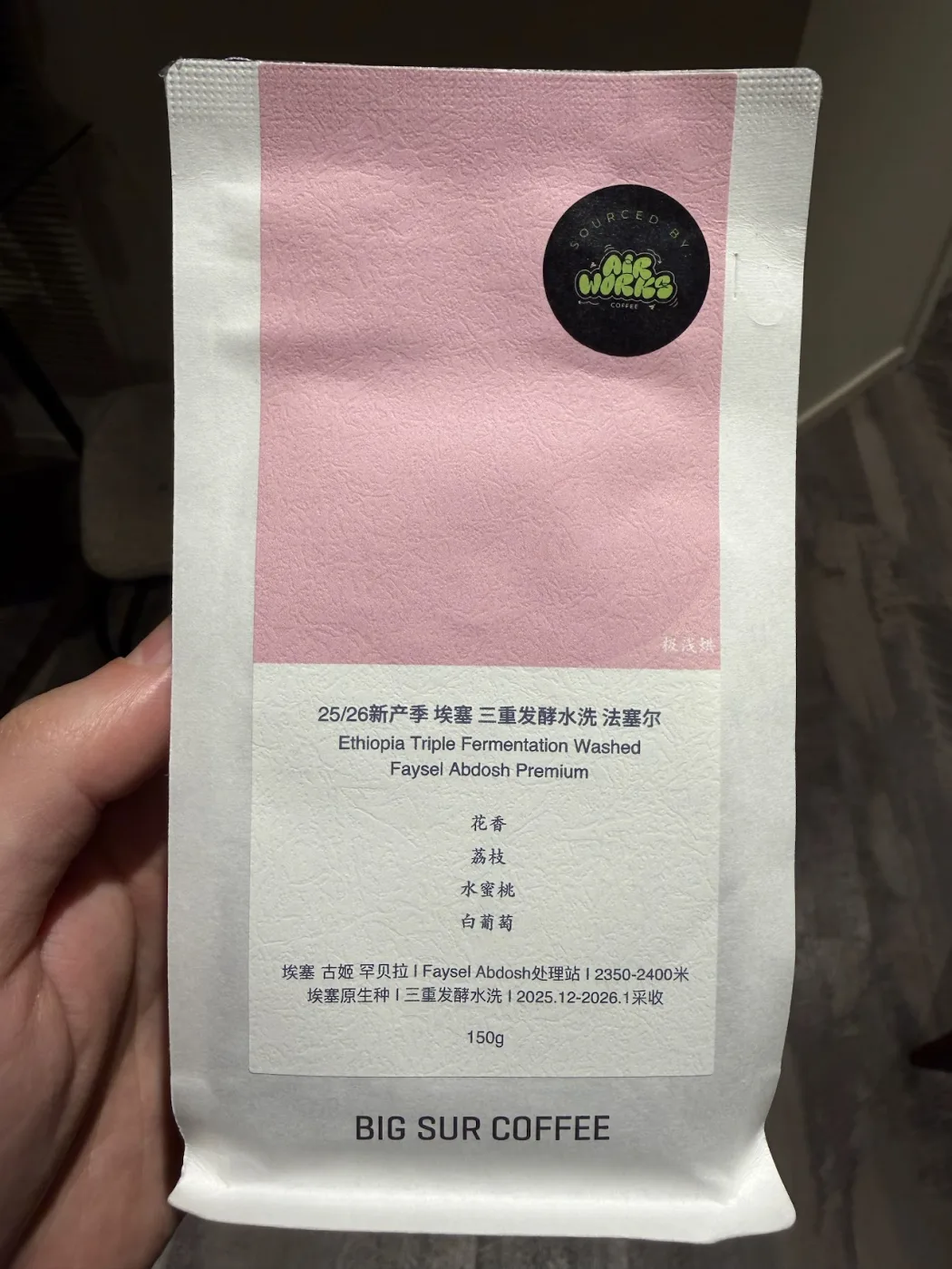
A triple fermented washed Ethiopian from Testi's newest Guji washing station, roasted extremely light in Shanghai by Big Sur and flown into Seattle by Airworks.
In the cup
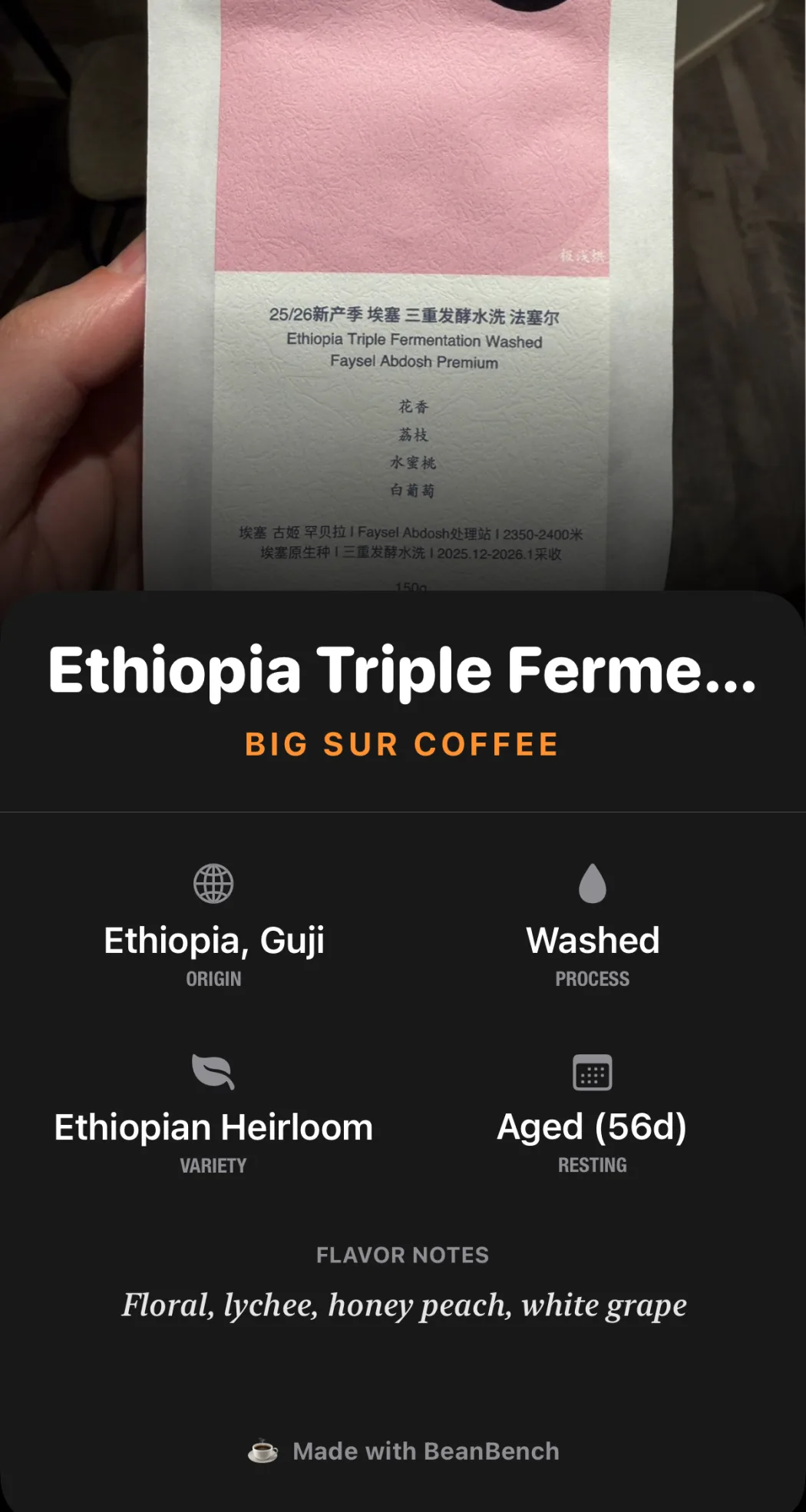
Two of the four notes on the bag turned up without any hunting. Floral came first, and the lychee sitting behind it was specific enough to name instead of a general fruit impression I had to argue myself into. The cup also kept moving as it cooled. Every filter coffee shifts down the temperature range, but with this one the shifting was the interesting part of drinking it, so I slowed down and let it go cold in the cup. Five stars in the log.
I had tasted it the day before at a cupping with four other washed coffees, where it read floral and stone-fruity next to a blueberry co-ferment on one side and a very clean DAK Ethiopian on the other. Brewing it alone told me more.
The coffee
Faysel Abdosh Yonis founded Testi Trading in 2009. He had been buying ten and twenty kilo lots of cherry from farmers since high school, spent three years exporting to Saudi Arabia, then turned the company toward specialty and opened Jigesa, the first specialty-focused washing station in Guji. Testi runs twenty-odd stations now across Sidama, Yirgacheffe and Guji. This lot comes from the newest one, built for the 2025/26 harvest in the village of Deri, in Hambela Wamena, and named after him. Big Sur calls it the culmination of sixteen years of Testi practice, and the arithmetic works: 2009 plus sixteen is 2025. The sixteen years belong to the company. Faysel’s own run in coffee is closer to thirty.
One number to hold loosely. The station reports 2,350 to 2,400 meters, high even for Guji. Independent listings for coffee out of Deri Kidame, the kebele the village sits in, generally say 2,000 to 2,200, and the higher figure appears only inside this supply chain, so read it as the producer’s. The route to my grinder ran Testi in Guji, Big Sur in Shanghai, and Airworks in Seattle, who buy finished roasted bags from international roasters and fly them in. The DAK Lemon Squeeze I wrote up three weeks ago came the same way.
What heirloom means here
The bag lists the variety as Ethiopian Heirloom. Goût & Co, a roaster in Hong Kong, sells a lot from the same station, the same village and the same reported altitude, run through the identical three-stage protocol down to the hour and the pH endpoint. Their listing names the varieties: 74110 and 74158.
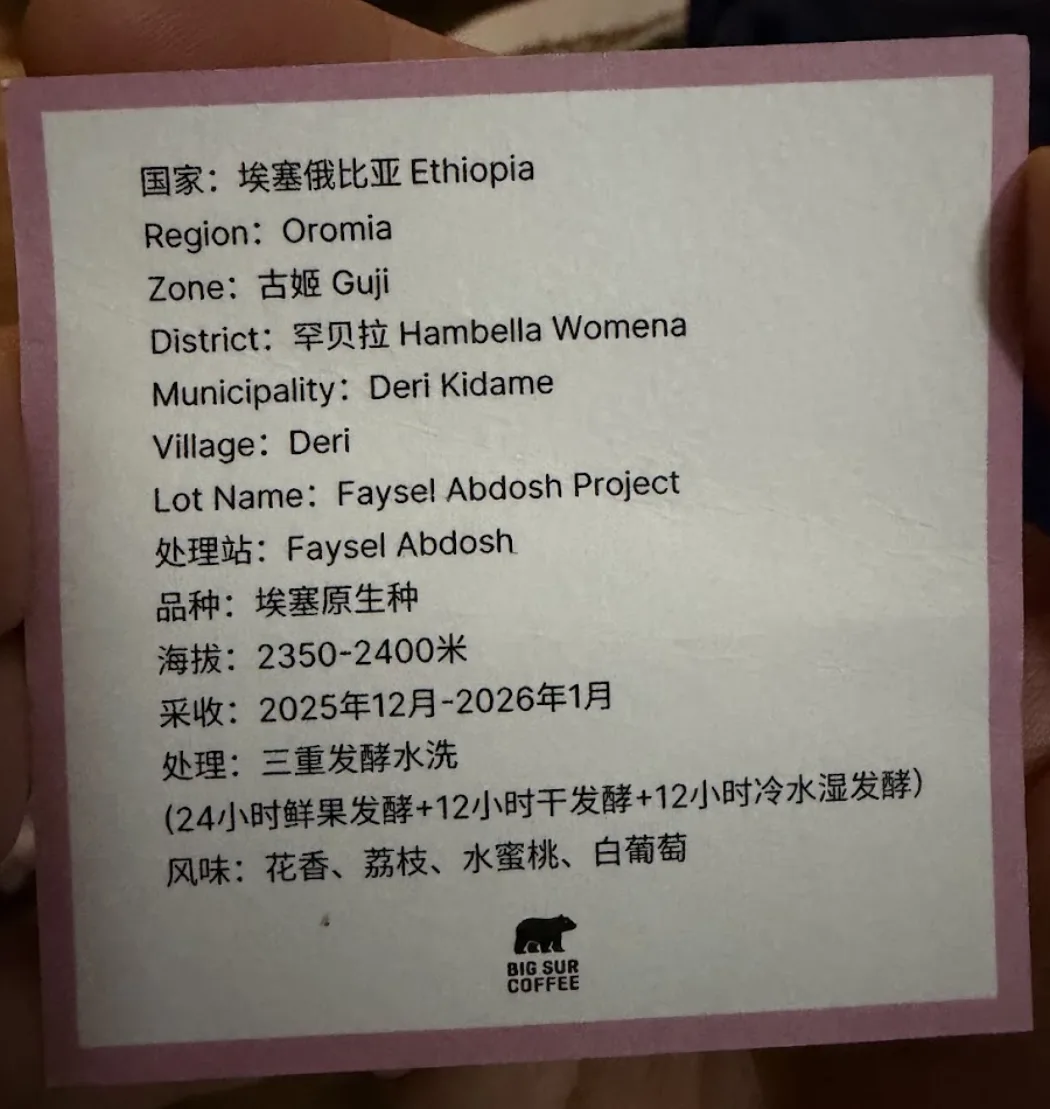
The card that came in the bag. The variety line, 品种, reads 埃塞原生种: Ethiopian heirloom.
Those are catalogue numbers from the Jimma Agricultural Research Center. 74110 was selected from a mother tree in Bishari village, in Metu, and the 74 is the year it went into the catalogue. JARC released it in 1979 after testing it for coffee berry disease resistance and yield. 74158 is a sibling selection from the same program. There are around forty JARC varieties in total.
So heirloom on this bag is a placeholder, and the reason it sticks is the interesting part. Early specialty buyers in Ethiopia could not identify what they were looking at, so anything that was not obviously Typica or Bourbon got filed under one word, and the word outlived the confusion because Ethiopia’s smallholder structure makes plant-level traceability genuinely hard. It also implies more antiquity than it delivers. A 1979 JARC release is a bred variety, sitting alongside true regional landraces like Kurume that farmers selected and named after local trees.
Two labels on one coffee is the cleanest version of this I have run into. Neither roaster is lying. One of them had the information and printed it. More on how varieties get named, and why the name changes what you taste, in our guide to coffee varieties.
The triple fermentation
Washed is the restrained category. Skin and mucilage come off before drying, so the flavor is supposed to come from the seed. Three fermentations is a lot of process to spend on a washed lot, and the protocol is specific enough to be worth walking through.
Whole cherries go into sealed tanks for 24 hours. They come out, get depulped, and ferment dry for another 12 hours with the mucilage still on the seed and no water added, until the mucilage reaches pH 4.0 to 4.3. Cold water goes in for a final 12 hours, until pH lands between 3.8 and 4.0. Then the coffee is washed and moved to raised beds.
The pH numbers are the part worth understanding, because they read like a quality claim and they are not one. They are a clock. Microbes on the mucilage convert sugars into lactic, acetic and citric acid, so pH falls as fermentation progresses, and a producer with a meter can stop a batch at a repeatable point instead of a guess. There is no correct number in the abstract. A conventional wet ferment protecting a clean profile would treat pH 4 as well past the mark; this protocol drives there on purpose.
The cold water in the third stage earns its place. Chilling slows the microbes down, which buys another twelve hours of contact between seed and mucilage without letting acetic character run away. It adds time to the ferment rather than intensity. Our guide to coffee fermentation covers what the different vessels and atmospheres actually change, and processing methods covers where washed sits among the rest.
Drying gets the same attention. Big Sur describes the beds being covered with black shade net and yellow plastic through the middle of the day, uncovered around three, and covered again before the evening dew, holding them at 23 to 25 °C. Midday covering is standard practice in Guji, where high-altitude sun will crack brittle parchment if it stays uncovered too long, and Perfect Daily Grind’s guide to drying washed coffees puts the ceiling at 20 °C for the fragile first days and 35 °C later, so 23 to 25 sits well inside normal practice. The goal is evenness. Coffee dried fast case-hardens, holds uneven moisture through the lot, and ages early.
How I brewed it
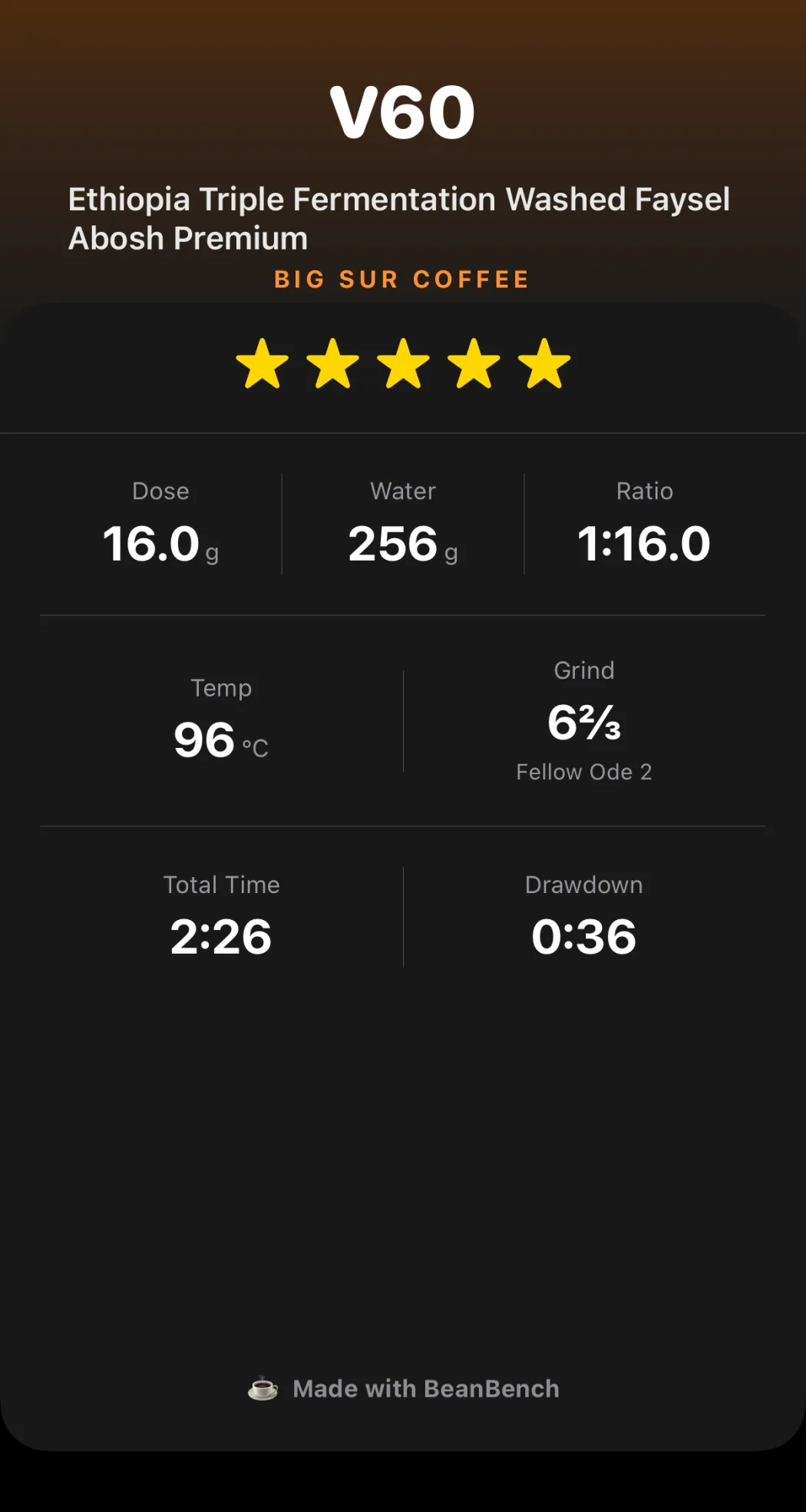
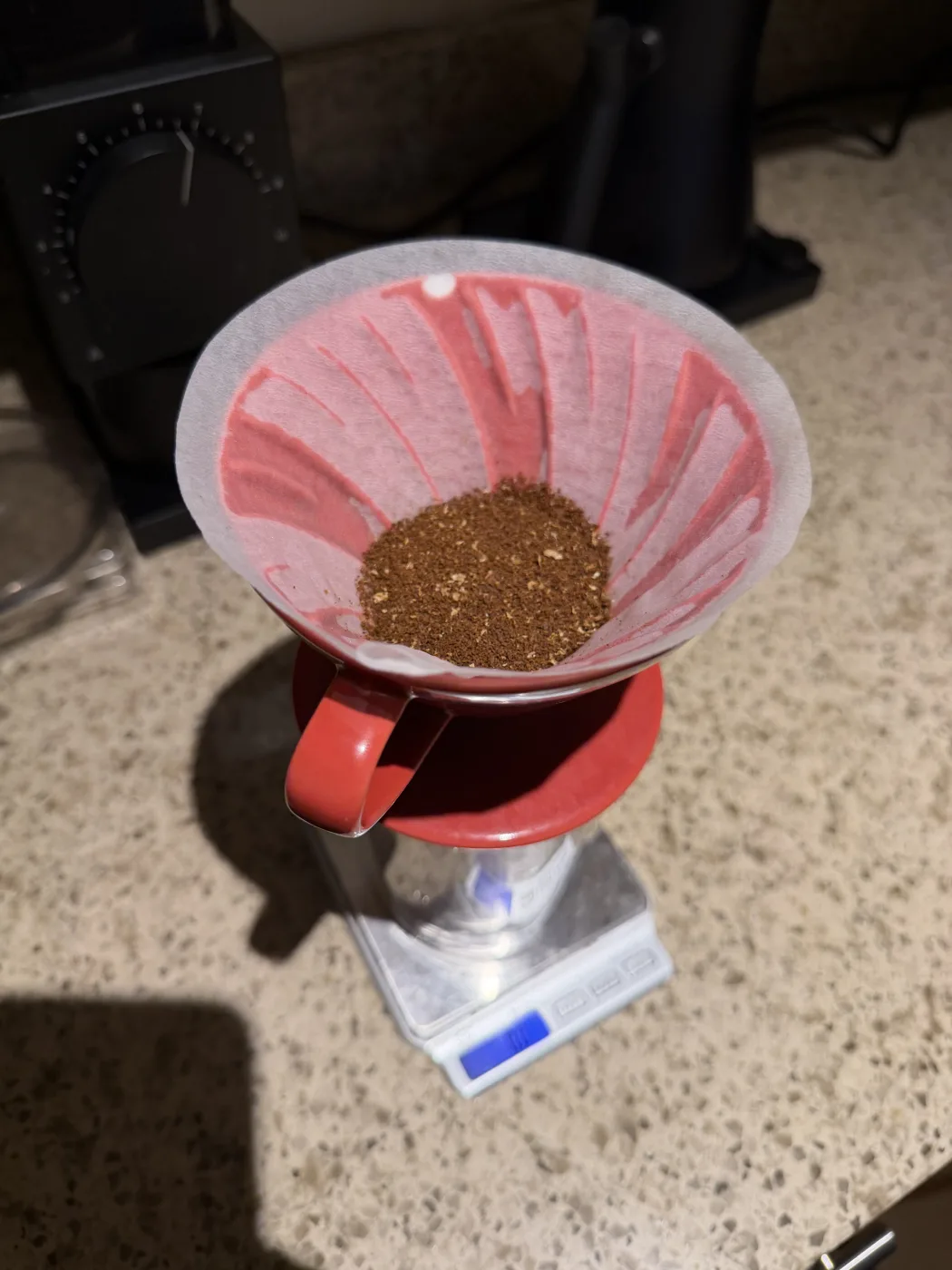
A V60 on our house recipe: 16 g of coffee to 256 g of water, 1:16, at 96 °C, ground at 6⅔ on a Fellow Ode Gen 2. Total time came in at 2:26 with a 36-second drawdown, quicker than I usually run and a direct consequence of how this coffee is roasted.
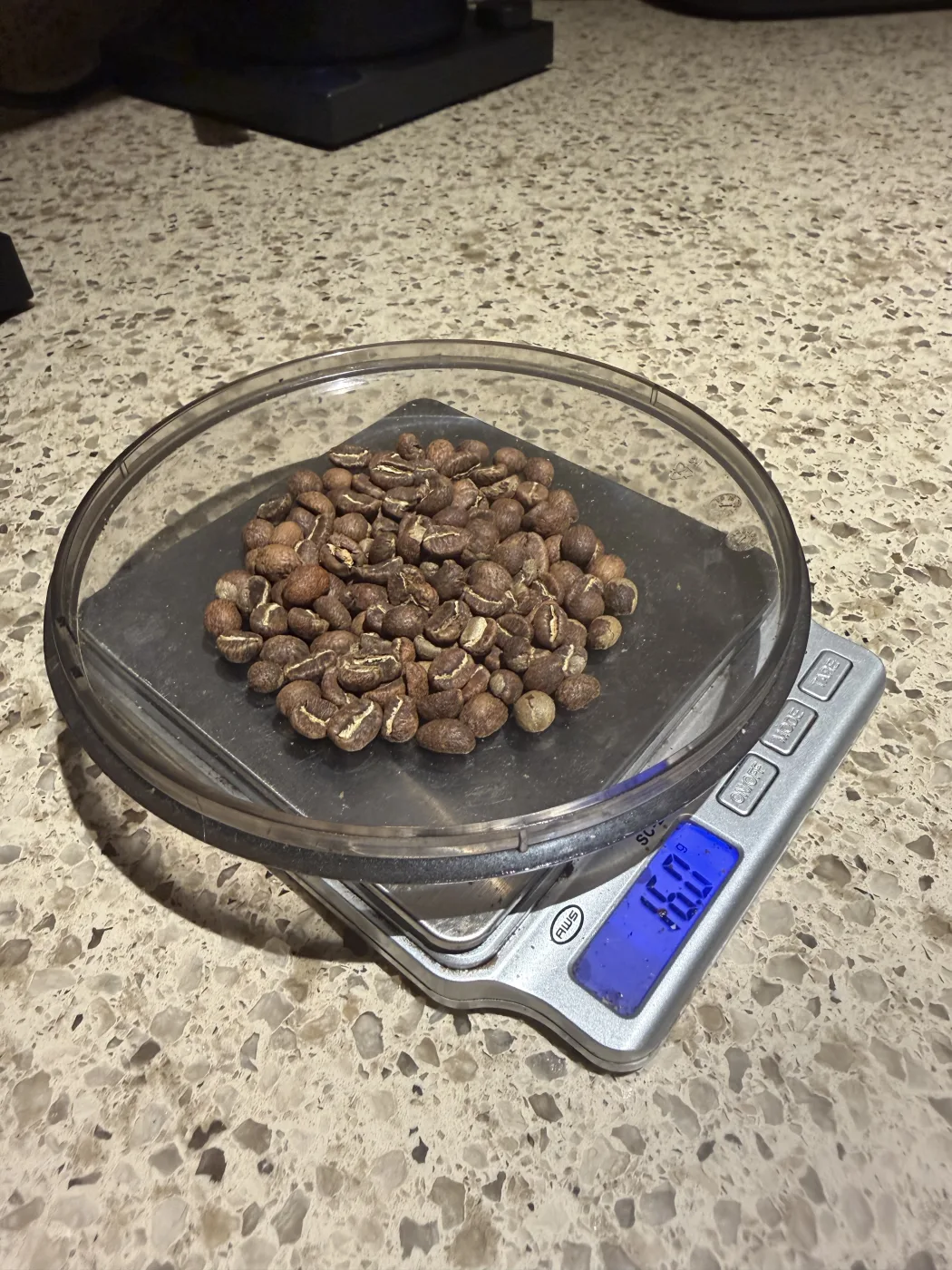
The bag was 56 days off roast when I brewed this, and that is the number I would pay attention to if you find one. 极浅烘 on the front of the bag means extremely light roast, and Big Sur means it. The beans still show pale silverskin sitting in the center cut. Then the bag flies from Shanghai to Seattle, which adds weeks of its own. Our guide to resting coffee puts dense ultra-light roasts at three weeks minimum, with many still improving past four to six weeks. Eight weeks is past even that, and this one was still opening up.
Airworks sold it as a Big Sur release at $26.50 for 150 g, about $177 a kilo. Big Sur lists the double fermentation lot from the same station, on their own site in Shanghai, at $15 for 150 g. The gap is the import: getting a 150 gram bag of roasted coffee out of Shanghai, through customs, and onto a shelf here costs what it costs, and Airworks is a two-year-old operation absorbing that on small releases. Every listing I checked, Big Sur’s own included, is sold out now.
Big Sur is already on our Favorites page. Airworks is how this bag reached Seattle, and how a good share of the international roasters on that page reach anyone here at all.